
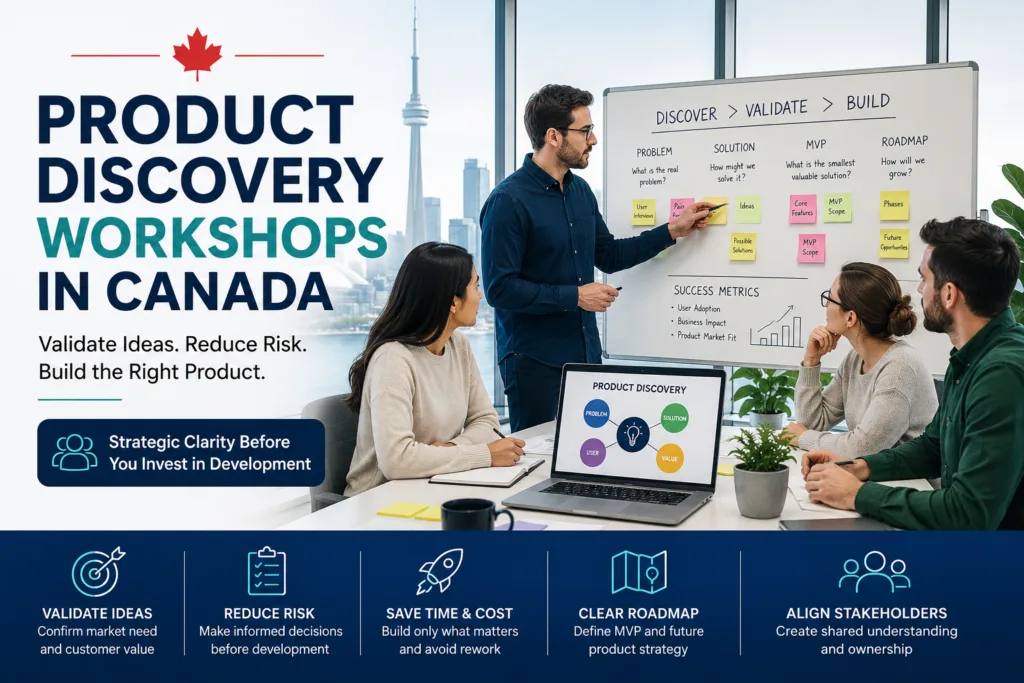
Product Discovery Workshop Canada | MVP Planning & Product Strategy
Every year, businesses invest thousands, sometimes millions, of dollars into software development projects that never achieve their intended outcomes.
Some products launch and fail to gain traction.
Others exceed budgets, miss deadlines, or solve problems customers never actually had.
The harsh reality is that most software failures don’t happen because of poor development.
They happen because teams start building before validating what should be built.
This is why product discovery workshops in Canada have become a critical first step for startups, enterprises, and growing businesses looking to reduce risk before investing in development.
A structured discovery process helps organizations validate ideas, align stakeholders, define product requirements, and create a roadmap that increases the likelihood of success.
In this guide, we’ll explore how product discovery workshops work, why they matter, and how they help businesses make smarter product decisions in 2026.
What Is a Product Discovery Workshop?
A product discovery workshop is a collaborative strategic process designed to validate a product idea before development begins.
The goal is simple:
Understand the problem before building the solution.
Rather than jumping directly into design or development, discovery workshops help organizations answer critical questions such as:
- Who is the target user?
- What problem are we solving?
- Is there market demand?
- What features matter most?
- What should be included in the MVP?
- What technical challenges exist?
- How should the product evolve over time?
The outcome is a clear product strategy that minimizes assumptions and maximizes confidence.
Why Businesses Are Prioritizing Product Discovery in 2026
Software development has become faster than ever.
AI tools, low-code platforms, cloud infrastructure, and modern frameworks allow teams to build products rapidly.
However, building the wrong product quickly is still a costly mistake.
Today’s businesses face increasing pressure to:
- Reduce development risk
- Validate ideas early
- Control budgets
- Accelerate time-to-market
- Improve customer adoption
- Avoid costly pivots
As a result, companies across Canada are investing in product discovery services before committing significant resources to development.
Discovery helps organizations ensure they are solving the right problem for the right audience.
The Real Cost of Skipping Product Discovery
Many companies assume they can save time by moving directly into development.
Unfortunately, skipping discovery often creates larger problems later.
Building Features Nobody Uses
Teams frequently spend months developing functionality that customers don’t actually need.
This leads to wasted development effort and reduced ROI.
Constant Scope Changes
Without clear requirements, projects often experience ongoing changes that increase costs and delay delivery.
Budget Overruns
Poor planning results in unexpected development complexity, requiring additional resources and investment.
Product-Market Misalignment
A technically impressive product can still fail if it doesn’t address genuine market needs.
Delayed Time-to-Market
Teams often spend more time correcting mistakes than they would have spent validating assumptions upfront.
What Happens During a Product Discovery Workshop?
A successful workshop brings together business stakeholders, product leaders, technical experts, and end-user perspectives.
The objective is to create alignment around both business goals and product strategy.
Key activities typically include:
Business Goals Alignment
Understanding the desired outcomes of the product.
Questions include:
- What business problem are we solving?
- What metrics define success?
- What are the growth objectives?
Aligning stakeholders early prevents future confusion and conflicting priorities.
User Research and Validation
Products succeed when they solve real user problems.
Discovery workshops often examine:
- User personas
- Customer pain points
- Existing workflows
- User expectations
- Competitive alternatives
The goal is to validate demand before investing in development.
Feature Prioritization
Not every feature belongs in version one.
Workshops help identify:
- Must-have features
- Nice-to-have features
- Future enhancements
- Features that should be removed entirely
This process prevents overbuilding and improves focus.
Technical Feasibility Assessment
Technical experts evaluate:
- Architecture requirements
- Integration challenges
- Scalability considerations
- Compliance requirements
- Security implications
Early technical validation reduces future surprises.
MVP Planning
One of the most valuable outcomes of discovery is defining a Minimum Viable Product (MVP).
An MVP focuses on:
- Core functionality
- Fast market validation
- Reduced development cost
- Early customer feedback
Effective MVP planning workshops help businesses launch faster while minimizing risk.
Product Discovery Services: What Deliverables Should You Expect?
A professional product discovery engagement should produce clear, actionable outputs.
Typical deliverables include:
Product Vision Document
A detailed overview of:
- Product goals
- User problems
- Business objectives
- Market opportunity
User Journey Maps
Visual representations showing how users interact with the product.
These help identify friction points and opportunities for improvement.
Feature Prioritization Framework
A structured approach to deciding what gets built first.
MVP Definition
Clear documentation of:
- Core features
- Release priorities
- Success criteria
Product Roadmap
A phased plan outlining future product evolution.
This serves as a strategic guide for development and growth.
Technical Recommendations
Guidance on architecture, technology selection, integrations, and scalability requirements.
How Product Discovery Reduces Development Risk
One of the biggest benefits of a discovery workshop is risk reduction.
Before development begins, organizations gain clarity on:
Market Risk
Is there actual demand for the solution?
User Risk
Will users find value in the product?
Technical Risk
Can the solution be built effectively within constraints?
Financial Risk
Does the opportunity justify the investment?
Delivery Risk
Are timelines realistic and achievable?
Addressing these questions early can save months of wasted effort and significant development costs.
The Connection Between Product Discovery and Software Product Strategy
Many organizations mistakenly view discovery as a one-time workshop.
In reality, it forms the foundation of a broader software product strategy.
Product strategy defines:
- Market positioning
- User value proposition
- Competitive differentiation
- Growth priorities
- Product evolution plans
Discovery provides the insights necessary to build that strategy effectively.
Without discovery, product strategy is often based on assumptions rather than evidence.
Why MVP Planning Is Critical for Modern Product Development
One of the most common reasons software projects fail is attempting to build too much too soon.
Businesses often try to launch every possible feature in the first release.
This creates:
- Longer development cycles
- Higher costs
- Increased complexity
- Greater risk
A structured MVP planning workshop helps teams focus on delivering value quickly.
Instead of asking:
“What can we build?”
Teams begin asking:
“What is the smallest solution that solves the problem?”
This shift significantly improves product success rates.
How Product Roadmap Consulting Supports Long-Term Growth
Launching a product is only the beginning.
Businesses need a roadmap that aligns product development with evolving customer needs and business objectives.
Professional product roadmap consulting helps organizations:
- Prioritize investments
- Plan future releases
- Allocate resources effectively
- Support scaling initiatives
- Respond to market changes
A roadmap ensures product decisions remain strategic rather than reactive.
Who Should Consider a Product Discovery Workshop?
Discovery workshops are valuable for:
Startups
Validate ideas before investing limited resources.
Growing Businesses
Explore new products, services, or digital initiatives.
Enterprises
Align stakeholders across departments and reduce project risk.
Product Teams
Improve decision-making and establish clear priorities.
Technology Leaders
Validate technical feasibility and long-term scalability requirements.
Choosing the Right Product Discovery Partner in Canada
When evaluating discovery consultants, look for:
Strategic Expertise
The ability to connect product decisions with business outcomes.
Technical Knowledge
Understanding both business requirements and software architecture.
User-Centered Thinking
A focus on solving customer problems rather than simply building features.
Experience Across Industries
Exposure to multiple markets provides broader strategic insights.
Structured Methodology
A repeatable framework ensures consistent results and actionable outcomes.
The Future of Product Discovery in 2026
As software development accelerates through AI and automation, discovery becomes even more important.
The future of successful product development will depend on:
- Faster validation cycles
- Data-driven decision making
- Continuous customer feedback
- AI-assisted research
- Lean MVP development
- Agile product roadmaps
Organizations that validate ideas before building will consistently outperform those that rely on assumptions.
Final Thoughts
Building software without validating the idea is one of the most expensive risks a business can take.
A structured product discovery workshop in Canada helps organizations reduce uncertainty, align stakeholders, define MVPs, and create a roadmap for successful product development.
Before investing months of time and significant development budgets, businesses should ensure they understand the problem, the customer, and the opportunity.
In 2026, successful products won’t be defined by how quickly they’re built.
They’ll be defined by how well they’re validated before development even begins.
Categories: Uncategorized
Have a project in mind?
Let's talk about how we can build it. Free consultation, no obligation.
Get a Free Consultation