
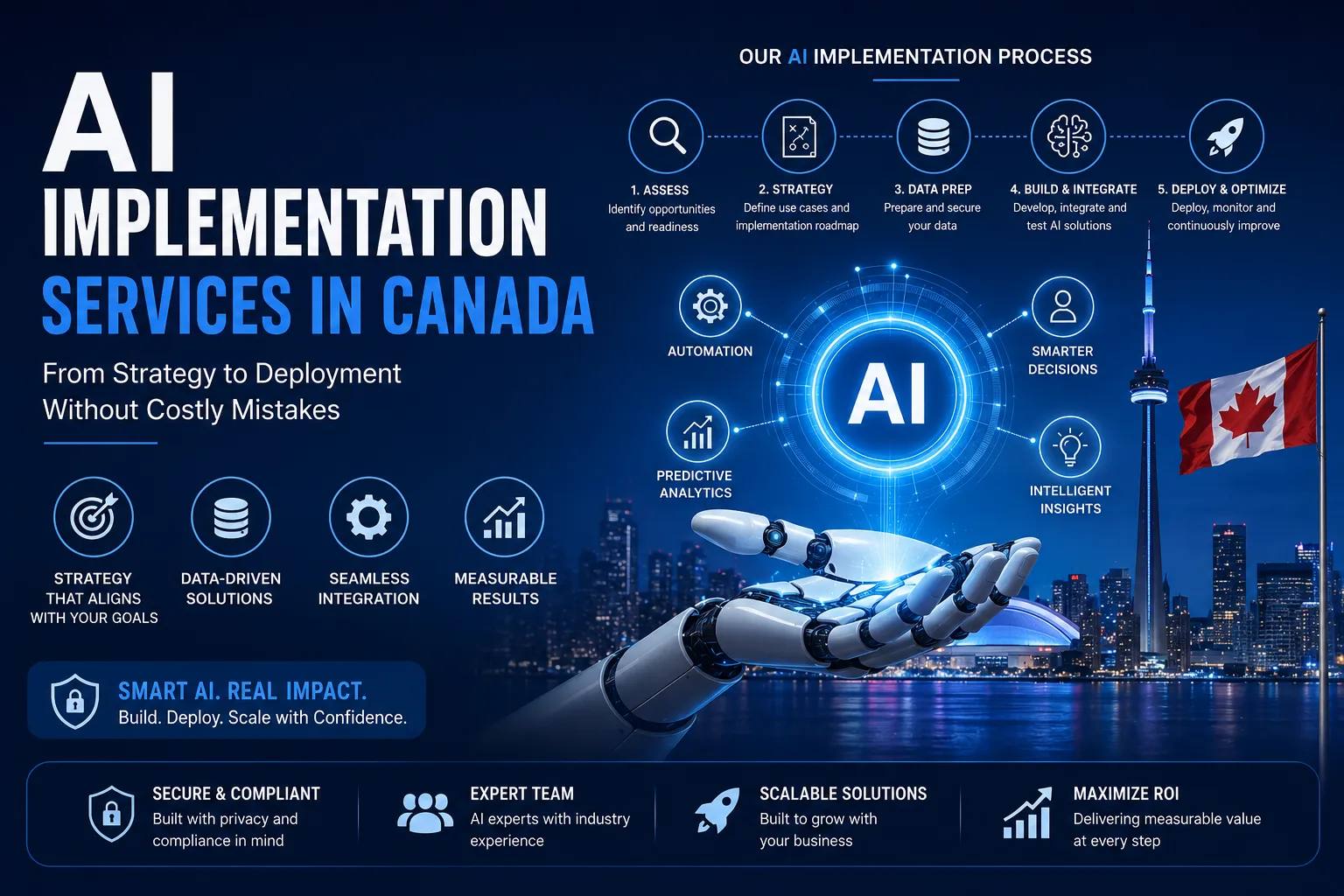
AI Implementation Services Canada (2026)
Artificial Intelligence has moved beyond experimentation and become a strategic priority for businesses across Canada. From automating repetitive tasks and improving customer experiences to generating business insights and optimizing operations, AI is helping organizations unlock new levels of efficiency and growth.
However, while AI adoption is accelerating, many projects fail to deliver expected results. Businesses often rush into implementation without a clear strategy, proper data infrastructure, or alignment with business objectives.
This is why AI implementation services have become increasingly important.
Successful AI adoption is not just about selecting the right technology. It requires careful planning, data readiness, integration, governance, deployment, and ongoing optimization.
In this guide, we’ll explore what AI implementation services involve, common challenges businesses face, implementation best practices, costs, and how organizations in Canada can maximize ROI from AI investments.
What Are AI Implementation Services?
AI implementation services help organizations successfully integrate artificial intelligence into their existing operations, systems, and workflows.
Rather than focusing solely on AI development, implementation services cover the complete journey from strategy to deployment.
This typically includes:
- AI readiness assessment
- Use case identification
- Data preparation
- Solution architecture
- AI model integration
- Workflow automation
- Change management
- Security and compliance planning
- User adoption support
- Performance optimization
The objective is simple:
Transform AI from an idea into a measurable business outcome.
Why Many AI Projects Fail
Despite growing investments in AI, many organizations struggle to achieve meaningful results.
Common reasons include:
Lack of Clear Business Objectives
Many businesses adopt AI because competitors are doing it, not because they have a defined problem to solve.
Without measurable goals, projects often fail to demonstrate value.
Poor Data Quality
AI systems depend heavily on data.
Incomplete, outdated, or inconsistent data can significantly reduce model effectiveness.
Integration Challenges
AI solutions that operate independently from existing systems rarely provide long-term value.
Organizations often underestimate integration complexity.
Unrealistic Expectations
Many executives expect AI to immediately transform operations.
In reality, successful implementation requires phased adoption and continuous improvement.
Limited Internal Expertise
Without experienced AI consultants or implementation partners, businesses often make costly architectural and deployment mistakes.
Why Canadian Businesses Are Investing in AI Implementation
Organizations across Canada are increasingly using AI to improve operational efficiency and gain competitive advantages.
Popular business objectives include:
Process Automation
Reducing manual work through intelligent automation.
Examples include:
- Invoice processing
- Data entry
- Customer onboarding
- Document classification
Customer Service Enhancement
AI-powered chatbots and virtual assistants help organizations:
- Improve response times
- Reduce support costs
- Deliver 24/7 assistance
Business Intelligence
AI helps analyze large volumes of data and uncover actionable insights.
Businesses can:
- Predict trends
- Identify risks
- Optimize operations
- Improve forecasting accuracy
Employee Productivity
AI-powered assistants help employees find information faster, automate routine tasks, and improve decision-making.
Revenue Growth
Organizations are leveraging AI to personalize customer experiences, improve sales processes, and identify new market opportunities.
The AI Implementation Process
A successful AI initiative follows a structured implementation roadmap.
Phase 1: AI Readiness Assessment
Before selecting tools or technologies, organizations must evaluate their readiness.
Key questions include:
- Is the data accessible and reliable?
- Which processes create the biggest bottlenecks?
- What business outcomes are expected?
- Are existing systems integration-ready?
This phase prevents costly implementation mistakes later.
Phase 2: Identifying High-Value Use Cases
The most successful AI projects solve specific business problems.
Examples include:
- Customer support automation
- Predictive analytics
- Intelligent document processing
- Knowledge management systems
- AI-powered workflow automation
Prioritizing high-impact use cases ensures faster ROI.
Phase 3: Data Preparation
Data is the foundation of every AI initiative.
Organizations must:
- Clean datasets
- Remove duplicates
- Standardize information
- Establish governance policies
Without quality data, even advanced AI models will produce poor results.
Phase 4: Solution Architecture
The architecture phase determines:
- AI models
- Infrastructure requirements
- Integration strategy
- Security framework
- Scalability planning
An architecture-first approach significantly reduces implementation risks.
Phase 5: Development and Integration
AI systems are integrated into existing business environments.
Common integrations include:
- CRM systems
- ERP platforms
- Customer support software
- Internal databases
- Business applications
The goal is seamless workflow integration.
Phase 6: Testing and Validation
Before deployment, AI systems must be tested for:
- Accuracy
- Performance
- Security
- Compliance
- Reliability
Organizations should validate outputs against real-world scenarios.
Phase 7: Deployment and Optimization
Deployment is not the end of the journey.
AI systems require:
- Monitoring
- Performance tuning
- Model updates
- User feedback collection
- Continuous improvement
Successful organizations treat AI as an evolving capability rather than a one-time project.
Popular AI Solutions Businesses Are Implementing
AI-Powered Customer Support
Organizations are deploying AI assistants capable of:
- Answering customer inquiries
- Resolving common issues
- Escalating complex requests
This improves customer satisfaction while reducing support costs.
Intelligent Document Processing
AI systems can automatically process:
- Contracts
- Invoices
- Forms
- Insurance claims
- Financial documents
This significantly reduces manual effort.
AI Workflow Automation
Businesses are automating repetitive tasks across departments.
Examples include:
- Lead qualification
- Approval workflows
- Reporting processes
- Employee onboarding
Enterprise Knowledge Assistants
AI-powered knowledge systems help employees instantly access information from:
- SOPs
- Documentation
- Knowledge bases
- Internal systems
This improves productivity and reduces search time.
Predictive Analytics
Organizations use AI to forecast:
- Customer behavior
- Sales performance
- Inventory requirements
- Operational risks
This enables proactive decision-making.
Security and Compliance Considerations
Security remains one of the most important aspects of AI implementation.
Organizations should prioritize:
Data Privacy
Sensitive information must be protected throughout the AI lifecycle.
Access Controls
Role-based permissions prevent unauthorized access.
Regulatory Compliance
Businesses should ensure alignment with:
- PIPEDA
- PHIPA
- Industry-specific regulations
Auditability
Organizations should maintain visibility into AI-generated outputs and decision-making processes.
How Much Do AI Implementation Services Cost in Canada?
Costs vary depending on complexity and scope.
AI Readiness Assessment
Estimated Cost: CAD $5,000 – $15,000
AI Pilot Project
Estimated Cost: CAD $15,000 – $50,000
Mid-Sized AI Implementation
Estimated Cost: CAD $50,000 – $150,000
Enterprise AI Transformation
Estimated Cost: CAD $150,000+
Factors influencing costs include:
- Data complexity
- Number of integrations
- Infrastructure requirements
- Security needs
- Customization level
How to Choose the Right AI Implementation Partner
Selecting the right implementation partner is often the difference between success and failure.
Look for partners who provide:
Business-First Strategy
Technology should support business objectives, not drive them.
Architecture Expertise
A strong technical foundation prevents future scalability issues.
Integration Experience
The ability to connect AI with existing systems is essential.
Security Focus
AI implementations must protect sensitive business information.
Long-Term Support
AI systems require ongoing optimization and maintenance.
The Future of AI Implementation in Canada
Over the next few years, AI adoption will continue to expand across industries.
Organizations will increasingly invest in:
- AI workflow automation
- Generative AI applications
- Enterprise knowledge systems
- Predictive analytics platforms
- AI-powered business intelligence
- AI agents and autonomous workflows
Businesses that establish strong AI foundations today will be better positioned to compete in an increasingly digital economy.
Conclusion
AI implementation service is no longer a technology initiative, it is a business transformation strategy.
Organizations that approach AI with a clear roadmap, strong data foundations, secure architecture, and measurable objectives are significantly more likely to achieve meaningful results.
Whether you’re automating workflows, deploying intelligent assistants, implementing predictive analytics, or integrating AI into existing business systems, a structured implementation approach helps reduce risk and maximize ROI.
For Canadian businesses, investing in professional AI implementation services ensures that AI moves beyond experimentation and becomes a sustainable competitive advantage.
Categories: Uncategorized
Have a project in mind?
Let's talk about how we can build it. Free consultation, no obligation.
Get a Free Consultation