
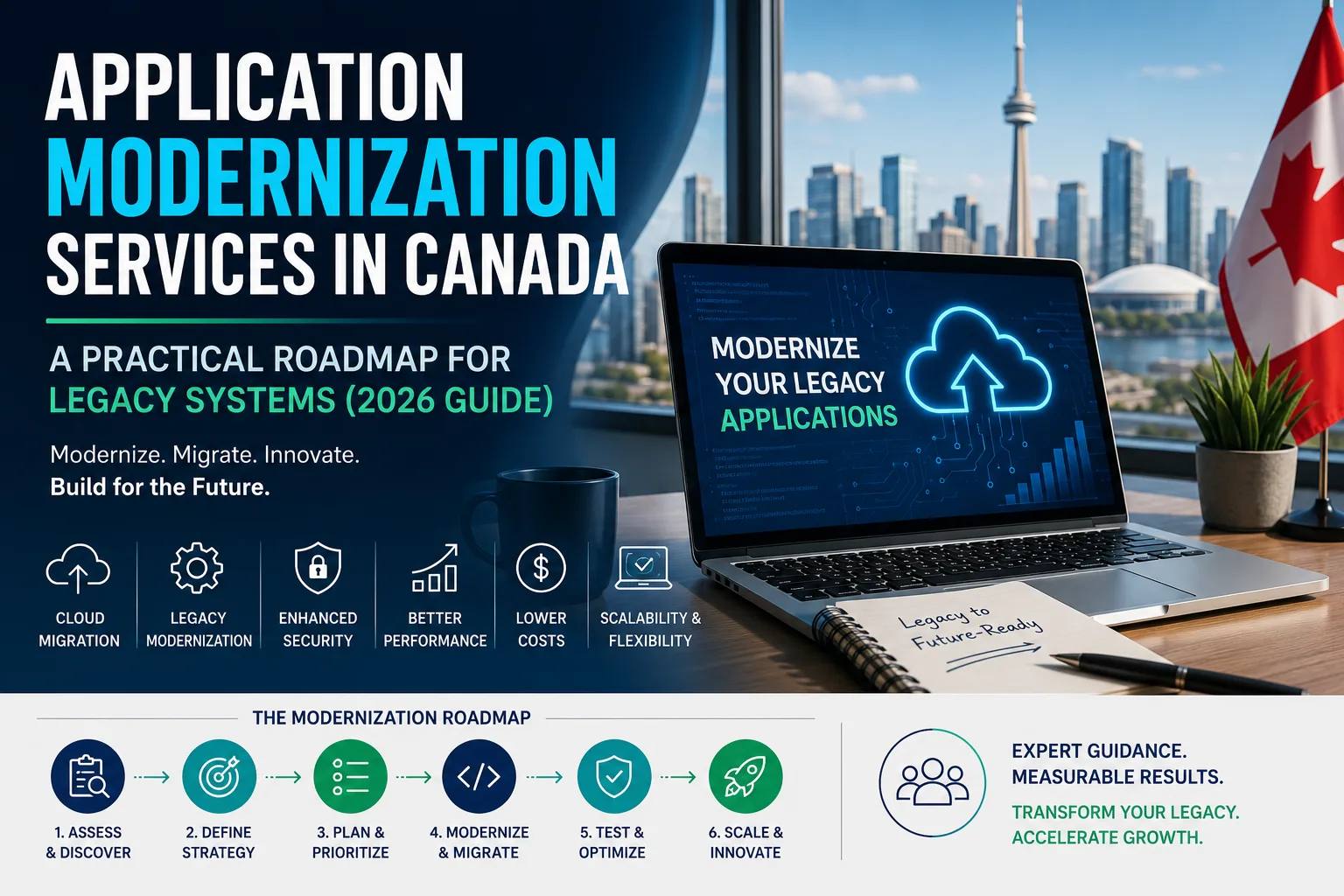
Application Modernization Services Canada: 2026 Guide
Many organizations across Canada still rely on legacy software systems that were built years—or even decades—ago. While these systems may continue to support core business operations, they often become barriers to innovation, scalability, and growth.
As customer expectations evolve and digital transformation accelerates, businesses need software that is agile, secure, cloud-ready, and capable of integrating with modern technologies such as AI, analytics, and automation.
This is where Application Modernization Services play a critical role.
Rather than replacing existing systems entirely, application modernization enables businesses to transform legacy applications into modern, scalable solutions while minimizing disruption to daily operations.
In this guide, we’ll explore what application modernization is, why it matters, modernization approaches, and a practical roadmap for Canadian businesses looking to future-proof their technology investments.
What Is Application Modernization?
Application modernization is the process of updating legacy software applications to improve performance, security, scalability, maintainability, and user experience.
The goal is not simply to move software to the cloud. It involves evaluating how existing systems support current business objectives and determining how they can better align with future growth.
Modernization can include:
- Cloud migration
- Software reengineering
- Technology stack upgrades
- API integration
- Database modernization
- UI/UX improvements
- Microservices adoption
- Infrastructure optimization
Application modernization helps businesses extend the value of existing investments while enabling innovation and growth.
Why Canadian Businesses Are Modernizing Legacy Applications
Legacy systems often create challenges that impact operational efficiency and competitiveness.
Common issues include:
Rising Maintenance Costs
Older applications typically require more resources to maintain, support, and secure.
Limited Scalability
Many legacy systems were never designed to support today’s business demands.
Security Vulnerabilities
Outdated frameworks and unsupported technologies increase cybersecurity risks.
Poor User Experience
Modern users expect fast, intuitive, and mobile-friendly digital experiences.
Integration Challenges
Legacy software often struggles to connect with modern platforms, APIs, and cloud services.
Slower Innovation
When teams spend most of their time maintaining outdated systems, innovation suffers.
Application modernization addresses these challenges while creating a stronger foundation for future growth.
Signs Your Business Needs Application Modernization
Organizations should consider modernization if they experience:
- Frequent system downtime
- Increasing maintenance costs
- Slow application performance
- Difficulty integrating new technologies
- Security concerns
- Poor customer experience
- Challenges scaling operations
- Lack of mobile accessibility
- Dependence on outdated technologies
These symptoms often indicate that legacy systems are becoming a liability rather than an asset.
Benefits of Application Modernization
Improved Business Agility
Modern applications allow businesses to adapt quickly to changing market demands.
Better Performance
Optimized systems deliver faster response times and improved reliability.
Enhanced Security
Modern security frameworks help reduce vulnerabilities and compliance risks.
Lower Operating Costs
Cloud-native and optimized applications reduce infrastructure and maintenance expenses.
Improved Scalability
Businesses can support growth without major infrastructure investments.
Better Customer Experience
Modern applications provide intuitive, responsive, and user-friendly experiences.
Easier Integration
Modern systems connect seamlessly with CRMs, ERPs, payment gateways, analytics platforms, and AI solutions.
Common Application Modernization Approaches
Not every legacy system requires a complete rebuild.
The right approach depends on business objectives, technical complexity, budget, and timelines.
Rehost (Lift and Shift)
Applications are moved to cloud infrastructure with minimal changes.
Best for:
- Quick cloud migration
- Lower-risk modernization projects
Advantages:
- Faster implementation
- Lower upfront investment
Replatform
Applications receive targeted improvements while moving to modern infrastructure.
Examples include:
- Database upgrades
- Cloud optimization
- Containerization
Best for:
- Businesses seeking moderate improvements without full redevelopment.
Refactor
Code is restructured and optimized while preserving core functionality.
Benefits include:
- Improved performance
- Better maintainability
- Reduced technical debt
Rearchitect
Applications are redesigned to support modern architecture patterns such as:
- Microservices
- Event-driven systems
- API-first development
Best for:
- High-growth organizations
- Complex enterprise applications
Rebuild
Applications are redeveloped using modern technologies and frameworks.
Best for:
- Severely outdated systems
- Applications that cannot meet future business requirements
Although more expensive, rebuilding often delivers the greatest long-term value.
The Role of Cloud Migration in Modernization
Cloud adoption is a major driver of application modernization across Canada.
Cloud platforms provide:
- Scalability
- Reliability
- Disaster recovery
- Cost optimization
- Faster deployment
Leading cloud providers include:
- AWS
- Microsoft Azure
- Google Cloud Platform
Migrating applications to the cloud often serves as the first step toward broader modernization initiatives.
A Practical Roadmap for Application Modernization
Successful modernization requires a structured approach.
Step 1: Assess Current Systems
Evaluate:
- Technical architecture
- Infrastructure
- Dependencies
- Security posture
- Business impact
This helps identify modernization priorities.
Step 2: Define Business Objectives
Determine what modernization should achieve.
Examples:
- Reduce costs
- Improve customer experience
- Increase scalability
- Enable AI integration
- Accelerate product development
Business goals should drive technical decisions.
Step 3: Create a Modernization Strategy
Develop a roadmap that outlines:
- Scope
- Timelines
- Budget
- Resource requirements
- Risk mitigation plans
A well-defined strategy reduces project uncertainty.
Step 4: Prioritize Applications
Not all systems require modernization simultaneously.
Organizations should prioritize based on:
- Business value
- Technical risk
- Operational impact
This allows for phased implementation.
Step 5: Execute Modernization
Implementation may include:
- Infrastructure upgrades
- Code refactoring
- Cloud migration
- API development
- UI improvements
Execution should be carefully managed to minimize disruption.
Step 6: Test and Optimize
Thorough testing ensures:
- Performance improvements
- Security compliance
- Functional stability
- User satisfaction
Optimization continues after deployment.
Step 7: Scale and Innovate
Once modernization is complete, businesses can more easily adopt:
- Artificial Intelligence
- Automation
- Advanced Analytics
- IoT Solutions
- Machine Learning
Modern systems create a foundation for ongoing innovation.
Common Challenges in Application Modernization
Despite its benefits, modernization can present challenges.
Legacy Dependencies
Older systems often rely on outdated technologies and integrations.
Data Migration Complexity
Moving data safely requires careful planning and execution.
Change Management
Employees may need training and support during transitions.
Budget Constraints
Modernization requires investment, but delaying upgrades often increases long-term costs.
Technical Debt
Accumulated shortcuts and outdated code can complicate modernization efforts.
Working with experienced modernization specialists helps mitigate these risks.
How to Choose the Right Application Modernization Partner
A strong modernization partner should offer:
Technical Expertise
Experience with:
- Cloud platforms
- Software architecture
- Enterprise systems
- Security best practices
Strategic Guidance
Modernization should align with business objectives, not just technical requirements.
Proven Methodology
Look for a structured approach to assessment, planning, execution, and optimization.
Long-Term Support
Modernization is an ongoing journey rather than a one-time project.
Why Application Modernization Matters in 2026
Businesses can no longer rely on software systems designed for yesterday’s challenges.
Customers expect seamless digital experiences. Teams need access to real-time data. Organizations require scalable and secure platforms.
Application modernization enables companies to remain competitive while maximizing the value of existing technology investments.
Rather than allowing legacy systems to limit growth, modernization creates a foundation for innovation, efficiency, and long-term success.
Conclusion
Application modernization is no longer optional for organizations seeking to compete in an increasingly digital economy.
By modernizing legacy systems, Canadian businesses can improve performance, reduce costs, strengthen security, and unlock new growth opportunities.
Whether through cloud migration, software reengineering, architecture modernization, or complete application rebuilding, the right modernization strategy helps organizations transform technology from a limitation into a competitive advantage.
For businesses planning digital transformation initiatives in 2026, application modernization is one of the most impactful investments they can make.
Categories: Uncategorized
Have a project in mind?
Let's talk about how we can build it. Free consultation, no obligation.
Get a Free Consultation