
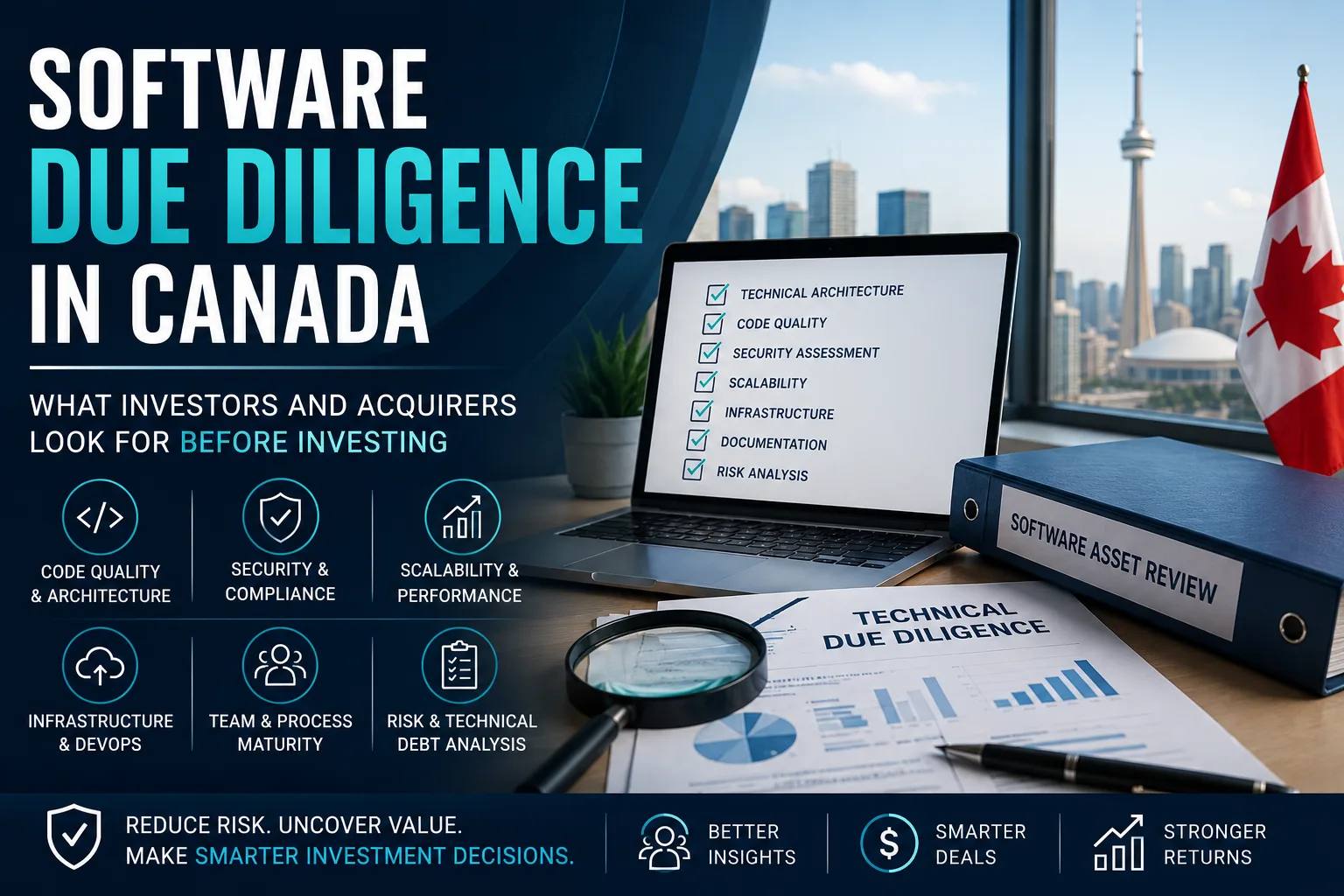
Software Due Diligence Canada: Investor Guide for 2026
When investors evaluate a software company, they aren’t just assessing revenue, market opportunity, or customer growth. Increasingly, they are examining the technology itself.
A promising SaaS platform, AI solution, mobile application, or enterprise software product can quickly lose value if its technical foundation is weak. Hidden technical debt, poor architecture decisions, security vulnerabilities, and scalability challenges can significantly impact future growth and profitability.
This is why Software Due Diligence has become a critical part of mergers, acquisitions, fundraising rounds, and strategic investments across Canada.
Whether you’re an investor evaluating a potential acquisition or a founder preparing for fundraising, understanding software due diligence can help minimize risk and improve decision-making.
In this guide, we’ll explore what software due diligence involves, why it matters, and what investors typically look for before committing capital.
What Is Software Due Diligence?
Software due diligence is a comprehensive technical assessment of a software product, development process, technology stack, infrastructure, and engineering organization.
The goal is to determine whether the technology can support future business objectives while identifying risks that may affect valuation, scalability, security, or operational performance.
Unlike a financial audit, software due diligence focuses specifically on the technical health of the business.
Areas typically reviewed include:
- Software architecture
- Source code quality
- Infrastructure and cloud environment
- Security posture
- Development processes
- Technical debt
- Scalability
- Team structure
- Product roadmap
- Compliance and governance
The outcome is a detailed assessment of technical strengths, weaknesses, and potential risks.
Why Software Due Diligence Matters
Many software companies appear healthy on the surface.
Revenue may be growing. Customers may be satisfied. Market demand may be strong.
However, underlying technical issues often remain hidden until significant growth exposes them.
Common examples include:
- Poorly structured codebases
- Outdated technology stacks
- Security vulnerabilities
- Lack of documentation
- Scalability limitations
- Dependence on key developers
- Unmanaged technical debt
For investors and acquirers, these issues can translate into higher costs, delayed growth, and reduced returns.
Software due diligence helps uncover these risks before they become expensive problems.
When Is Software Due Diligence Performed?
Software due diligence is commonly conducted during:
Venture Capital Funding
Investors want confidence that the product can scale and support future growth.
Mergers and Acquisitions
Acquirers evaluate whether the technology aligns with their long-term strategy.
Private Equity Investments
Technical reviews help estimate future modernization costs and operational risks.
Strategic Partnerships
Organizations may assess software capabilities before entering long-term agreements.
Internal Technology Assessments
Founders often conduct due diligence proactively to prepare for future fundraising or acquisitions.
What Investors Look For During Technical Due Diligence
1. Software Architecture
Architecture determines how effectively a product can evolve and scale.
Investors typically evaluate:
- System design
- Application structure
- Service dependencies
- Cloud architecture
- Database design
- API architecture
Questions often include:
- Can the platform support 10x growth?
- Is the architecture maintainable?
- Are there single points of failure?
A strong architecture reduces future development costs and scalability risks.
2. Code Quality
Source code is often the most valuable technical asset within a software company.
Reviewers assess:
- Code maintainability
- Coding standards
- Test coverage
- Documentation quality
- Refactoring needs
Indicators of concern include:
- Large amounts of duplicate code
- Poor documentation
- Lack of automated testing
- Inconsistent development practices
Poor code quality frequently increases future engineering costs.
3. Technical Debt
Technical debt refers to shortcuts taken during development that create future maintenance challenges.
While some technical debt is expected, excessive debt creates risks.
Investors evaluate:
- Legacy components
- Workarounds
- Temporary fixes
- Outdated frameworks
- Unsupported dependencies
Understanding technical debt helps estimate future modernization costs.
4. Scalability
A product may function effectively today but fail under increased demand.
Scalability assessments focus on:
- Infrastructure capacity
- Database performance
- Application performance
- Cloud resource management
- Traffic handling capabilities
Investors want confidence that growth won’t require expensive architectural rewrites.
5. Security and Compliance
Security has become one of the most important areas of technical due diligence.
Assessments often include:
- Authentication systems
- Data protection practices
- Encryption standards
- Vulnerability management
- Security monitoring
Canadian businesses may also need to demonstrate compliance with:
- PIPEDA
- PHIPA
- SOC 2
- GDPR (for international operations)
Security weaknesses can create significant legal and financial risks.
6. Development Processes
A strong engineering team requires repeatable development processes.
Reviewers evaluate:
- Agile workflows
- Release management
- Sprint planning
- Quality assurance
- Deployment practices
Companies with mature processes generally deliver products more efficiently and predictably.
7. Cloud Infrastructure
Modern software products rely heavily on cloud environments.
Investors assess:
- AWS architecture
- Azure environments
- Google Cloud infrastructure
- Disaster recovery planning
- Backup strategies
- Cost optimization
Cloud inefficiencies can significantly impact profitability.
8. Product Roadmap Feasibility
A company’s growth projections often depend on future product development.
Due diligence helps determine whether:
- Roadmap commitments are realistic
- Development capacity is sufficient
- Technical constraints exist
- Resource requirements have been estimated accurately
This helps investors validate growth assumptions.
9. Team and Talent Assessment
Technology is built by people.
Reviewers often assess:
- Engineering team structure
- Leadership capabilities
- Hiring processes
- Knowledge distribution
- Key-person dependencies
Heavy reliance on one or two developers increases operational risk.
Common Red Flags Found During Software Due Diligence
Several issues frequently appear during technical reviews.
Lack of Documentation
Poor documentation increases onboarding costs and slows future development.
No Automated Testing
Manual testing alone creates quality and deployment risks.
Outdated Technology Stack
Unsupported technologies can increase maintenance costs and security exposure.
Weak Security Controls
Security gaps often become major concerns for investors.
Excessive Technical Debt
Large amounts of debt may require significant future investment.
Poor Architecture
Scalability limitations can reduce long-term business value.
Identifying these issues early allows founders to address them before fundraising or acquisition discussions.
How Founders Can Prepare for Software Due Diligence
Preparation significantly improves investor confidence.
Recommended steps include:
Conduct a Technical Audit
Identify and address major risks before external review.
Improve Documentation
Document architecture, APIs, infrastructure, and deployment processes.
Strengthen Security
Implement security best practices and regular vulnerability assessments.
Reduce Technical Debt
Prioritize critical modernization efforts.
Establish Development Standards
Introduce consistent engineering processes and code quality practices.
These improvements often increase valuation and reduce investor concerns.
The Business Value of Software Due Diligence
Software due diligence benefits both investors and founders.
For Investors
- Reduced investment risk
- Better valuation decisions
- Improved acquisition outcomes
- Greater visibility into technical challenges
For Founders
- Increased investor confidence
- Stronger technical foundation
- Improved scalability
- Higher company valuation
- Faster fundraising processes
Ultimately, software due diligence creates transparency and supports informed decision-making.
Conclusion
As software becomes the core asset of many modern businesses, technical due diligence has become an essential component of investment and acquisition decisions.
Investors no longer evaluate only financial performance. They want confidence that the underlying technology can scale, remain secure, and support long-term growth.
By conducting comprehensive software due diligence, organizations can identify risks, uncover opportunities, and build confidence among investors, acquirers, and stakeholders.
For Canadian startups and technology companies preparing for funding, mergers, or strategic growth, investing in software due diligence can significantly improve outcomes and reduce future risk.
Categories: Uncategorized
Have a project in mind?
Let's talk about how we can build it. Free consultation, no obligation.
Get a Free Consultation