
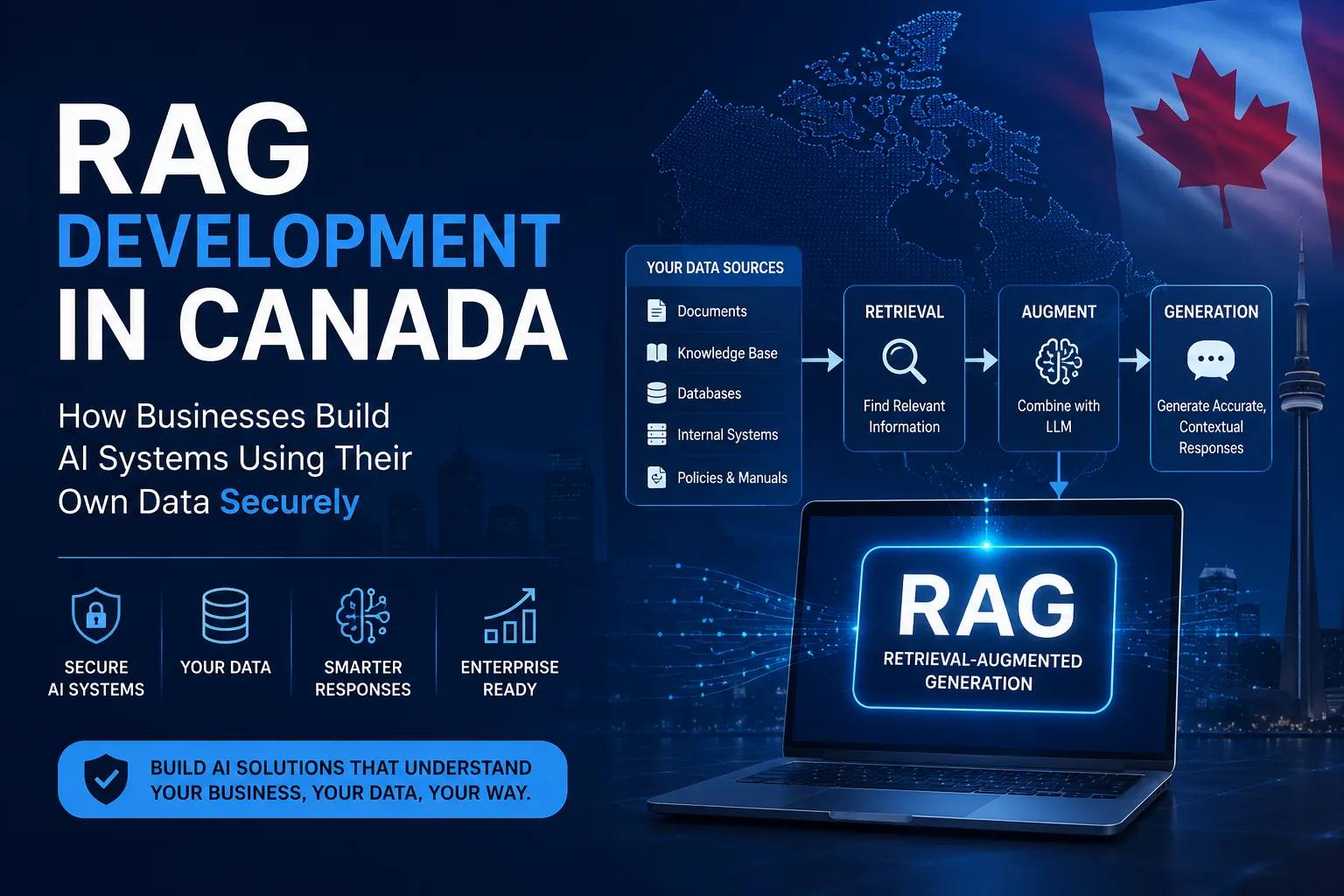
RAG Development Canada: Secure Enterprise AI Solutions (2026)
Artificial Intelligence has transformed the way businesses operate, but many organizations are discovering a critical limitation with traditional AI models such as ChatGPT and other Large Language Models (LLMs): they don’t know your company’s data.
A generic AI model can answer public knowledge questions, but it cannot accurately access your internal documents, policies, contracts, customer records, knowledge bases, SOPs, or proprietary business information without additional architecture.
This is where Retrieval-Augmented Generation (RAG) comes in.
Businesses across Canada are investing in RAG development to build AI systems that can securely access company-specific information while maintaining accuracy, compliance, and control.
In this guide, we’ll explore what RAG is, how it works, why Canadian businesses are adopting it, implementation considerations, costs, and best practices for building enterprise-grade AI solutions.
What Is Retrieval-Augmented Generation (RAG)?
Retrieval-Augmented Generation (RAG) is an AI architecture that combines:
- Large Language Models (LLMs)
- Enterprise data sources
- Intelligent search and retrieval systems
- Vector databases
- Real-time knowledge access
Instead of relying solely on the AI model’s training data, a RAG system retrieves relevant information from your organization’s data sources before generating a response.
The result is an AI assistant that can answer questions using current, accurate, and company-specific information.
For example:
Without RAG:
“What is our employee onboarding process?”
The AI cannot answer because it has never seen your internal documents.
With RAG:
The system retrieves onboarding policies, HR documentation, training materials, and process guidelines before generating an accurate response.
Why Canadian Businesses Are Investing in RAG Development
Organizations across industries are struggling with information overload.
Important business knowledge often exists across:
- SharePoint
- Google Drive
- CRM systems
- ERP platforms
- Internal Wikis
- PDFs
- Contracts
- Emails
- Customer support databases
Employees spend significant time searching for information that already exists.
RAG-powered systems solve this problem by creating a unified AI-powered knowledge layer across the organization.
Key benefits include:
Faster Information Retrieval
Employees can ask questions in natural language instead of manually searching through multiple systems.
Improved Decision-Making
Teams gain instant access to accurate information needed for critical business decisions.
Reduced Operational Costs
Organizations reduce repetitive support requests and manual research efforts.
Better Customer Support
Support teams receive instant access to product documentation, troubleshooting guides, and customer information.
Enterprise Data Security
Unlike public AI tools, RAG systems can be designed with strict security controls and data governance policies.
How RAG Works: A Simple Breakdown
A RAG architecture generally follows five steps:
Step 1: Data Collection
Business information is gathered from various sources:
- Documents
- Knowledge bases
- CRM platforms
- ERP systems
- Databases
- Internal applications
Step 2: Data Processing
The content is cleaned, structured, and divided into smaller searchable chunks.
Step 3: Vectorization
The information is converted into vector embeddings that allow semantic search.
Step 4: Information Retrieval
When a user asks a question, the system retrieves the most relevant content from the knowledge base.
Step 5: AI Response Generation
The retrieved information is sent to the LLM, which generates a contextual and accurate response.
This process happens within seconds.
Common RAG Use Cases in Canada
Internal Knowledge Assistants
Organizations build AI assistants that help employees access:
- Company policies
- HR documentation
- Training materials
- SOPs
- Technical documentation
Customer Support Automation
Support teams can instantly retrieve answers from:
- Product manuals
- FAQs
- Troubleshooting guides
- Customer records
This significantly reduces resolution times.
Legal and Compliance Research
Law firms and compliance teams use RAG systems to search:
- Contracts
- Regulations
- Policies
- Legal precedents
while maintaining strict confidentiality.
Healthcare Knowledge Management
Healthcare organizations use RAG to help staff access:
- Clinical procedures
- Internal policies
- Research documents
- Compliance requirements
while maintaining privacy controls.
Manufacturing Operations Support
Manufacturers are building AI assistants that provide access to:
- Maintenance procedures
- Equipment manuals
- Safety documentation
- Production guidelines
- Quality assurance protocols
This improves operational efficiency and reduces downtime.
Why Traditional Chatbots Are Not Enough
Many businesses initially deploy basic chatbots expecting enterprise-level intelligence.
Unfortunately, traditional chatbots often suffer from:
- Hallucinations
- Outdated information
- Limited knowledge
- Poor contextual understanding
- Inability to access business systems
RAG addresses these limitations by grounding responses in verified business data.
This dramatically improves reliability and trustworthiness.
Key Components of a Modern RAG Architecture
A successful RAG implementation typically includes:
Large Language Models
Examples include:
- OpenAI GPT models
- Claude
- Gemini
- Llama
Vector Databases
Common choices include:
- Pinecone
- Weaviate
- Chroma
- Qdrant
Document Processing Layer
Used to:
- Extract text
- Clean data
- Chunk documents
- Generate embeddings
Enterprise Integrations
Connections to:
- CRM systems
- ERP platforms
- Document repositories
- Internal applications
Security & Governance Layer
Controls:
- User permissions
- Role-based access
- Encryption
- Audit logging
- Compliance requirements
Security Considerations for RAG Development
Security is one of the biggest concerns for Canadian organizations adopting AI.
Best practices include:
Data Encryption
Protect information during storage and transmission.
Role-Based Access Control
Ensure employees only access information relevant to their roles.
Private LLM Deployments
For highly regulated industries, businesses may choose private AI infrastructure.
Audit Trails
Track AI usage and information access.
Compliance Alignment
Ensure adherence to:
- PIPEDA
- PHIPA
- Industry regulations
- Internal governance policies
How Much Does RAG Development Cost in Canada?
The cost depends on complexity, integrations, and infrastructure requirements.
Basic RAG Solution
Suitable for internal document search.
Estimated Cost: CAD $15,000 – $40,000
Mid-Level Enterprise RAG Platform
Includes integrations, permissions, and workflow automation.
Estimated Cost: CAD $40,000 – $100,000
Enterprise-Grade AI Knowledge Platform
Includes:
- Multiple integrations
- Advanced governance
- Private deployment
- High-scale architecture
Estimated Cost: CAD $100,000+
Common Challenges During RAG Implementation
Many projects fail because organizations focus on AI before addressing data quality.
Common obstacles include:
Poor Data Organization
Messy documentation reduces answer quality.
Inadequate Search Architecture
Weak retrieval systems produce inaccurate responses.
Lack of Governance
Without proper controls, security risks increase.
Scaling Issues
Systems designed for pilots often struggle in production environments.
This is why architecture-first planning is critical before development begins.
Best Practices for Successful RAG Development
Organizations that achieve the best outcomes typically:
Start With High-Value Use Cases
Focus on solving measurable business problems.
Prioritize Data Quality
Clean, structured information produces better results.
Build Secure Foundations
Security should be part of the architecture from day one.
Integrate Existing Systems
Avoid creating another disconnected tool.
Measure Business Impact
Track:
- Time saved
- Productivity improvements
- Support ticket reduction
- Cost savings
The Future of RAG in Canada
As AI adoption accelerates, RAG is becoming the preferred architecture for enterprise AI initiatives.
Businesses no longer want generic AI responses.
They want AI systems that understand:
- Their business
- Their customers
- Their processes
- Their data
Organizations that invest in secure, scalable RAG solutions today will be better positioned to leverage AI for competitive advantage in the years ahead.
Conclusion
Retrieval-Augmented Generation is transforming how Canadian businesses use artificial intelligence.
Rather than relying on generic AI models, organizations can build secure systems that access their own knowledge, deliver accurate responses, and improve operational efficiency.
Whether you’re creating an internal knowledge assistant, automating customer support, enabling enterprise search, or building industry-specific AI applications, RAG provides the foundation for trustworthy and scalable AI adoption.
For businesses exploring AI initiatives, investing in a well-architected RAG solution is often the fastest path from experimentation to measurable business value.
Categories: Uncategorized
Have a project in mind?
Let's talk about how we can build it. Free consultation, no obligation.
Get a Free Consultation