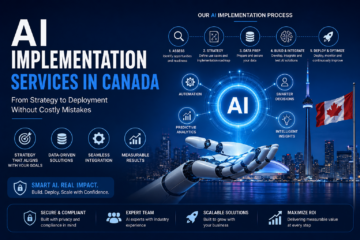
Artificial Intelligence has moved far beyond experimentation. In 2026, businesses across Canada are actively integrating AI into their existing software, workflows, and business operations to improve efficiency, reduce costs, and gain a competitive advantage.
However, building AI solutions from scratch is not always necessary. Many organizations already have CRM systems, ERP platforms, customer portals, mobile applications, and business software in place. The real opportunity lies in integrating AI into these existing systems to unlock new capabilities without replacing current infrastructure.
From AI-powered customer support and intelligent document processing to predictive analytics and workflow automation, AI integration services are helping Canadian businesses modernize operations faster than ever.
In this guide, we’ll explore what AI integration services are, why they matter, and how organizations are successfully embedding AI into existing business systems in 2026.
What Are AI Integration Services?
AI integration services involve connecting artificial intelligence technologies with existing software, applications, databases, and business processes.
Instead of building entirely new systems, organizations enhance their current platforms with AI-powered capabilities.
Examples include:
- Integrating ChatGPT into customer support systems
- Adding AI-powered search to web applications
- Automating document processing
- Embedding predictive analytics into dashboards
- Integrating AI assistants into internal workflows
- Automating CRM and ERP operations
- Creating intelligent recommendation engines
The goal is to improve business performance while maximizing the value of existing technology investments.
Why Canadian Businesses Are Investing in AI Integration
Many organizations already have mature software ecosystems.
Replacing these systems can be expensive, disruptive, and risky.
AI integration provides a more practical path toward digital transformation.
Faster ROI
Businesses can enhance existing platforms instead of rebuilding entire systems.
This reduces implementation costs and accelerates return on investment.
Improved Productivity
AI automates repetitive tasks, reducing manual workload across departments.
Better Decision-Making
AI analyzes large volumes of data and delivers actionable insights in real time.
Enhanced Customer Experience
AI-powered tools improve response times, personalization, and service quality.
Competitive Advantage
Organizations that successfully leverage AI often outperform competitors in efficiency and innovation.
Common AI Integration Use Cases
AI-Powered Customer Support
One of the most popular applications is integrating AI chatbots and virtual assistants into customer service platforms.
Benefits include:
- 24/7 customer support
- Faster response times
- Reduced support costs
- Improved customer satisfaction
Modern AI assistants can answer questions, process requests, and escalate complex issues to human agents when necessary.
Intelligent Document Processing
Businesses process thousands of documents every year.
AI can automatically:
- Extract information from invoices
- Read contracts
- Process forms
- Classify documents
- Validate data
This dramatically reduces manual data entry and administrative workload.
AI Integration with CRM Systems
Customer Relationship Management platforms become significantly more powerful when enhanced with AI.
AI-powered CRM capabilities include:
- Lead scoring
- Sales forecasting
- Customer behavior analysis
- Personalized recommendations
- Automated follow-ups
Sales teams can focus on high-value opportunities instead of repetitive tasks.
AI-Powered Business Intelligence
Traditional reporting tools provide historical data.
AI-enhanced business intelligence platforms provide:
- Predictive insights
- Trend analysis
- Revenue forecasting
- Risk detection
- Strategic recommendations
This allows executives to make faster and more informed decisions.
Workflow Automation
AI can automate complex workflows that previously required human intervention.
Examples include:
- Employee onboarding
- Approval processes
- Customer onboarding
- Procurement workflows
- Compliance monitoring
The result is improved efficiency and reduced operational costs.
How ChatGPT Integration Is Transforming Businesses
Large Language Models (LLMs) such as ChatGPT are becoming a major driver of AI adoption.
Canadian businesses are integrating ChatGPT into:
Customer Support Systems
AI assistants handle common inquiries instantly.
Internal Knowledge Bases
Employees can access company information through conversational AI.
Content Generation
Marketing teams use AI to create:
- Blog content
- Product descriptions
- Social media posts
- Email campaigns
Sales Assistance
AI helps sales teams generate proposals, summarize meetings, and draft customer communications.
Enterprise Search
Employees can quickly find information across documents, databases, and internal systems.
AI Integration with Existing Business Systems
Successful AI implementation often involves connecting AI models with current software infrastructure.
CRM Platforms
Examples:
- Salesforce
- HubSpot
- Zoho CRM
- Microsoft Dynamics
AI improves sales forecasting, lead management, and customer engagement.
ERP Systems
Examples:
- SAP
- Oracle
- Microsoft Dynamics 365
- NetSuite
AI can optimize inventory management, procurement, forecasting, and resource planning.
Web Applications
AI enhances:
- Search functionality
- Recommendations
- User personalization
- Customer support
Modern web applications increasingly rely on AI to improve user experiences.
Mobile Applications
Businesses integrate AI into mobile apps to enable:
- Personalized experiences
- Intelligent recommendations
- Voice assistants
- Predictive analytics
AI-powered mobile applications often achieve higher engagement and retention rates.
Industries Leading AI Adoption in Canada
Healthcare
Healthcare providers use AI for:
- Patient scheduling
- Medical document processing
- Clinical decision support
- Predictive healthcare analytics
Financial Services
Banks and fintech companies leverage AI for:
- Fraud detection
- Risk assessment
- Customer onboarding
- Automated support
Manufacturing
Manufacturers use AI for:
- Predictive maintenance
- Quality control
- Supply chain optimization
- Production forecasting
Retail and E-Commerce
Retailers integrate AI to improve:
- Product recommendations
- Customer support
- Inventory planning
- Demand forecasting
Professional Services
Law firms, consulting companies, and accounting firms automate document-intensive workflows through AI integration.
Challenges Businesses Face During AI Integration
Despite its benefits, AI implementation can present challenges.
Data Quality Issues
AI systems rely on clean and accurate data.
Poor data quality often limits effectiveness.
Legacy Infrastructure
Older systems may require modernization before AI can be integrated effectively.
Security and Compliance
Organizations must ensure sensitive data remains protected.
Change Management
Employees need proper training and support to adopt AI-powered workflows successfully.
Working with experienced AI integration specialists helps businesses overcome these obstacles.
Key Technologies Used in AI Integration
Modern AI integration projects often combine multiple technologies.
Machine Learning
Used for predictions, recommendations, and data analysis.
Natural Language Processing (NLP)
Enables conversational AI and language understanding.
Generative AI
Supports content creation, summarization, and intelligent assistance.
APIs and System Integrations
Connect AI models with existing business applications.
Cloud Infrastructure
Provides scalability and computing power for AI workloads.
How to Successfully Implement AI Integration
Step 1: Identify High-Impact Use Cases
Focus on processes that consume significant time or resources.
Step 2: Assess Existing Infrastructure
Determine which systems can support AI enhancements.
Step 3: Define Success Metrics
Examples include:
- Cost savings
- Productivity improvements
- Customer satisfaction
- Revenue growth
Step 4: Start with a Pilot Project
Test AI capabilities before scaling across the organization.
Step 5: Continuously Optimize
Monitor performance and refine AI models over time.
The Future of AI Integration in Canada
AI adoption is expected to accelerate significantly over the next few years.
Key trends include:
- Autonomous AI agents
- AI-powered workflow orchestration
- Hyperautomation
- Intelligent business process management
- Enterprise-wide AI assistants
- Predictive business operations
Organizations that integrate AI strategically today will be better positioned for long-term growth and innovation.
Conclusion
AI is no longer a standalone technology—it is becoming a core component of modern business systems.
Rather than replacing existing software, Canadian organizations are integrating AI into CRM platforms, ERP systems, web applications, mobile apps, and operational workflows to unlock greater efficiency and business value.
Whether you’re implementing AI-powered customer support, intelligent document processing, predictive analytics, workflow automation, or ChatGPT integration, AI integration services provide a practical and scalable path toward digital transformation.
As businesses continue to embrace automation and intelligent decision-making, AI integration will play a critical role in helping organizations remain competitive, innovative, and future-ready in 2026 and beyond.
Partnering with an experienced AI integration company can help ensure successful implementation, faster ROI, and long-term business impact.