
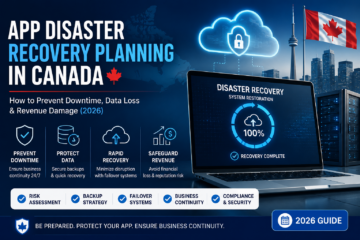
In today’s digital economy, downtime is not just an inconvenience it’s a financial and reputational disaster.
For Canadian businesses relying on mobile apps, SaaS platforms, and enterprise software, even one hour of downtime can mean:
- Lost revenue
- Customer churn
- Data breaches
- Compliance penalties
- Damaged brand trust
That’s why app disaster recovery planning in Canada has become a critical part of modern digital strategy in 2026.
If your application generates revenue, stores sensitive user data, or powers business operations, you need a structured disaster recovery plan — not just basic backups.
What Is App Disaster Recovery?
App disaster recovery (DR) is a structured plan that ensures your application can quickly recover from:
- Server failures
- Cyberattacks (ransomware, DDoS)
- Cloud outages
- Data corruption
- Human errors
- Infrastructure failures
- Natural disasters
It focuses on restoring systems, databases, and services with minimal downtime and data loss.
Why Canadian Businesses Must Prioritize Disaster Recovery in 2026
Canada has strict data privacy and compliance regulations, including:
- PIPEDA requirements
- Industry-specific security mandates
- Enterprise governance standards
Without proper disaster recovery planning in Canada, businesses risk:
- Legal penalties
- Data exposure lawsuits
- Revenue disruption
- Investor confidence loss
Disaster recovery is no longer optional — especially for fintech, healthcare, SaaS, and e-commerce platforms.
The Real Cost of App Downtime
Many companies underestimate the cost of downtime.
Consider:
- E-commerce apps lose sales every minute
- SaaS platforms face subscription cancellations
- Enterprise systems disrupt internal operations
- Healthcare apps risk patient safety issues
For mid-sized Canadian businesses, downtime can cost anywhere from CAD $5,000 to $50,000 per hour depending on industry.
Prevention is far cheaper than recovery after damage.
Disaster Recovery vs Backup: What’s the Difference?
Many companies believe backups alone are enough. They are not.
| Backup | Disaster Recovery |
|---|---|
| Copies of data | Complete recovery strategy |
| Focus on storage | Focus on business continuity |
| Manual restoration possible | Automated restoration systems |
| Limited scope | Infrastructure + application + data |
An app backup strategy is only one component of a complete disaster recovery plan.
Key Components of App Disaster Recovery Planning in Canada
1️⃣ Risk Assessment
Identify:
- Infrastructure vulnerabilities
- Data storage risks
- Third-party dependencies
- Regulatory exposure
Risk mapping is the foundation of downtime prevention.
2️⃣ Recovery Time Objective (RTO)
RTO defines:
How quickly must your app be restored after failure?
Examples:
- E-commerce app: under 1 hour
- SaaS platform: 1–4 hours
- Internal enterprise tool: 4–12 hours
3️⃣ Recovery Point Objective (RPO)
RPO defines:
How much data loss is acceptable?
For example:
- 5 minutes of lost data
- 1 hour of lost transactions
- Zero tolerance for financial records
Fintech and healthcare apps usually require near-zero RPO.
4️⃣ Automated Backup Systems
Modern Canadian businesses use:
- Real-time database replication
- Cloud backups across regions
- Encrypted storage
- Scheduled snapshot systems
Backup without automation increases risk.
5️⃣ Cloud Redundancy & Failover Systems
High-availability infrastructure includes:
- Multi-region cloud deployment
- Load balancers
- Auto-scaling groups
- Failover environments
If one server fails, another instantly takes over.
This is essential for preventing revenue damage.
Common Causes of App Downtime in Canada
- Misconfigured cloud servers
- Lack of monitoring
- Poor DevOps practices
- Expired SSL certificates
- Database overload
- Cybersecurity attacks
- Unpatched vulnerabilities
Many disasters are preventable with proper infrastructure monitoring.
App Disaster Recovery for Different Industries
Fintech
Requires strict uptime, encryption, and compliance protection.
Healthcare
Must protect patient records and follow privacy standards.
E-commerce
Needs 24/7 uptime during peak sales periods.
SaaS Platforms
Customer trust depends on platform reliability.
Enterprise Software
Operational downtime impacts productivity and contracts.
How Much Does App Disaster Recovery Planning Cost in Canada (2026)?
Costs vary based on:
- App complexity
- Cloud architecture
- Data volume
- Compliance requirements
Typical 2026 Estimates:
- Small SaaS / MVP: CAD $2,000 – $5,000 setup
- Mid-size business app: CAD $6,000 – $15,000
- Enterprise systems: CAD $20,000+
Ongoing cloud redundancy and monitoring costs are additional.
However, compared to potential downtime losses, the investment is minimal.
Signs Your App Is at Risk
You may need immediate disaster recovery planning if:
- You rely on a single cloud region
- You don’t test backups regularly
- There’s no automated failover
- You’ve never conducted a recovery drill
- Security patches are inconsistent
- There is no documented DR strategy
If you can’t restore your app within hours, your business is vulnerable.
Best Practices for App Downtime Prevention in 2026
✔ Multi-region cloud infrastructure
✔ Continuous monitoring & alerts
✔ Real-time database replication
✔ Regular disaster recovery testing
✔ Security audits
✔ DevOps automation pipelines
✔ Incident response documentation
Testing your recovery plan is just as important as creating it.
The Role of DevOps in Disaster Recovery
Modern DevOps practices improve disaster recovery by:
- Automating deployment
- Enabling quick rollback versions
- Reducing human error
- Monitoring infrastructure in real time
CI/CD pipelines make recovery faster and more reliable.
Final Thoughts: Protect Your App Before Disaster Strikes
In 2026, digital resilience is a competitive advantage.
App disaster recovery planning in Canada ensures:
- Business continuity
- Regulatory compliance
- Customer trust
- Revenue stability
- Investor confidence
The real question is not:
“Can your app fail?”
The real question is:
“How fast can you recover when it does?”
Businesses that plan ahead survive. Businesses that don’t, struggle.
If your app supports critical operations, now is the time to implement a structured disaster recovery strategy — before downtime turns into disaster.