
8 Common Mistakes in Software Development Project Management and how to avoid them

Software development is a demanding and intricate process. Projects inevitably experience highs and lows along the way. Often, these setbacks arise from seemingly minor errors. And if we promptly acknowledge and rectify, we overcome these mistakes. Neglecting to address them, however, can lead to the project’s demise. Research indicates that the failure rates of software projects typically range from 50% to 80%. Let’s take a closer look at these mistakes and explore how we can overcome them.
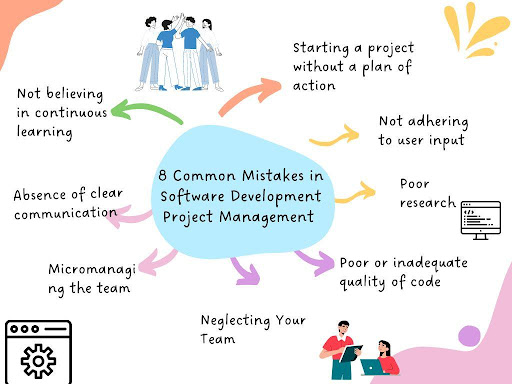
Mistakes


Mistake #1: Starting a project without a plan of action 

Planning is bringing the future into the present so that you can do something about it now. When it comes to software development, when you fail to plan, you are preparing to fail. Planning for the project gives you a roadmap. As these projects are big, proper planning will form a great foundation. 

How to avoid it:

  • Prepare an outline of the project.
  • Gather all the requirements. This involves involving the stakeholders, and don’t forget to document the requirements.
  • Evaluate the technical, financial, and operational feasibility.
  • Assess the risks.
  • Prepare the schedule, timelines, milestones, and dependencies using techniques like Gantt charts.
Mistake #2: Not adhering to user input 

Misunderstanding the user requirements or not adhering to user input is one of the most common and gravest mistakes anyone can commit – that can lead to mismatched expectations, inefficient development, reduced adoption, and missed opportunities. One essentially has to keep their eyes and ears open while taking the inputs. 

How to avoid it

  • Conduct interviews
  • Engage users from the beginning
  • Conduct user testing 
  • Provide feedback channels  
  • Build a foundation for communication
  • Continuously develop and evolve.

Read more: https://stackify.com/mistakes-to-avoid-in-software-development-projects/

Mistake #3: Poor research

Research is essentially about seeing what everyone has seen and thinking what nobody has thought of. In the fiercely competitive software development industry, creating the best product requires a strong emphasis on research, and failing to do so will be risky for your project. 

How to avoid it:

  • Comprehensive requirement analysis
  • Expert team building
  • Thorough research by a team
  • Engage industry experts
  • Conduct multifaceted research
Mistake #4: Poor or inadequate quality of code

In software development, the quality of your code is the cornerstone that upholds the entire project. Neglecting coding standards and best practices can introduce vulnerabilities that threaten the stability of your software, potentially leading to system crashes, data loss, and security breaches.

How to Avoid It:

  • Maintain code readability by consistently using the right number of spaces and tabs for indentation.
  • Enhance code clarity with meaningful variable and function names that convey their purpose.
  • Incorporate comments to elucidate complex or non-obvious code segments, aiding both current and future developers.
  • Ensure code reliability by implementing automated testing processes that expedite testing and improve the overall development workflow.

Read more: https://blog.codacy.com/8-common-software-development-mistakes-and-how-to-avoid-them/

Mistake #5: Neglecting Your Team 

Your people a.k.a employees are often referred to as the heart and soul of your company. And they indeed are your most valuable asset. While project goals and objectives naturally take center stage, it’s imperative not to lose sight of the fact that your people are the bedrock of your organization. Neglecting them in favor of project priorities can have severe consequences, including burnout, stress, employee discontent, and attrition.

How to Avoid it:

  • Cultivate a supportive environment where you regularly connect with your team members, assess their well-being, and address any concerns.
  • Establish realistic project goals and timelines that consider your team’s capabilities and workloads. Avoid imposing unrealistic or arbitrary deadlines.
  • Encourage your team to voice their ideas, concerns, and feedback. Involve them in decision-making processes that impact their work.
  • Foster the professional development and growth of your team members by offering opportunities for learning and skill enhancement.
  • Acknowledge and appreciate the dedication and hard work of your team. Recognize their contributions and implement rewards or incentives when appropriate.
Mistake #6: Micromanaging the team

Micromanagement is the dead weight that stifles a team’s creativity and slows down progress. Few things are as frustrating as having a manager who constantly micromanages employees. It sends a message of mistrust and can significantly impede progress. Furthermore, it eats up precious time and the company’s resources.

How to Avoid it:

  • Allow your team members the space to exercise their creativity and problem-solving skills.
  • Demonstrate confidence in your team’s abilities by granting them autonomy in their tasks.
  • Encourage open and transparent communication, creating an environment where team members feel comfortable sharing ideas and concerns.
  • Offer constructive feedback and acknowledge accomplishments on a consistent basis.
  • Assign tasks and responsibilities to team members based on their skills and strengths.
  • Clearly define project objectives and expectations from the outset, ensuring everyone is on the same page.

Read more: https://www.software-developer-india.com/10-common-mistakes-when-developing-software/

Mistake #7: Absence of clear communication

Not communicating efficiently is a cardinal sin. Hence improving communication efficiency is crucial. Whether it’s within your team or with clients, a foundation of clear communication is essential. The lack of it can lead to misunderstandings, project delays, and increased costs.

Here’s how to avoid it:

  • Establish clear expectations and roles.
  • Choose the appropriate communication medium.
  • Be precise.
  • Actively listen and engage with others.
  • Foster a culture of open feedback.
  • Hold regular meetings to stay aligned.
  • Practice empathy to understand others’ perspectives.
  • Work diligently on the feedback
Mistake #8: Not believing in continuous learning

Failing to engage in continuous learning can hinder success. The cornerstone of achievement lies in a commitment to lifelong learning. In our fast-paced world, staying current with the latest

technologies, trends, and industry developments is imperative. Failing to do so can render one obsolete.

How to avoid it:

  • Have a well-defined purpose and direction for your learning journey.
  • Foster a natural inclination to explore new ideas and concepts.
  • Immerse yourself in a variety of written materials to expand your knowledge base.
  • Take advantage of digital platforms to access a wide array of courses and subjects.
  • Leverage available electronic resources and modules to enhance your skills and expertise.
  • Capitalize on auditory learning with podcasts and audiobooks, which can be consumed on the go.
  • Record key insights and thoughts, and periodically review them to reinforce your learning.

By integrating these practices into your routine, you can ensure that you’re continuously evolving and staying ahead in today’s dynamic world.

In conclusion

It is essential for the software development process to be seamless in order to achieve success. Above, we have discussed eight common mistakes and how to avoid them. Committing these errors can be costly. Following these best practices can help you steer clear of these common pitfalls. For further details, you can contact the App Scoop mobile app development team at:
https://app-scoop.com/

 

Importance of UX design in software development – business guide.

The primary objective of any application is to endure over time and contribute to business growth while being efficient in terms of time and cost. A good UX design can address all of these requirements. In this article, we will discuss the significance of UX design in software development.


UX and Software Development

What is UX?

UX also known as User Experience is the way end users interact with the company’s products and services. It also encompasses the overall experience the user undergoes. This is precisely why UX designs should be meaningful, easy to use, interactive, flexible, funky, and enjoyable. In essence, a good UX is the most essential reason that increases the business of the product and makes it successful. Most importantly, UX makes sure that all the needs of users are looked after.

Here are some of the reasons why UX is important.

  • User Engagement: Higher the user engagement, the more successful the product is. And UX design is one of the ways you can hit the right chord with the audience.

  • User satisfaction: UX designs predominantly focus on meeting the users’ needs. When the users are happy, the user satisfaction rate increases too.

  • A good UX design can result in a healthy SEO ranking. Further promoting brand loyalty.

  • Business growth: When user engagement and satisfaction are high, the business is bound to grow.

  • Overall, a good UX design is responsible for giving the product a competitive edge while making the product more accessible to its users.  

What is Software Architecture?

Simply put, Software Architecture is the structure of a software system that outlines its overall design. It serves as a blueprint for the software system, which may be complex. Providing a structured solution streamlines the process and ensures that the system is efficient, maintainable, and scalable.

  • In the 60s and 70s, the concept of structured programming and modular design gave birth to the idea of software architecture.
  • This industry is growing at a steady pace, and it is said that the software architecture industry is expected to grow from 6.8% from 2020 to 2027.
  • Studies suggest that software architecture has become a hotspot for software professionals.
  • An average software architect can earn around $130,000 per year.

It is said that the market size is estimated to grow to $2.2 trillion by 2025. 


Correlation between UX and Software Development

The relationship between UX and software development is very close, with UX being an essential component of the software development process. By prioritizing the needs and preferences of users, UX designers ensure that the software development phase is made intuitive and user-friendly.

  • To facilitate the development process, UX designers analyze user behaviour and needs, which are then communicated to the software development team.
  • The UX team creates design guidelines and protocols during their research, which are then followed by the development team.
  • Before the development begins, the UX team provides software prototypes to evaluate the user experience. Additionally, the UX team conducts usability testing to ensure that the product meets user needs.
  • UX design is an ongoing process that involves making changes to the software based on user feedback to improve the user experience.

Key components of UX design  for software development

Overall, UX design plays a crucial role in ensuring that software development meets the needs of users and provides an exceptional user experience.

  • User Research: The research component of UX design is crucial for understanding the user and their needs, pain points, expectations, and behaviour. This forms a cyclical process essential to UX design.

  • User Flow: UX design defines the user’s journey through the software, making it intuitive, clear, and easy to use.

  • Architecture and Design: UX plans the architecture and design of the product in a way that makes sense for the users.

  • Performance Optimization: Users expect the product to be quick, smooth, and hassle-free. This involves ensuring that the page loads quickly and responds to the user’s prompts promptly.

  • Content Strategy: Engaging content that meets the needs of users is key to keeping them hooked on the product.

  • Usability Testing: Before launching the product, it’s essential to test it with actual users to ensure that it’s optimal.

  • Accessibility: The product should be accessible to everyone regardless of their abilities.

The importance of user experience (UX) design in software development

While a developer can create a functional application, it will be of little value if it fails to meet user needs. That’s where a well-crafted UX design comes in, as it can make all the difference in software development. Here is what UX brings to the table while software development. 

  • Improved User Satisfaction: User satisfaction is the measure of how happy the users are with a product or service. UX design plays a critical role in ensuring user satisfaction during software development by making the design clear and intuitive, meeting user needs, being consistent, minimizing errors, and working on feedback and communication. UX designers can measure user satisfaction through various methods, such as conducting surveys, taking feedback, using analytics tools, and usability testing. A well-designed UX that focuses on user needs and preferences increases user satisfaction, making it a crucial aspect of software development.

  • Higher user engagement: A good UX design ensures high user engagement in software development by conducting thorough research to understand users’ needs and behaviors, creating a clear user flow that guides users through the product, designing an appealing visual interface, and incorporating gamification techniques. These elements work together to create an engaging experience that captures users’ attention and encourages them to interact with the product or service. By prioritizing user needs and preferences and incorporating techniques that enhance the user experience, a good UX design can increase user engagement and satisfaction.

  • Reduced development cost and time management: Investing in a robust and well-designed application can help ensure that clients have no complaints, making it advisable to invest in good UX design during software development. By investing in a good UX design, companies can save money that would have been spent on updates, thereby avoiding losses. The solid foundation of a well-built UX design can save time during the development process, reducing the need for updates and minimizing the cost of mockups and prototypes. Overall, investing in a good UX design is an efficient way to reduce costs, improve client satisfaction, and minimize the risk of costly errors and issues during software development.

  • Overall growth: A good UX design can contribute to high productivity by making the application easy to use, minimizing errors, and reducing the learning curve for users. This, in turn, can give the business a competitive edge, leading to growth.

Read more: https://medium.com/@tobiegbude/importance-of-ui-ux-design-in-software-development-c21b342c2f12

  •  Brand recognition and loyalty

A good UX design can help improve brand recognition in software development in several ways. Firstly, a well-designed UX can attract and retain users, which in turn creates a positive image of the brand. Secondly, a consistent visual identity throughout the application can increase brand recognition and create a strong brand image. Finally, by providing a unique and enjoyable user experience, a good UX can differentiate the brand from competitors and enhance brand loyalty.

Read more: https://softwarethings.pro/blog/importance-of-ui-ux-design-in-software-development-business-guide/#benefits

In Conclusion

Over the years, incorporating UX into app development has become crucial as an application without it is bound to fail. Although developers may focus on building a strong application, it’s equally important to cater to the users’ needs. Implementing a good UX design is vital in making an application user-friendly, intuitive, and functional. If you have an idea for an application, our diligent team will be happy to assist you. To collaborate with us, you can contact the App Scoop mobile app development team at: https://www.app-scoop.com/contact-us.html