
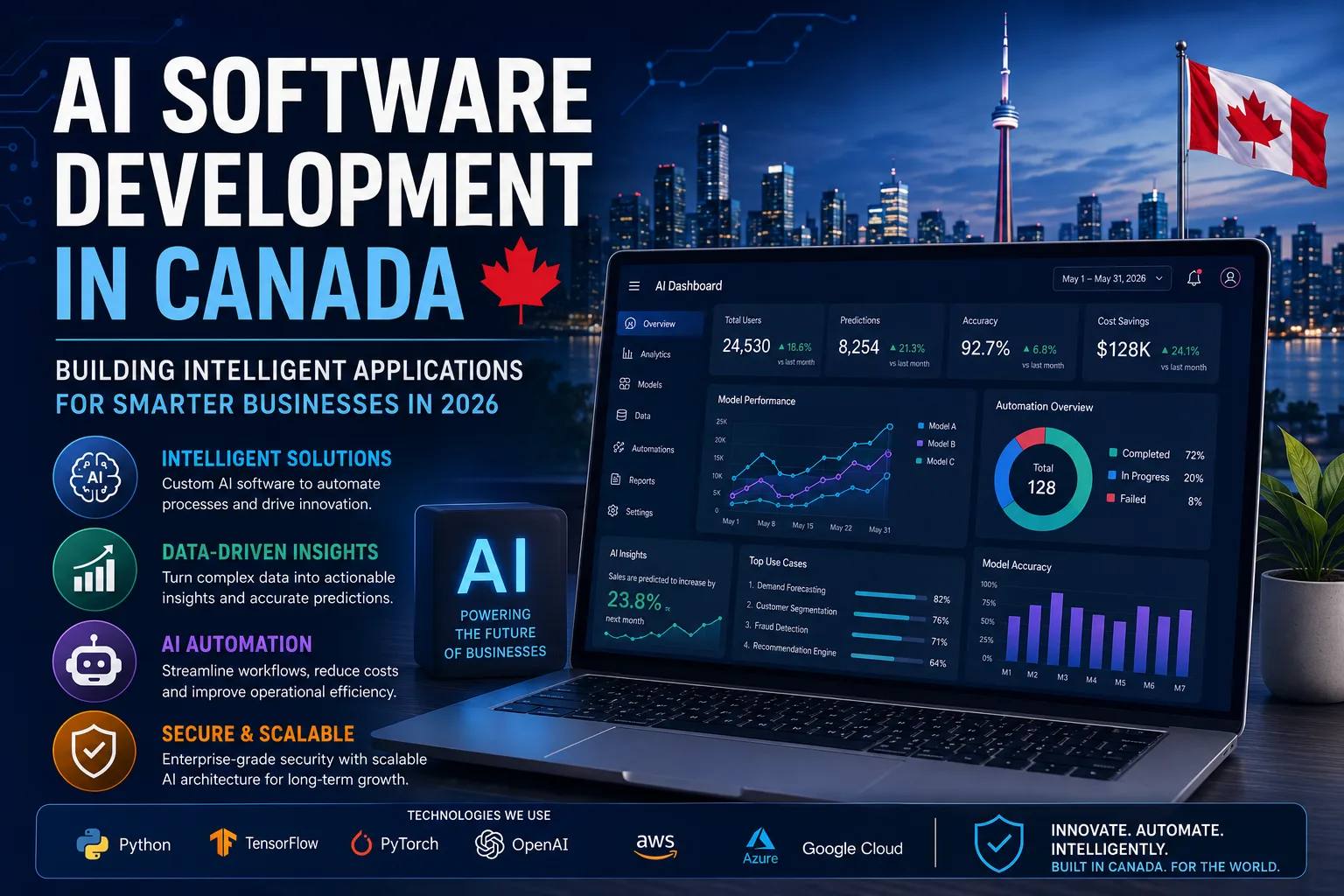
AI Software Development Canada: Intelligent Business Solutions
Artificial Intelligence is no longer a futuristic concept reserved for large tech companies. Businesses across Canada are now integrating AI into software products to automate operations, improve customer experiences, reduce costs, and gain competitive advantages.
From healthcare and fintech to logistics and SaaS platforms, organizations are rapidly investing in AI software development in Canada to create smarter and more scalable digital solutions.
Whether it is predictive analytics, AI chatbots, recommendation engines, workflow automation, or intelligent business platforms, AI-powered software is transforming how companies operate in 2026.
In this guide, we will explore:
- What AI software development is
- Types of AI-powered applications
- Benefits of AI software solutions
- Popular AI technologies and frameworks
- Development costs in Canada
- Industry use cases
- Future AI trends for businesses
What Is AI Software Development?
AI software development involves creating applications that can simulate human intelligence using technologies such as:
- Machine learning
- Natural language processing (NLP)
- Computer vision
- Predictive analytics
- Generative AI
- AI automation systems
Unlike traditional software, AI-powered applications can:
- Learn from data
- Recognize patterns
- Make predictions
- Automate repetitive tasks
- Improve performance over time
AI software can be integrated into:
- Mobile applications
- Web platforms
- Enterprise software
- SaaS products
- CRM systems
- ERP platforms
- Customer support systems
Internal linking opportunity:
- “AI App Development in Canada”
- “Enterprise AI Development in Canada”
- “AI Integration in Mobile Apps in Canada”
Why Businesses in Canada Are Investing in AI Software Development
1. Automation of Repetitive Tasks
Many businesses spend significant time handling repetitive operational tasks.
AI software can automate:
- Data entry
- Customer support
- Email workflows
- Reporting
- Scheduling
- Document processing
This improves efficiency while reducing operational costs.
Internal link:
- “AI Workflow Automation in Canada”
- “AI Automation Services in Canada”
2. Smarter Business Decision-Making
AI-powered analytics platforms can process massive amounts of data in real time.
Businesses use AI to:
- Predict customer behavior
- Forecast demand
- Detect anomalies
- Optimize operations
- Generate business insights
AI-driven decision-making improves productivity and strategic planning.
Internal linking opportunity:
- “Custom Dashboard Development in Canada”
- “App Analytics in Canada”
3. Improved Customer Experiences
Modern consumers expect personalized digital experiences.
AI applications help businesses provide:
- Personalized recommendations
- AI chatbots
- Smart search
- Automated customer support
- Predictive suggestions
This increases customer satisfaction and retention.
Internal link:
- “AI Chatbot Development in Canada”
4. Competitive Advantage
Companies adopting AI early gain advantages through:
- Faster operations
- Better data analysis
- Reduced costs
- Higher scalability
- Smarter automation
Businesses that delay AI adoption may struggle to compete in rapidly evolving markets.
Types of AI Software Solutions
AI Chatbots & Virtual Assistants
AI chatbots use NLP models to understand and respond to users intelligently.
Common use cases:
- Customer support
- Lead generation
- Appointment booking
- Internal help desks
Internal linking:
- “Generative AI App Development in Canada”
- “AI Chatbot Development in Canada”
Predictive Analytics Platforms
These systems analyze historical data to predict future outcomes.
Used for:
- Sales forecasting
- Risk analysis
- Fraud detection
- Inventory prediction
Industries like finance and logistics heavily rely on predictive analytics.
AI Workflow Automation
AI-powered workflow systems automate business processes using intelligent decision-making.
Examples include:
- Invoice processing
- HR onboarding
- Customer service automation
- Smart approvals
Internal link:
- “AI Workflow Automation in Canada”
Recommendation Engines
Recommendation systems personalize content and product suggestions.
Popular in:
- E-commerce
- Streaming platforms
- SaaS products
- Education apps
Computer Vision Applications
Computer vision allows software to analyze images and videos.
Used for:
- Facial recognition
- Medical imaging
- Security monitoring
- Retail analytics
AI-Powered SaaS Platforms
Many SaaS businesses are integrating AI features into their products.
Examples include:
- Smart analytics
- AI-generated content
- Automated reporting
- Intelligent dashboards
Internal linking:
- “AI Powered SaaS Development in Canada”
- “SaaS Application Development in Canada”
Technologies Used in AI Software Development
Canadian AI development companies commonly use advanced AI frameworks and cloud infrastructure.
AI Frameworks
- TensorFlow
- PyTorch
- Scikit-learn
- Keras
- LangChain
Programming Languages
- Python
- JavaScript
- Java
- R
Cloud Platforms
- AWS AI Services
- Microsoft Azure AI
- Google Cloud AI
Generative AI Technologies
- OpenAI APIs
- Claude AI
- Gemini AI
- LLM integrations
Database & Infrastructure
- PostgreSQL
- MongoDB
- Vector databases
- Kubernetes
Internal linking opportunity:
- “Cloud App Development in Canada”
- “DevOps for App Development in Canada”
Industries Using AI Software Development in Canada
Healthcare
Healthcare organizations use AI software for:
- Medical diagnostics
- Patient analytics
- Virtual healthcare assistants
- Predictive healthcare insights
Healthcare AI systems must comply with PHIPA and PIPEDA regulations.
Internal linking:
- “Healthcare App Development in Canada”
- “App Compliance in Canada”
Finance & Fintech
Fintech companies use AI for:
- Fraud detection
- Credit scoring
- Risk analysis
- Automated financial insights
Internal linking:
- “Fintech App Development in Canada”
Retail & E-Commerce
AI improves e-commerce platforms through:
- Product recommendations
- Customer segmentation
- Inventory forecasting
- AI-powered search
Internal link:
- “E-Commerce App Development in Canada”
Logistics & Transportation
AI software helps logistics companies optimize:
- Fleet management
- Route planning
- Demand forecasting
- Supply chain analytics
Internal linking:
- “Logistics App Development in Canada”
Enterprise Businesses
Large organizations use AI to improve:
- Internal workflows
- Business intelligence
- Employee productivity
- Enterprise automation
Internal linking:
- “Enterprise Software Development in Canada”
- “Custom ERP Software Development in Canada”
How Much Does AI Software Development Cost in Canada?
AI software development costs depend on:
- Application complexity
- AI model requirements
- Data infrastructure
- Third-party integrations
- Training datasets
- Security requirements
Estimated pricing ranges:
| AI Solution Type | Estimated Cost |
|---|---|
| Basic AI Chatbot | CAD $5,000 – $20,000 |
| AI Workflow Automation System | CAD $15,000 – $50,000 |
| Predictive Analytics Platform | CAD $25,000 – $100,000+ |
| Enterprise AI Software | CAD $50,000 – $250,000+ |
| Generative AI Applications | CAD $40,000 – $200,000+ |
Ongoing expenses may include:
- AI model maintenance
- Cloud infrastructure
- API usage
- Security monitoring
- Continuous AI training
Internal linking:
- “App Support & Maintenance Cost in Canada”
Key Challenges in AI Software Development
Data Quality Issues
AI systems depend heavily on clean and accurate data.
Poor-quality datasets can reduce model performance and accuracy.
Security & Compliance
AI applications often process sensitive information.
Businesses must ensure:
- Data encryption
- Secure APIs
- Compliance management
- Responsible AI practices
Internal link:
- “Mobile App Security in Canada”
Scalability
AI applications require scalable infrastructure to process large datasets efficiently.
Cloud-native architecture is often essential for enterprise AI systems.
AI Bias & Ethical Concerns
Businesses must ensure AI systems remain fair, transparent, and unbiased.
Responsible AI development is becoming increasingly important in Canada and globally.
Future Trends in AI Software Development
The AI software industry in Canada is evolving rapidly.
Key trends shaping 2026 include:
- Autonomous AI agents
- AI copilots
- Multimodal AI applications
- AI-powered enterprise workflows
- Generative AI integration
- Low-code AI platforms
- Edge AI computing
- Intelligent automation systems
Businesses investing early in AI innovation will likely gain long-term competitive advantages.
Internal linking opportunity:
- “AI Agents Development in Canada”
- “Generative AI App Development in Canada”
Final Thoughts
AI software development is transforming how Canadian businesses operate, innovate, and scale.
From workflow automation and predictive analytics to intelligent SaaS products and AI chatbots, businesses are leveraging AI to improve efficiency, reduce costs, and deliver better user experiences.
Whether you are building an AI-powered mobile app, enterprise platform, SaaS product, or automation system, investing in custom AI software development can provide long-term business value and scalability.
As AI adoption accelerates in 2026, companies that embrace intelligent software solutions early will be better positioned to compete in the digital economy.
Categories: Uncategorized
Have a project in mind?
Let's talk about how we can build it. Free consultation, no obligation.
Get a Free Consultation