
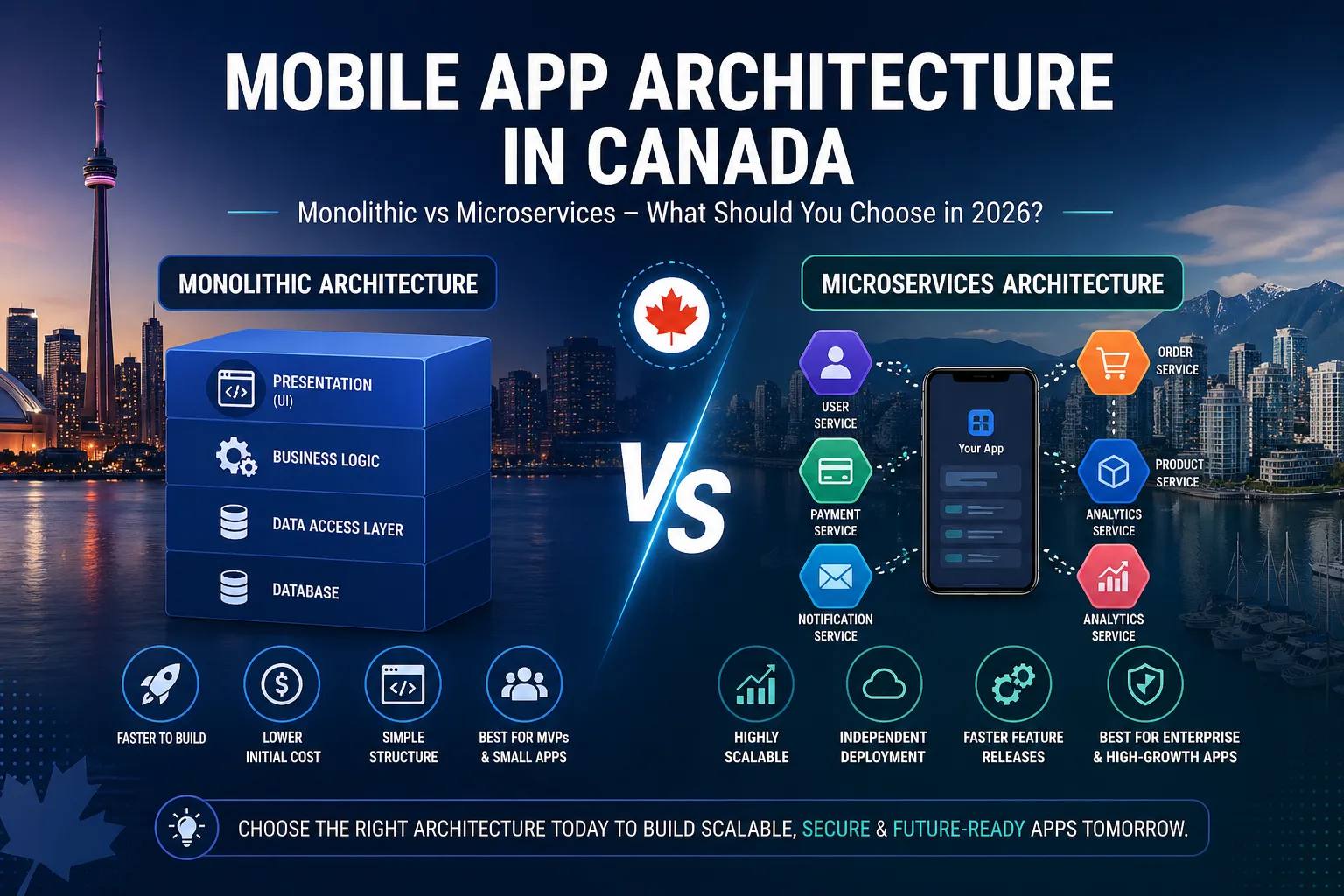
Mobile App Architecture in Canada: 2026 Comparison Guide
Choosing the right mobile app architecture is one of the most important technical decisions Canadian businesses make when building an application.
Whether you’re a startup in Toronto, an enterprise in Vancouver, or a scaling SaaS company anywhere in Canada — your app architecture directly impacts:
- Performance
- Scalability
- Development cost
- Time to market
- Long-term maintenance
In this 2026 guide, we’ll break down:
- What mobile app architecture means
- Monolithic vs Microservices architecture
- When to choose each
- Cost implications in Canada
- Architecture trends for 2026
What Is Mobile App Architecture?
Mobile app architecture refers to the structural design of your app, including:
- Frontend (UI layer)
- Backend services
- Database structure
- APIs
- Cloud infrastructure
- Integration systems
A strong architecture ensures your app is:
- Scalable
- Secure
- Maintainable
- Fast under heavy traffic
Without proper architecture, apps often suffer from performance bottlenecks, crashes, and expensive rebuilds.
Monolithic Architecture Explained
A monolithic architecture is a single, unified codebase where all components of the application are interconnected and deployed together.
How It Works:
- One backend
- One database
- One deployment pipeline
- All features tightly integrated
✅ Advantages
- Faster initial development
- Lower upfront cost
- Easier for small teams
- Simpler debugging in early stages
❌ Disadvantages
- Hard to scale specific components
- Slower updates as the app grows
- Risky deployments (one bug can impact everything)
- Difficult to manage large teams
Best For:
- MVPs
- Small startups
- Budget-conscious projects
- Apps with limited features
Microservices Architecture Explained
A microservices architecture divides your app into independent services that communicate via APIs.
Each service handles a specific function, such as:
- Authentication
- Payments
- Notifications
- User management
- Analytics
Each service can be deployed, scaled, and updated independently.
✅ Advantages
- High scalability
- Faster feature releases
- Independent deployments
- Better fault isolation
- Ideal for large applications
❌ Disadvantages
- Higher development cost
- Complex infrastructure
- Requires DevOps maturity
- More monitoring needed
Best For:
- Enterprise apps
- SaaS platforms
- Fintech apps
- Healthcare platforms
- High-traffic marketplaces
Monolithic vs Microservices: Key Comparison
| Factor | Monolithic | Microservices |
|---|---|---|
| Initial Cost | Lower | Higher |
| Scalability | Limited | Highly scalable |
| Development Speed | Faster early-stage | Faster long-term |
| Maintenance | Harder over time | Easier long-term |
| Deployment | Single unit | Independent services |
| Best For | MVPs & small apps | Enterprise & scalable apps |
What Do Canadian Businesses Prefer in 2026?
In Canada, architecture choice depends on business stage:
🚀 Startups
Most Canadian startups begin with monolithic architecture to reduce cost and validate their MVP.
🏢 Enterprises
Enterprises prefer microservices architecture due to:
- Compliance requirements
- Scalability needs
- Integration complexity
- Cloud-first strategies
💳 Fintech & Healthcare
Industries with strict compliance (PIPEDA, PHIPA) increasingly adopt microservices for:
- Security isolation
- Modular compliance handling
- Secure data segmentation
Cost of App Architecture in Canada (2026 Estimate)
Here’s a general breakdown:
| Architecture Type | Estimated Development Cost |
|---|---|
| Monolithic App | $30,000 – $80,000 |
| Microservices App | $80,000 – $200,000+ |
Cost depends on:
- Features
- Cloud infrastructure
- Security requirements
- DevOps setup
- Integrations
Microservices cost more upfront but reduce long-term scalability risks.
Hybrid Approach: The Smart 2026 Strategy
Many Canadian tech companies now follow a “Modular Monolith” approach, meaning:
- Start monolithic
- Structure code modularly
- Transition gradually to microservices when scaling
This reduces risk and controls budget while keeping future flexibility.
Key Architecture Components in 2026
Modern Canadian mobile apps typically use:
- Cloud-native infrastructure (AWS, Azure, GCP)
- Containerization (Docker)
- CI/CD pipelines
- API-first development
- Serverless computing
- Scalable databases
- Automated monitoring tools
Architecture is no longer just backend — it’s part of business strategy.
How to Choose the Right Architecture for Your App
Ask these questions:
- Are you building an MVP or enterprise product?
- How fast do you expect user growth?
- Will your app require complex integrations?
- Do you need independent feature deployments?
- What is your long-term scaling vision?
If you expect rapid growth → Microservices If you are validating an idea → Monolithic
Common Architecture Mistakes to Avoid
- Over-engineering MVPs
- Choosing microservices without DevOps capability
- Ignoring scalability planning
- Poor API documentation
- No monitoring system
- Not planning database scaling
Final Thoughts: What Should You Choose in 2026?
There is no one-size-fits-all architecture.
For most Canadian businesses:
- Start simple
- Plan for scalability
- Design with future growth in mind
If you’re unsure, consulting an experienced app development team before building can save thousands in rebuild costs later.
Architecture is not just a technical decision — it’s a long-term business investment.
Categories: Uncategorized
Have a project in mind?
Let's talk about how we can build it. Free consultation, no obligation.
Get a Free Consultation