
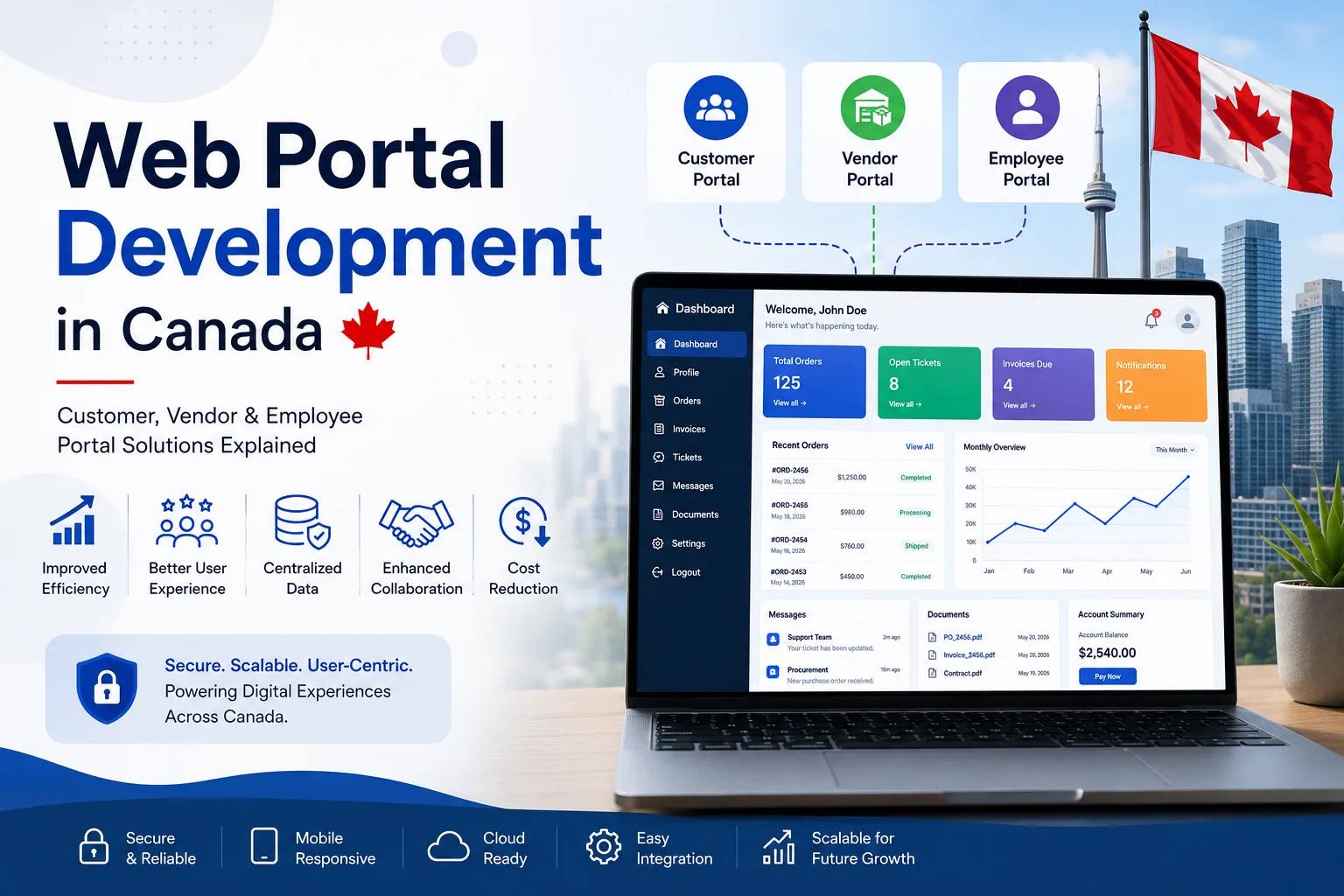
Web Portal Development in Canada: Customer & Employee Portals
In today’s digital-first business environment, companies across Canada are increasingly investing in web portal development to streamline operations, improve customer experience, and automate internal workflows. Whether it’s a customer self-service portal, a vendor management system, or an employee intranet, web portals have become essential enterprise tools.
This blog explores everything you need to know about web portal development in Canada, including types, features, benefits, technology stack, and cost considerations.
What is Web Portal Development?
Web portal development refers to building a centralized web-based platform that provides users with personalized access to information, services, and tools.
Unlike traditional websites, web portals are interactive and role-based. Users log in to access customized dashboards depending on their role—customer, employee, vendor, or administrator.
Types of Web Portals
1. Customer Portals
Customer portals allow users to:
- Track orders and transactions
- Submit support tickets
- Access invoices and billing history
- Manage their account settings
These portals improve customer satisfaction and reduce support workload.
2. Vendor Portals
Vendor portals are designed for supplier and partner collaboration:
- Purchase order management
- Invoice submission and tracking
- Contract management
- Communication with procurement teams
They help businesses build stronger and more transparent supply chains.
3. Employee Portals
Employee portals (intranets) improve internal communication and productivity:
- HR documents and payroll access
- Leave management
- Internal announcements
- Training and onboarding resources
They act as a centralized digital workspace for employees.
Key Features of a Web Portal
A modern web portal typically includes:
- Role-based dashboards
- Secure login and authentication
- Real-time data synchronization
- API integrations with third-party tools
- Notifications and alerts
- Advanced search functionality
- Mobile responsiveness
Security and scalability are critical, especially for enterprise-level applications.
Benefits of Web Portal Development in Canada
Businesses investing in web portals gain several advantages:
1. Improved Efficiency
Automates repetitive tasks and reduces manual workload.
2. Better User Experience
Users get personalized dashboards and faster access to information.
3. Centralized Data Management
All data is stored and managed in one secure platform.
4. Enhanced Collaboration
Employees, vendors, and customers can interact seamlessly.
5. Cost Reduction
Reduces operational and customer support costs over time.
Web Portal Development Process
A structured development process ensures success:
1. Requirement Analysis
Understanding business goals and user roles.
2. UI/UX Design
Creating user-friendly interfaces for different user types.
3. Backend Development
Building secure APIs, databases, and business logic.
4. Frontend Development
Developing responsive and interactive user interfaces.
5. Integration
Connecting CRM, ERP, payment gateways, and other systems.
6. Testing & QA
Ensuring performance, security, and usability.
7. Deployment & Maintenance
Launching the portal and providing ongoing support.
Technology Stack Used
Common technologies used in web portal development include:
- Frontend: React, Angular, Vue.js
- Backend: Node.js, .NET, Python (Django/Flask)
- Database: PostgreSQL, MySQL, MongoDB
- Cloud: AWS, Azure, Google Cloud
- Authentication: OAuth, JWT
Cost of Web Portal Development in Canada
The cost depends on complexity and features:
- Basic portal: CAD $10,000 – $25,000
- Mid-level enterprise portal: CAD $25,000 – $75,000
- Advanced enterprise portal: CAD $75,000 – $150,000+
Factors affecting cost include integrations, scalability, UI complexity, and security requirements.
Why Businesses in Canada Need Web Portals
With increasing digital transformation demands, businesses in Canada are adopting portals to:
- Improve operational efficiency
- Enhance customer engagement
- Enable remote workforce management
- Support scalable business growth
Web portals are no longer optional—they are a competitive necessity.
Conclusion
Web portal development is a powerful solution for businesses looking to streamline operations and improve user experience. Whether it’s customer, vendor, or employee portals, companies across Canada are leveraging these platforms to stay competitive in a digital economy.
If your business is planning to build a scalable enterprise solution, investing in web portal development in Canada can be a game-changing decision.
Categories: Uncategorized
Have a project in mind?
Let's talk about how we can build it. Free consultation, no obligation.
Get a Free Consultation