
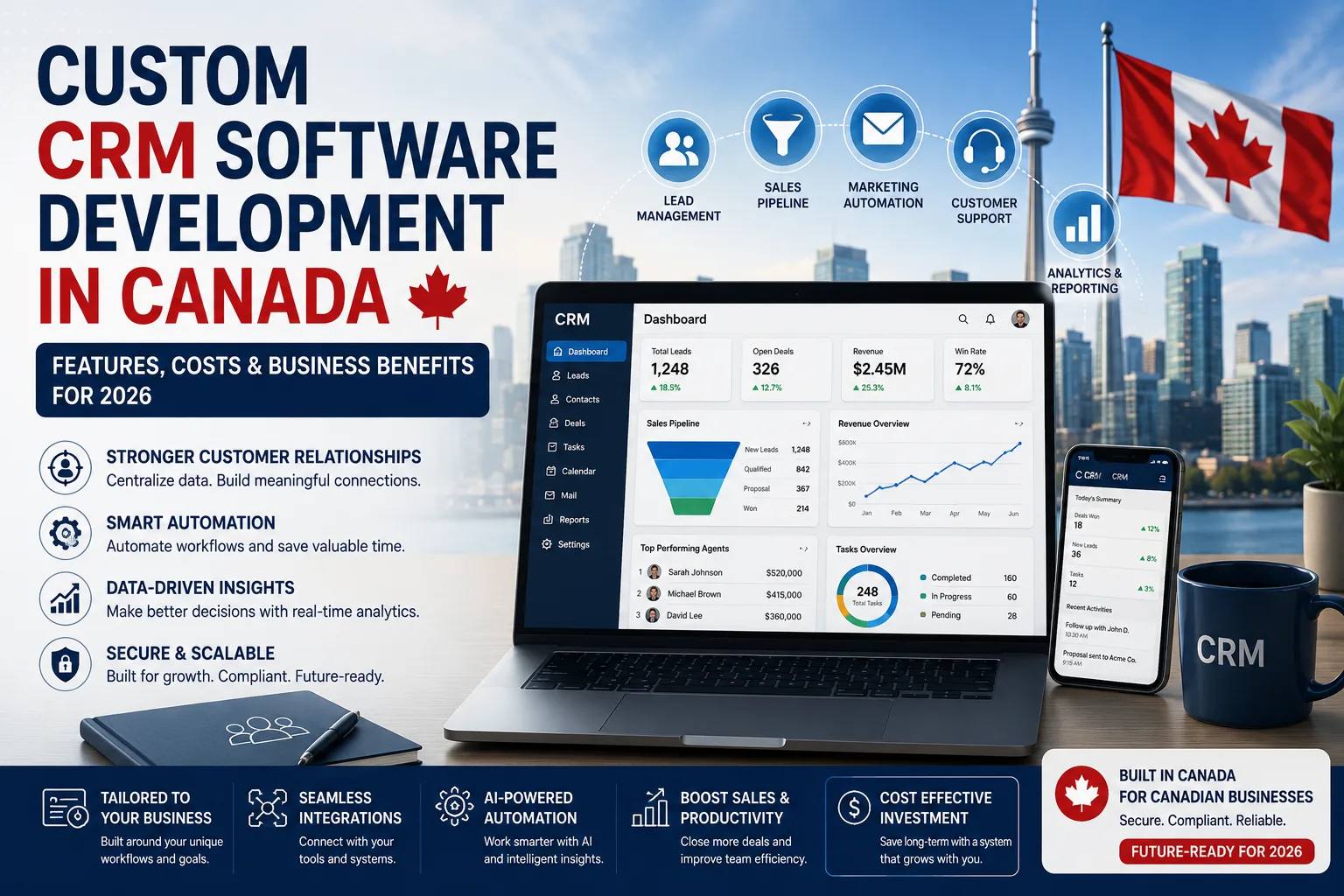
Custom CRM Software Development Canada: 2026 Business Guide
Customer relationships are one of the most valuable assets any business can have. In 2026, companies across Canada are investing heavily in CRM technology to improve customer engagement, automate operations, increase sales efficiency, and centralize business data.
However, many businesses are discovering that off-the-shelf CRM platforms often fail to meet their unique operational requirements. This is why demand for custom CRM software development in Canada is growing rapidly.
Custom CRM solutions allow businesses to build platforms tailored specifically to their workflows, customer journey, industry requirements, and growth goals.
In this guide, we’ll cover:
- What custom CRM software development means
- Key CRM features businesses need
- CRM development costs in Canada
- Automation and AI integrations
- CRM architecture and scalability
- Benefits of custom CRM systems
- How to choose the right CRM development company
What Is Custom CRM Software Development?
Custom CRM software development involves building a customer relationship management platform specifically designed for a company’s unique processes and operational needs.
Unlike generic CRM tools, custom CRM systems provide:
- Personalized workflows
- Tailored dashboards
- Custom integrations
- Advanced automation
- Better scalability
- Industry-specific features
A custom CRM can help businesses manage:
- Leads
- Sales pipelines
- Customer communication
- Marketing campaigns
- Support tickets
- Analytics
- Team collaboration
Canadian businesses across industries are increasingly investing in CRM systems to improve customer retention and operational efficiency.
Why Businesses in Canada Are Choosing Custom CRM Solutions
Off-the-Shelf CRM Limitations
Popular CRM platforms often include unnecessary features while lacking critical customization options.
Common limitations include:
- Expensive licensing fees
- Limited workflow flexibility
- Difficult integrations
- Poor scalability
- Restricted data ownership
- Generic reporting systems
As businesses grow, these limitations can slow down productivity and create operational inefficiencies.
Need for Workflow Automation
Modern businesses require automation across:
- Sales
- Marketing
- Customer support
- Reporting
- Internal communication
Custom CRM software enables organizations to automate repetitive processes and improve team efficiency.
Better Data Control & Security
Custom CRM platforms offer better control over:
- Customer data
- Hosting infrastructure
- Security protocols
- Compliance management
This is especially important for Canadian businesses operating in regulated industries like:
- Healthcare
- Finance
- Government
- Legal services
Core Features of Custom CRM Software
Lead Management
CRM systems help businesses organize and track leads throughout the sales pipeline.
Features include:
- Lead capture forms
- Pipeline tracking
- Contact management
- Lead scoring
- Follow-up reminders
This helps sales teams close deals more efficiently.
Sales Automation
Automation improves productivity by reducing manual tasks.
CRM automation can include:
- Automated email sequences
- Task assignments
- Sales reminders
- Follow-up workflows
- Proposal generation
Sales automation improves response times and reduces operational bottlenecks.
Customer Communication Tracking
A CRM centralizes all customer interactions in one place.
Businesses can track:
- Emails
- Calls
- Support tickets
- Chat conversations
- Meeting history
This improves customer service and team collaboration.
Analytics & Reporting
Modern CRM systems provide real-time analytics for:
- Sales performance
- Customer behavior
- Conversion rates
- Team productivity
- Revenue forecasting
Advanced reporting helps businesses make data-driven decisions.
Role-Based Access Control
CRM systems should include permission management to ensure secure data access.
Businesses can assign:
- Admin roles
- Sales permissions
- Support access
- Department-specific visibility
This improves both security and operational organization.
Mobile Accessibility
Modern CRM platforms need mobile-friendly interfaces for remote and hybrid teams.
Mobile CRM features may include:
- Real-time notifications
- Mobile dashboards
- Contact management
- Sales updates
- Field team access
Mobile accessibility improves responsiveness and team productivity.
AI-Powered CRM Features in 2026
AI is transforming CRM systems across Canada.
AI Lead Scoring
AI can automatically identify high-converting leads using behavioral and historical data.
This helps sales teams prioritize opportunities more effectively.
Predictive Analytics
AI-powered CRMs can forecast:
- Customer churn
- Revenue trends
- Sales opportunities
- User engagement patterns
Predictive insights improve strategic planning.
AI Chatbots & Virtual Assistants
Businesses are integrating AI chatbots into CRM systems for:
- Customer support
- Lead qualification
- Appointment booking
- Automated responses
This improves customer experience while reducing support workload.
Smart Workflow Automation
AI automation can:
- Trigger follow-ups
- Route support tickets
- Recommend actions
- Generate insights automatically
AI-powered workflows significantly improve operational efficiency.
CRM Integrations Businesses Need
Modern CRM systems must integrate with existing business tools.
Common integrations include:
- Email platforms
- Marketing automation software
- ERP systems
- Payment gateways
- Analytics tools
- Customer support platforms
- Accounting software
- AI APIs
API-first architecture ensures long-term scalability and flexibility.
Custom CRM Development Cost in Canada
CRM development costs vary depending on:
- Features
- User roles
- Integrations
- Automation complexity
- AI functionality
- Security requirements
Estimated CRM Development Costs
| CRM Type | Estimated Cost (CAD) |
|---|---|
| Basic CRM MVP | $20,000 – $50,000 |
| Mid-scale CRM platform | $50,000 – $120,000 |
| Enterprise CRM software | $120,000 – $400,000+ |
Additional ongoing costs may include:
- Cloud hosting
- Maintenance
- API usage
- Security monitoring
- AI integrations
- DevOps infrastructure
CRM Development Timeline
Typical Development Timelines
| Project Scope | Estimated Timeline |
|---|---|
| Basic CRM system | 2–4 months |
| Mid-scale CRM platform | 4–7 months |
| Enterprise CRM solution | 8–12 months |
AI-powered CRM systems usually require additional development and testing time.
Recommended CRM Architecture
Cloud-Native Infrastructure
Most modern CRM platforms use cloud environments like:
- AWS
- Azure
- Google Cloud
Benefits include:
- Scalability
- High uptime
- Better performance
- Easier remote access
Modular Architecture
Modular CRM systems allow businesses to add features as they grow.
Examples:
- Sales module
- Support module
- Analytics module
- Marketing automation module
This improves long-term flexibility.
API-First Development
API-driven CRM systems simplify integrations with:
- Third-party tools
- Mobile applications
- AI services
- External databases
This creates a future-ready software ecosystem.
Security & Compliance Considerations
CRM systems often store sensitive customer data.
Canadian businesses should implement:
- End-to-end encryption
- Role-based access control
- Secure authentication
- Data backups
- Audit logging
- PIPEDA compliance
Healthcare and finance companies may require additional regulatory compliance.
Benefits of Custom CRM Software
Improved Customer Relationships
CRM systems help businesses deliver:
- Faster responses
- Personalized communication
- Better support experiences
This improves customer retention and loyalty.
Increased Team Productivity
Automation reduces repetitive tasks and improves operational efficiency.
Teams can focus more on:
- Sales
- Customer service
- Strategic growth
instead of manual administration.
Better Business Insights
Centralized data improves decision-making through:
- Real-time analytics
- Sales forecasting
- Customer behavior tracking
Scalability for Future Growth
Custom CRM platforms can scale with:
- Growing user bases
- Expanding teams
- New business processes
- Additional integrations
Businesses avoid the limitations of generic CRM software.
Industries Using Custom CRM Software in Canada
Healthcare
Healthcare organizations use CRM systems for:
- Patient communication
- Appointment management
- Follow-up automation
Real Estate
Real estate companies use CRMs for:
- Property lead tracking
- Agent management
- Automated communication
Financial Services
Fintech companies use CRM systems for:
- Client onboarding
- Compliance tracking
- Customer support
E-Commerce
Retail businesses use CRM software for:
- Customer retention
- Marketing automation
- Loyalty programs
- Personalized recommendations
Challenges in CRM Development
Integration Complexity
Connecting multiple business systems can increase development complexity.
Professional architecture planning is essential.
Data Migration
Migrating customer data from legacy systems requires:
- Validation
- Cleaning
- Backup planning
- Security testing
User Adoption
CRM systems should prioritize:
- User-friendly design
- Training
- Workflow simplicity
Complex systems reduce adoption rates.
Choosing the Right CRM Development Company in Canada
When selecting a CRM development partner, evaluate:
- Industry experience
- CRM expertise
- AI capabilities
- API integration experience
- Cloud infrastructure knowledge
- Security practices
- Scalability expertise
A strong development partner helps businesses:
- Reduce operational inefficiencies
- Improve customer management
- Scale more effectively
- Automate critical workflows
Final Thoughts
Customer expectations are evolving rapidly, and businesses need smarter systems to manage relationships, automate workflows, and scale operations efficiently.
Investing in custom CRM software development in Canada allows businesses to build flexible, scalable, and intelligent platforms tailored specifically to their operations.
Whether you need a sales automation platform, AI-powered CRM, customer support system, or enterprise customer management solution, custom CRM software can become a major competitive advantage in 2026 and beyond.
Businesses that invest in modern CRM infrastructure today will be better positioned for long-term growth, stronger customer retention, and operational efficiency in the future.
Categories: Uncategorized
Have a project in mind?
Let's talk about how we can build it. Free consultation, no obligation.
Get a Free Consultation