
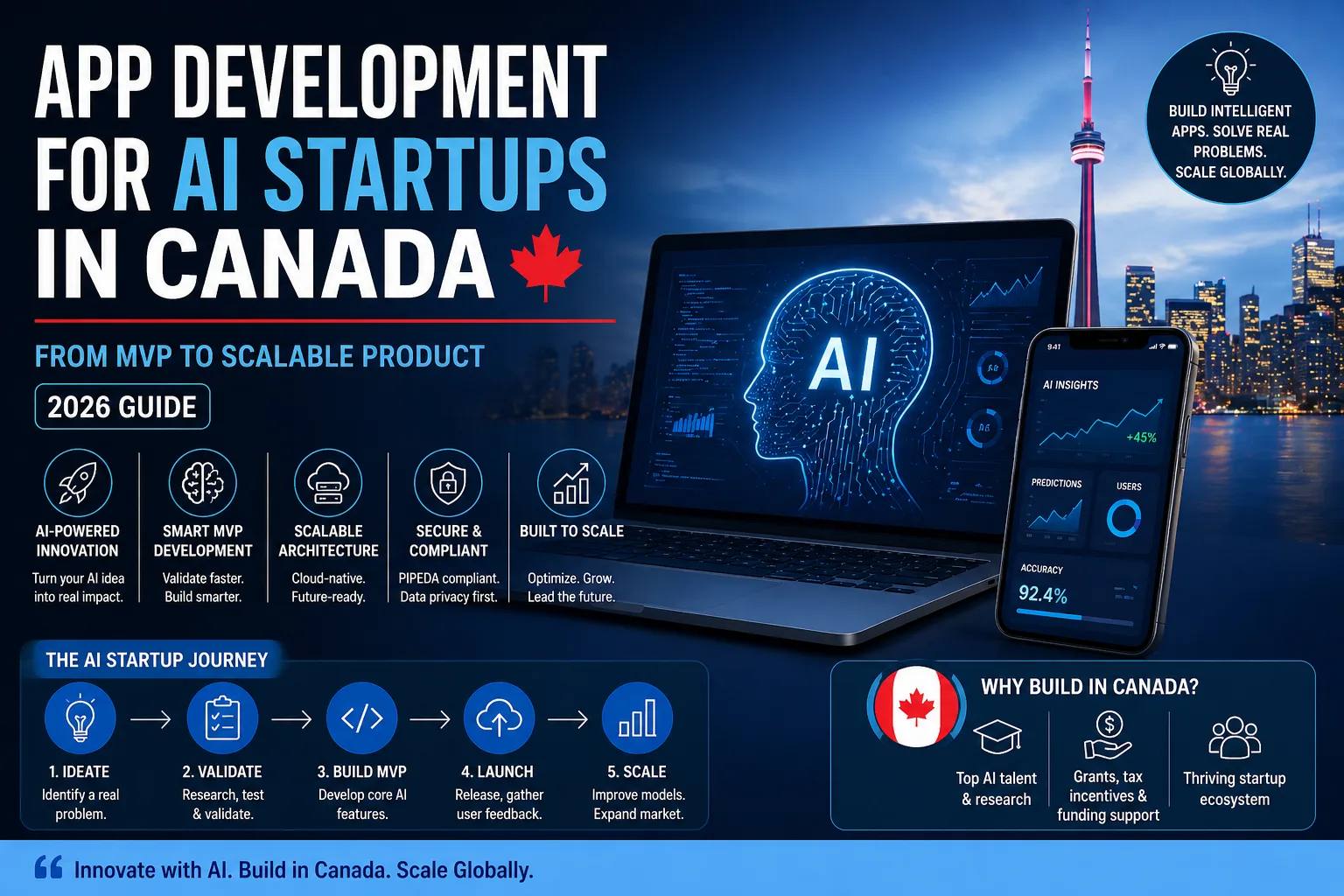
App Development for AI Startups Canada (2026 Guide)
Canada has become a global hub for artificial intelligence innovation. Cities like Toronto, Montreal, and Vancouver are home to thriving AI ecosystems, research institutions, and venture-backed startups.
But building an AI idea is one thing. Turning it into a scalable mobile or web app is another.
This guide explains how AI startups in Canada can go from MVP to full-scale product — while managing cost, compliance, and performance in 2026.
Why Canada Is a Strong Market for AI Startups
Canada offers:
- Strong AI research institutions
- Government grants and funding programs
- Access to skilled developers
- Growing venture capital support
- Supportive startup ecosystems
AI startups across healthcare, fintech, logistics, SaaS, and climate tech are rapidly scaling — but success depends on smart product development.
What Makes AI App Development Different?
AI apps are not traditional apps.
They involve:
- Machine learning models
- Large datasets
- Real-time processing
- Predictive analytics
- Ongoing training and optimization
Unlike regular mobile apps, AI products evolve over time. That’s why architecture and scalability matter from day one.
Step 1: Start With a Lean AI MVP
Most AI startups fail because they overbuild too early.
Instead, focus on:
🎯 Define One Core Use Case
Example:
- Fraud detection for fintech
- Patient risk scoring in healthcare
- Smart recommendation engine for e-commerce
🧠 Use Pre-Trained Models Initially
Instead of building models from scratch, consider:
- Open-source ML models
- API-based AI tools
- Cloud AI services
This reduces development cost and speeds up launch.
📊 Validate With Real Users
AI models improve with real-world data. Launch early, collect feedback, refine continuously.
Step 2: Choose the Right Tech Stack
AI startup apps in Canada typically use:
Backend:
- Python (for ML logic)
- Node.js (API handling)
- FastAPI or Django
Machine Learning:
- TensorFlow
- PyTorch
- Scikit-learn
Cloud Infrastructure:
- AWS
- Google Cloud
- Microsoft Azure
Frontend:
- React Native (cross-platform)
- Flutter
- Native iOS & Android
Cloud-native architecture is highly recommended for AI scalability.
Step 3: Build Scalable Infrastructure From Day One
AI apps consume more computing power than regular apps.
Key considerations:
- Cloud-based GPU support
- Microservices architecture
- API-first structure
- Secure data pipelines
- Scalable databases
Scalability ensures your AI startup can handle growth without major rebuilds.
Step 4: Data Privacy & Compliance in Canada
AI startups must comply with:
- PIPEDA (data privacy law)
- Provincial healthcare regulations (if applicable)
- Financial compliance standards (for fintech)
AI apps often process sensitive user data. Proper encryption, consent management, and secure storage are critical.
Compliance mistakes can delay funding or partnerships.
Step 5: AI Model Optimization & Monitoring
AI apps are not “set and forget.”
You must:
- Monitor model accuracy
- Detect bias
- Update training datasets
- Track performance metrics
- Improve response times
Ongoing optimization is part of the product lifecycle.
Common Challenges AI Startups Face
❌ High infrastructure costs ❌ Model accuracy issues ❌ Data scarcity ❌ Slow inference time ❌ Overcomplicated MVP ❌ Regulatory risks
Strategic planning reduces these risks significantly.
Cost of AI App Development in Canada (2026)
Costs vary depending on complexity.
Estimated ranges:
- Basic AI MVP: $40,000 – $80,000
- Mid-level AI product: $80,000 – $150,000
- Advanced scalable AI platform: $150,000+
Factors affecting cost:
- Data engineering complexity
- Model customization
- Cloud infrastructure
- Security requirements
- Compliance needs
Planning architecture correctly saves long-term costs.
Funding Options for AI Startups in Canada
AI startups may explore:
- Government innovation grants
- SR&ED tax incentives
- Angel investors
- Venture capital
- Accelerators & incubators
Strong product validation increases funding chances.
From MVP to Scalable AI Product
Here’s a practical roadmap:
Phase 1 – MVP
- Core AI feature
- Limited user base
- Basic cloud setup
Phase 2 – Optimization
- Improve model accuracy
- Enhance UI/UX
- Strengthen data pipelines
Phase 3 – Scale
- Add automation
- Improve infrastructure
- Expand features
- Enter new markets
Scaling should be data-driven, not hype-driven.
Industries Where AI Startups Thrive in Canada
- Healthcare AI
- Fintech AI
- SaaS automation tools
- Smart logistics
- EdTech platforms
- Climate & sustainability tech
AI-driven innovation is becoming central to Canada’s digital economy.
Future of AI Startup App Development in Canada (2026 & Beyond)
Expect:
- Increased AI regulation
- Stronger data governance rules
- Greater demand for explainable AI
- Growth in AI-powered SaaS platforms
- More government-backed innovation funding
AI startups that combine strong tech architecture with regulatory awareness will dominate the market.
FAQs
Is Canada good for launching an AI startup?
Yes. Canada has strong AI research institutions, funding programs, and tech ecosystems.
How long does it take to build an AI MVP?
Typically 3–6 months depending on complexity.
Should AI startups build custom ML models?
Not always. Many startups begin with pre-trained models to reduce cost and speed up launch.
Is AI app development more expensive than traditional app development?
Yes, due to data engineering, model training, and cloud infrastructure requirements.
Final Thoughts
App development for AI startups in Canada requires more than coding — it requires strategic planning, scalable architecture, compliance awareness, and long-term optimization.
Start lean, validate fast, build scalable, and prioritize data governance.
AI startups that combine innovation with structured product development will lead Canada’s digital transformation in 2026.
Categories: Uncategorized
Have a project in mind?
Let's talk about how we can build it. Free consultation, no obligation.
Get a Free Consultation