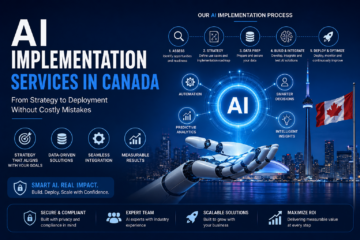
Artificial intelligence is no longer optional for mobile products. In 2026, AI integration in mobile apps in Canada is becoming a competitive necessity for startups and enterprises alike.
From chatbots and personalization engines to predictive analytics and automation, AI-powered mobile apps are transforming industries across Canada.
In this guide, you’ll learn:
- What AI integration actually means
- Key AI features businesses are implementing
- Real-world Canadian use cases
- Development costs
- How to choose the right AI strategy
What Does AI Integration in Mobile Apps Mean?
AI integration refers to embedding intelligent algorithms into mobile applications to simulate human-like decision-making, prediction, and automation.
Instead of static features, AI-powered apps:
- Learn from user behavior
- Improve over time
- Automate repetitive processes
- Deliver personalized experiences
This is achieved using:
- Machine learning models
- Natural language processing (NLP)
- Computer vision
- Predictive analytics
Why Canadian Businesses Are Investing in AI-Powered Mobile Apps
Businesses across Toronto, Vancouver, Calgary, and Montreal are leveraging AI to:
1️⃣ Improve Customer Experience
AI analyzes user behavior to personalize:
- Content recommendations
- Product suggestions
- Push notifications
- In-app journeys
2️⃣ Automate Customer Support
Chatbot integration in Canada is one of the most requested AI features.
AI chatbots:
- Provide 24/7 support
- Reduce operational costs
- Improve response time
3️⃣ Enhance Decision-Making
AI dashboards help businesses:
- Forecast demand
- Predict churn
- Optimize pricing
- Analyze user engagement
4️⃣ Increase Revenue
Personalized product recommendations and smart upselling increase conversion rates significantly.
Popular AI Features in Mobile Apps (2026)
Here are the most in-demand AI-powered mobile app features in Canada:
🤖 AI Chatbots & Virtual Assistants
- Automated support
- Booking assistance
- FAQ resolution
- Lead qualification
🧠 Personalized Recommendation Systems
Used in:
- E-commerce apps
- Streaming platforms
- EdTech apps
- Fitness apps
📊 Predictive Analytics
Helps with:
- Sales forecasting
- User churn prediction
- Inventory planning
📷 Computer Vision
- Face recognition
- Document scanning
- Object detection
- AR-based experiences
🎙️ Voice Recognition
- Voice commands
- Smart search
- Accessibility enhancement
Real Business Use Cases in Canada
🛒 Retail & E-commerce
AI suggests products based on browsing history and buying behavior.
🏥 Healthcare
AI-powered symptom checkers and appointment scheduling apps improve efficiency.
🏦 Fintech
Fraud detection algorithms analyze transaction patterns in real time.
🚚 Logistics
Route optimization using predictive AI reduces fuel and time costs.
How Much Does AI Integration in Mobile Apps Cost in Canada?
Costs vary depending on complexity.
💰 Estimated Cost Range (2026)
| AI Feature Type | Estimated Cost (CAD) |
|---|---|
| Basic chatbot integration | $8,000 – $20,000 |
| Recommendation engine | $15,000 – $40,000 |
| Predictive analytics system | $25,000 – $60,000 |
| Advanced AI app (full integration) | $50,000 – $150,000+ |
What Impacts the Cost?
- Type of AI model used
- Custom vs pre-trained AI
- Data availability & quality
- App platform (iOS, Android, cross-platform)
- Backend infrastructure
- Cloud usage (AWS, Azure, GCP)
Custom AI vs Pre-Built AI APIs
Pre-Built APIs
Examples:
- OpenAI APIs
- Google ML Kit
- Microsoft Azure AI
✔ Faster development
✔ Lower cost
✔ Good for MVP
Custom AI Models
✔ Tailored to business data
✔ Higher accuracy
✔ Better scalability
❌ Higher cost
For startups, beginning with APIs and scaling later is often the smart approach.
Challenges of AI Integration
Before implementing AI integration in mobile apps in Canada, consider:
- Data privacy compliance (PIPEDA)
- Model accuracy & training
- Infrastructure cost
- Ethical AI considerations
- Ongoing optimization needs
AI is not a one-time setup — it requires continuous monitoring.
Step-by-Step Process for AI App Integration
- Define business problem
- Identify AI use case
- Collect & structure data
- Choose AI model (API vs custom)
- Develop backend architecture
- Integrate with mobile app
- Test & optimize
- Deploy & monitor
Is AI Integration Worth It for Your App?
AI makes sense if:
✔ You need personalization
✔ You handle large data sets
✔ You want automation
✔ You aim to scale
✔ You want a competitive edge
If your app is purely informational, AI may not be necessary yet.
Future of AI in Mobile Apps in Canada (2026 & Beyond)
Expect growth in:
- Generative AI in mobile apps
- AI-powered voice commerce
- Hyper-personalized user journeys
- Edge AI (on-device processing)
- AI + AR integrations
Canada’s startup ecosystem is increasingly AI-first, and businesses that delay integration risk falling behind.
Final Thoughts
AI integration in mobile apps in Canada is no longer futuristic — it’s a strategic advantage.
Whether you’re a startup building an MVP or an enterprise modernizing operations, integrating AI features can improve efficiency, engagement, and revenue.
The key is choosing the right AI strategy based on business goals, data readiness, and budget.