

Fixed-Scope vs. Time & Materials: Which Pricing Model Fits Your SaaS Build?
Two agencies quote the same SaaS product. One says CAD $80,000, fixed. The other says $120 an hour, "probably around 650 hours." The second one looks cheaper, until you notice the word "probably" is doing a lot of work. The first looks safer, until you ask what happens when you need something that isn't in the spec.
That's the real choice behind fixed-scope and time-and-materials (T&M) pricing. It's not just about the number on the quote. It's about who carries the risk when reality turns out differently from the plan. Here's how the two models actually compare, when each one fits a SaaS build, and the hybrid that most founders end up using.
TL;DR
- Fixed scope gives you one agreed price for a clearly defined product. You get budget certainty, but changes go through a formal change process.
- Time and materials bills for the hours actually worked. You get flexibility, but you carry more of the budget risk and need to stay closely involved.
- Fixed scope only works when the scope is genuinely defined. A fixed price on a vague spec is how projects end in arguments.
- The common answer for SaaS is a hybrid: a short, fixed-fee discovery phase that produces a real specification, followed by a fixed-scope build for v1, then a more flexible arrangement for the ongoing roadmap.
What Is a Fixed-Scope (Fixed-Price) Contract?
In a fixed-scope contract, you and the development partner agree on what will be built, how you'll know it's done (acceptance criteria), when it will be delivered and what it will cost, all before the build starts. The price only changes if the scope does, and scope changes go through an agreed change process.
The model shifts delivery-cost risk to the agency. If the work takes longer than estimated, that's their problem, not yours. The catch is that this only protects you for what's written down. If the specification misses user roles, integrations, edge cases or performance requirements, those gaps come back as change requests.
What Is a Time & Materials Contract?
In a T&M contract, you pay for the time the team actually spends (hourly or daily rates), plus any third-party costs. There's no fixed final price. Work is usually organized in sprints, and you decide priorities as you go.
T&M gives you flexibility. You can change direction after user feedback without renegotiating a contract. In exchange, you carry the budget risk. If something takes twice as long as expected, you pay for twice the hours. T&M doesn't have to mean unlimited spending, but keeping it in check takes budget caps, regular reporting and someone on your side actively managing priorities.
Fixed Scope vs. Time & Materials at a Glance
| Factor | Fixed scope | Time & materials |
|---|---|---|
| Budget certainty | High: one agreed price for the defined scope | Lower: depends on hours actually worked |
| Flexibility | Lower: changes need a formal change request | High: priorities can shift sprint to sprint |
| Who carries delivery risk | Mostly the agency, for the defined scope | Mostly you, as the client |
| Up-front effort | Higher: the scope must be documented first | Lower: work can start sooner |
| Your ongoing involvement | Lighter: reviews at milestones | Heavier: weekly prioritization and budget checks |
| Biggest risk | A vague spec turning into disputes and change orders | Budget creep without strong reporting and caps |
| Best fit | A defined v1, a rebuild with a known scope, regulated components | Exploration, an evolving roadmap, ongoing improvements |
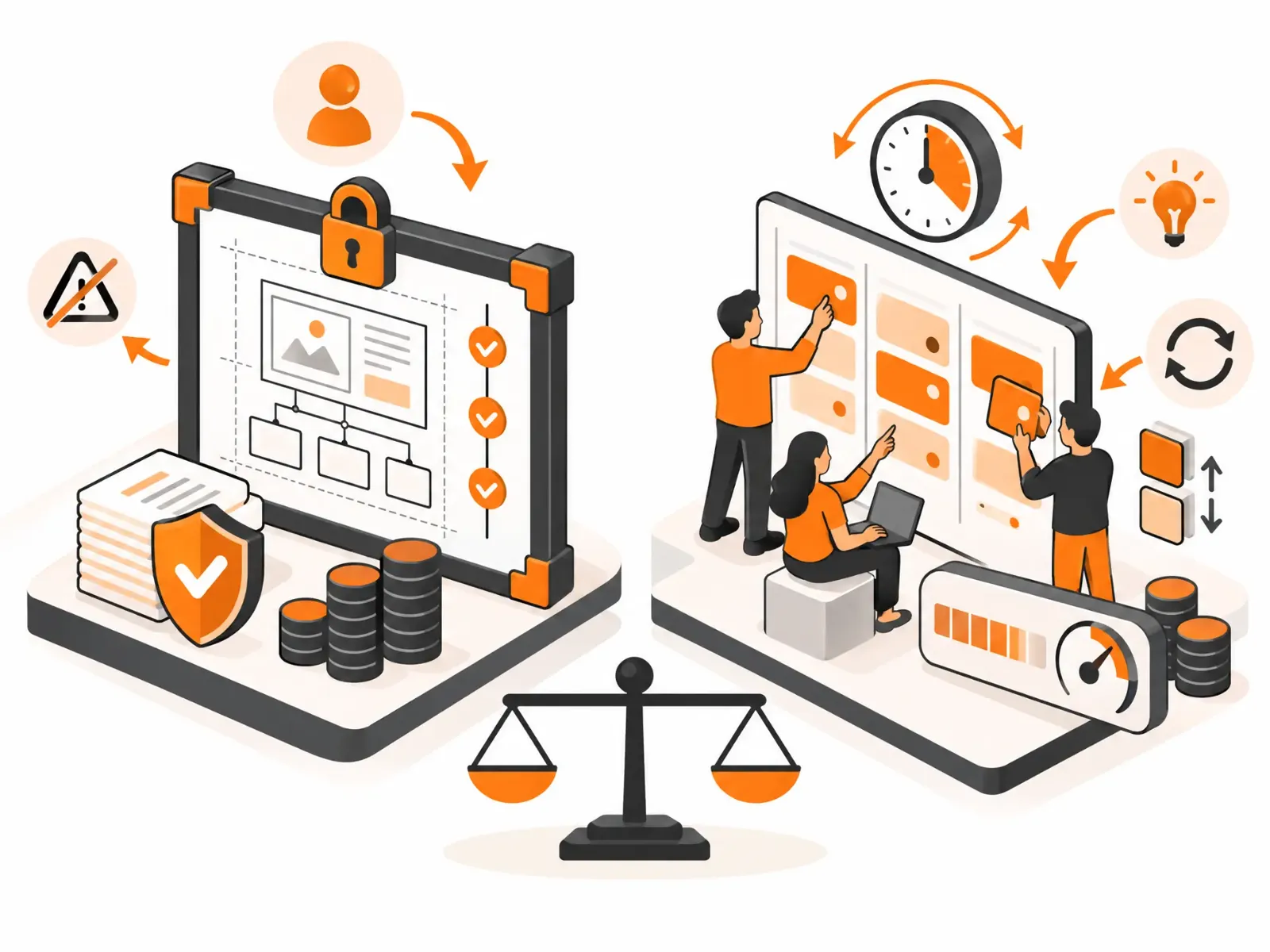
Who Really Carries the Risk?
This is the part most pricing articles skip, and it decides whether either model works for you.
- Fixed price includes a buffer. An agency taking on delivery risk prices that risk in. So a fixed quote is rarely the cheapest possible cost of the work. It's the cost plus insurance. That's fine, because you're paying for certainty, but it's worth knowing.
- An underestimated fixed bid creates pressure to cut corners. If an agency underbids to win the work, something has to give when the hours run out: testing, documentation or code quality. Clear acceptance criteria and a defined QA scope are what stop that.
- T&M rewards good management and punishes absent management. With weekly priorities, visible time tracking and a budget cap, T&M is efficient. Without them, it's an open tab.
- Either model fails on vague requirements. A fixed price on a fuzzy spec becomes a series of change orders. T&M on a fuzzy spec becomes months of expensive exploration. The fix is the same: define the product properly before committing to the full build.
When Fixed-Scope SaaS Development Works Best
- You've validated the idea and know what v1 must do, even if you don't know every detail yet.
- You're raising or spending a fixed round, and a predictable budget and launch date matter to investors.
- You're rebuilding or stabilizing an existing product, where the current app already shows what "done" looks like.
- Parts of the product are regulated (health or financial data, for example), and acceptance criteria need to be written down and testable.
For most funded founders building a first production version, fixed-scope SaaS development is the better default, as long as the scope is properly defined first. If you want to understand what "properly defined" needs to cover, our guide to what production-ready means for a SaaS product lists the areas a spec should address.
When Time & Materials Works Best
- You're still exploring whether the idea works at all. Paying hourly for a rough prototype is cheaper than writing a full specification for something that may change completely.
- The product is live and the roadmap changes month to month based on what users do.
- The work is genuinely uncertain, such as AI features whose output quality has to be tested and tuned, or integrations with poorly documented legacy systems. Our ChatGPT & LLM Integration team can help you separate the parts of an AI feature that can be scoped up front from the parts that need testing first.
- Ongoing maintenance and small enhancements, where the work arrives in small, unpredictable batches.
The Hybrid Most SaaS Founders End Up Using
Across nearly every serious guide on this topic, the same conclusion comes up: the choice isn't really binary. The common pattern for SaaS splits the work by how certain it is.

| Stage | Typical model | Why |
|---|---|---|
| Idea validation | T&M, or a cheap prototype | Too uncertain to specify; you're buying learning, not a product. |
| Discovery / blueprint | Fixed fee | The output is bounded (spec, architecture, prototype, estimate), so it's easy to price. |
| v1 build | Fixed scope, often paid by milestone | The discovery output makes a real fixed price possible. |
| Post-launch roadmap | T&M, capped T&M or a dedicated team | Priorities shift with user feedback, so flexibility is worth more than certainty. |
Two variations are worth knowing. Milestone-based fixed pricing breaks a fixed-scope build into stages, each with its own acceptance criteria and payment, so neither side commits everything at once. Capped T&M bills hourly up to an agreed ceiling per phase or month, which keeps flexibility without leaving the budget open-ended.
What a Good Fixed-Scope Contract Must Include
A fixed price is only as good as the document behind it. Before signing, check that it covers:
- Acceptance criteria. For each feature, how you'll both know it's finished and working.
- Assumptions and exclusions. What the price assumes, and what's explicitly not included.
- A change process. How new requests are estimated, approved and scheduled, and who can approve them.
- QA and testing scope. What gets tested, on which devices and browsers, and to what standard.
- Milestones and payment schedule. What you pay, and what you get at each stage.
- Code and IP ownership. That you own the code, and that the repositories and cloud accounts are in your name.
- What happens after launch. How long defects are fixed at no charge, and how ongoing work is billed.
Red Flags in Any Software Proposal
- A fixed price with only a one-page scope behind it.
- No assumptions, exclusions or change process.
- No acceptance criteria or QA scope.
- For T&M: no time tracking, reporting cadence or budget cap.
- No milestones, just one end date.
- No mention of code ownership.
- No suggestion of a discovery phase when your scope is clearly still unclear.
How We Price at App-Scoop
We'll be upfront about our bias: we use the hybrid model, because we think it's the fairest one for funded founders. Every engagement starts with a paid, fixed-fee Execution Blueprint: a risk audit of architecture, integrations, security and delivery, a clickable prototype, and a final scope, timeline and fixed price. The build is then delivered against that Blueprint in two-week sprints with working checkpoints, so the scope doesn't quietly creep, and our Zero-Defect Guarantee covers what's documented in it.
That said, fixed scope isn't right for everyone. If you haven't validated the idea yet, a cheap prototype is a better use of money than a full Blueprint, which is the balance we describe in Vibe Coding vs. Professional App Development. And if you already have an AI-built MVP, start with whether you need to start over, since the scope of a stabilization project looks quite different from a new build.
The same logic applies whether you're building a SaaS product, a web app or a mobile app. For realistic budget ranges, see SaaS product design and development in Canada and our Application Development Cost guide. And if you'd like an honest read on which model fits your project, see how we approach production-ready SaaS development or get in touch.
Frequently Asked Questions
Fixed price sets one agreed cost for a defined scope. Time and materials bills for the hours actually worked. The real difference is who carries the risk: with fixed price the agency carries delivery risk for the defined scope, and with T&M you carry the budget risk in exchange for flexibility.
Which is better for a SaaS MVP?
If the idea is validated and you can define what v1 must do, a fixed-scope build after a short discovery phase usually works best, because you get a predictable budget and launch date. If you're still testing whether anyone wants the product, a cheap prototype or a small T&M engagement is the better first step.
Is fixed price cheaper than time and materials?
Not necessarily. Fixed quotes include a buffer for the risk the agency takes on, and changes outside the scope add cost. T&M can cost less when the scope is managed well, and more when it isn't. Fixed price buys certainty, not necessarily the lowest total.
Why do agencies charge for discovery?
Because a real specification, architecture plan and prototype take senior time to produce, and that work has value on its own. A paid discovery is also what makes an honest fixed price possible. Free estimates based on a short call are usually guesses with a large buffer added.
Can a project start as time and materials and move to fixed price?
Yes, and it's common. Many teams use T&M or a fixed-fee discovery to define the product, then switch to fixed scope for the build. The reverse also happens: a fixed-scope v1, followed by T&M or capped T&M for the ongoing roadmap.
What is capped T&M?
Capped time and materials bills hourly up to an agreed maximum per phase or month. It keeps the flexibility of T&M while limiting how far the budget can run.
Can agile projects use fixed-price contracts?
Yes, if the scope is well defined or broken into fixed-scope milestones. Work can still be delivered in sprints. What's fixed is the scope and price, not the working method. If you expect major changes, a hybrid or capped T&M is easier to manage.
What happens if I need changes during a fixed-scope project?
They go through the change process: the agency estimates the new work, you approve it, and it's scheduled. That's normal and healthy. The warning sign is a contract with no change process at all, which usually leads to disputes.
How do I control the budget on a time and materials contract?
Set a cap per phase or month, require weekly time reports, agree on who approves priorities, and review progress against goals at each sprint. Without those controls, T&M budgets tend to drift.
Does fixed price mean I can be less involved?
Partly. You'll spend more time up front defining the scope and less time managing priorities week to week. But you still need to review milestones and answer questions promptly, since delays on your side can affect the timeline.
What should I check before signing a software development proposal?
A detailed scope, assumptions and exclusions, acceptance criteria, QA scope, a change process, milestones and payment terms, reporting (for T&M), and clear code and IP ownership. If several of these are missing, the proposal isn't ready to sign.
Have a project in mind?
Let's talk about how we can build it. Free consultation, no obligation.
Get a Free Consultation