
SaaS MVP Development: How to Scope, Build and Launch Your First Version
Most founders hear "build an MVP" and translate it as "build less." That's half right. A SaaS MVP should do less than your full vision, but it can't be flimsy. Real customers will log in, trust it with their data and decide each month whether it's worth paying for again. The hard part isn't building small. It's knowing which corners you can cut and which ones will cost you a rebuild six months later.
This guide covers how to scope a SaaS MVP, what to include, what you should never cut, how long it takes and what it costs in Canada, and how to know whether it actually worked.
Key takeaways
- A SaaS MVP is the smallest version of your product that real customers will use and pay for repeatedly. It has to prove recurring value, not just that the idea works once.
- Cut features freely, but not foundations. Authentication, tenant data separation, a sensible data model and basic security are expensive to retrofit, so they belong in version one.
- A focused SaaS MVP typically takes 3 to 5 months and costs roughly CAD $40,000–$85,000 in Canada. Integrations, compliance and AI features push it higher.
- Decide before launch what success looks like: activation, retention, conversion to paid. Otherwise every result will look like a reason to keep going.
What Is a SaaS MVP?
A SaaS minimum viable product is the first production version of a subscription product: lean, focused on one core workflow, and built to answer three questions. Do real users want this? Will they keep paying for it? Can the system grow from here?
It helps to separate it from the things it often gets confused with:
| Proof of concept | Prototype | MVP | Full product | |
|---|---|---|---|---|
| Purpose | Prove something can be built | Test the experience and flow | Prove people use it and pay | Grow and retain customers |
| Real users? | No | Testers only | Yes, paying or committed | Yes |
| Production-ready? | No | No | Yes, for its scope | Yes |
| Typical time | Days to weeks | 1–4 weeks | 3–5 months | Ongoing |
A one-off app can prove itself with a single successful use. SaaS can't, because the business depends on customers renewing. So a SaaS MVP has to show signs of recurring value: people come back, use the core feature repeatedly and are willing to pay again. It also has to handle things a simple app doesn't, such as several customers' data in one system and some form of subscription or billing logic.
Why Start With an MVP?
- Test willingness to pay early. Before investing in advanced modules, find out whether the core is worth a subscription.
- Sharpen the value proposition. One problem and one primary workflow force clarity that a long feature list hides.
- Reduce financial risk. You spend a fraction of the full budget before you have real evidence.
- Get to real data faster. Usage, retention and churn data replace opinions as the basis for the roadmap.
- Show investors traction. A live product with paying users is far stronger evidence than a pitch deck.
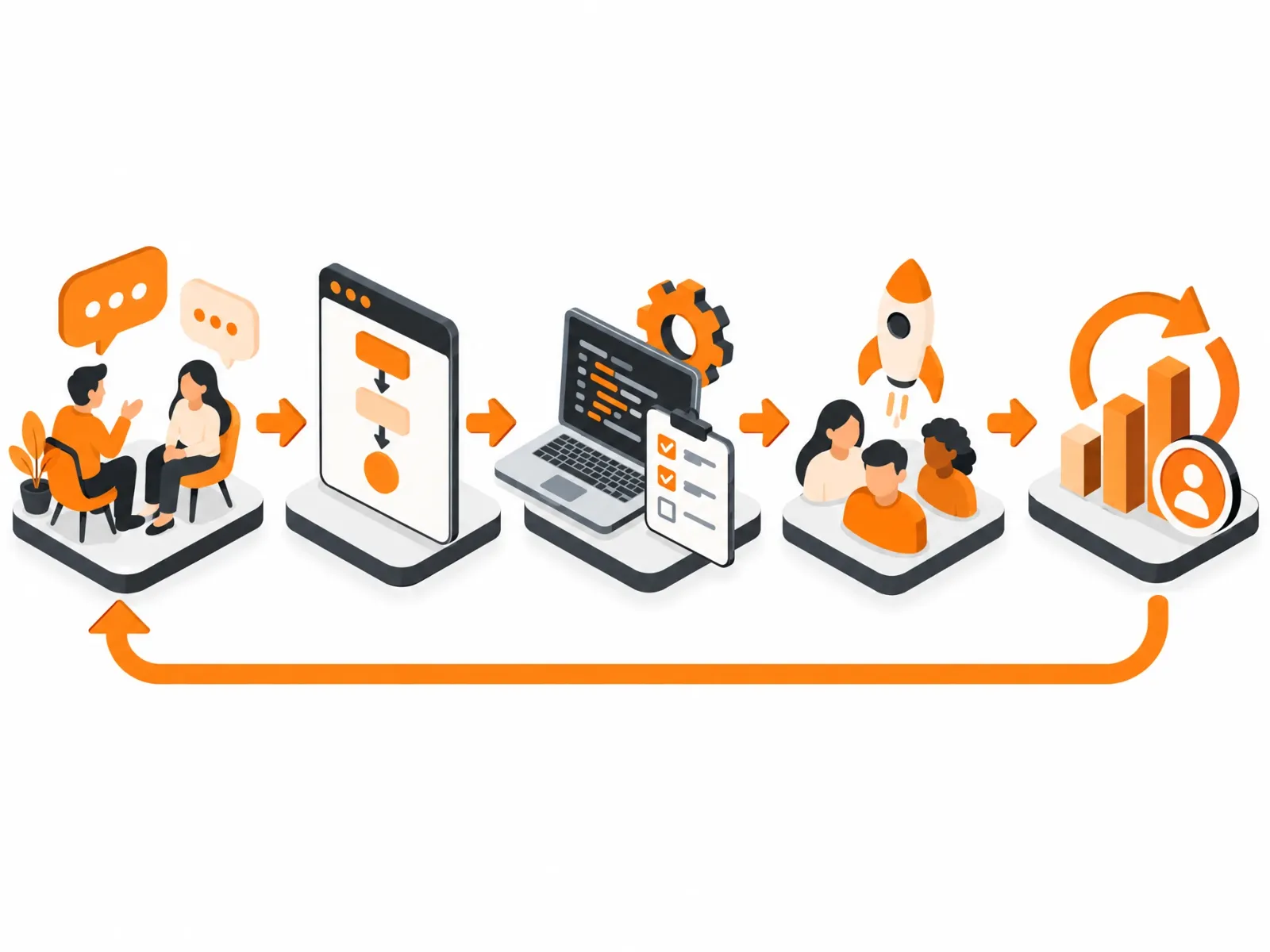
How to Build a SaaS MVP, Step by Step
Step 1: Validate the problem before the product
Talk to the people you want as customers. Ask what they do today, what it costs them, what workarounds they use and what they've already tried. Look at competitors: what they charge, what their customers complain about and where they underdeliver. If nobody is paying to solve this problem today, in money or in time, be cautious.
Step 2: Define one core workflow and your success metrics
Write down the single job your MVP must do well. For example: "A clinic manager can book, reschedule and confirm patient appointments without phone calls." Then decide what success means in numbers, such as how many trial users should complete that workflow, how many should return in week four and how many should convert to paid. Set these before launch, not after.
Step 3: Prioritize ruthlessly
List every feature idea, then sort them. MoSCoW (Must have, Should have, Could have, Won't have yet) works well for a first pass. RICE scoring (Reach, Impact, Confidence, Effort) helps when two "musts" compete for the same budget. Anything that doesn't support the core workflow waits.
Step 4: Decide your pricing model early
You don't need final prices, but you do need the model: per-seat, tiered, usage-based or freemium. Each one shapes what you build, from user management to usage metering to upgrade prompts. We compare the main models in what software as a service is.
Step 5: Prototype and test with real users
A clickable prototype lets you test the core workflow with five to ten target users before writing production code. It's the cheapest point to discover that a step is confusing or a screen is missing. If part of the product is technically risky, such as an AI feature or an unusual integration, run a small proof of concept at the same time.
Step 6: Make the architecture decisions that can't wait
Choose your tech stack, tenancy model and cloud provider deliberately. Most SaaS MVPs should be multi-tenant from day one, with each customer's data separated at the data layer. A well-structured single codebase is usually the right start; there's rarely a reason for microservices in an MVP. For more detail, see our complete guide to SaaS application development.
Step 7: Build in short, demoable sprints
Work in one- or two-week sprints that each end with something you can click through. Short cycles expose misunderstandings early, when they're cheap to fix, and keep the scope honest.
Step 8: Launch to a small group first
Start with a closed beta or a handful of design partners: early customers who agree to give feedback in exchange for early access or a discount. Fix what they find, then open sign-ups more widely.
Step 9: Measure, learn and iterate
Compare real results with the targets you set in step 2. Watch where users drop off, which features get used and which don't, and what people say when they cancel. Then decide: improve, pivot or stop.
What to Include, and What Never to Cut
This is where most SaaS MVPs go wrong. Teams either cut so deep that the foundation can't support growth, or keep so much that the MVP takes a year. A useful rule: cut features freely, protect foundations.
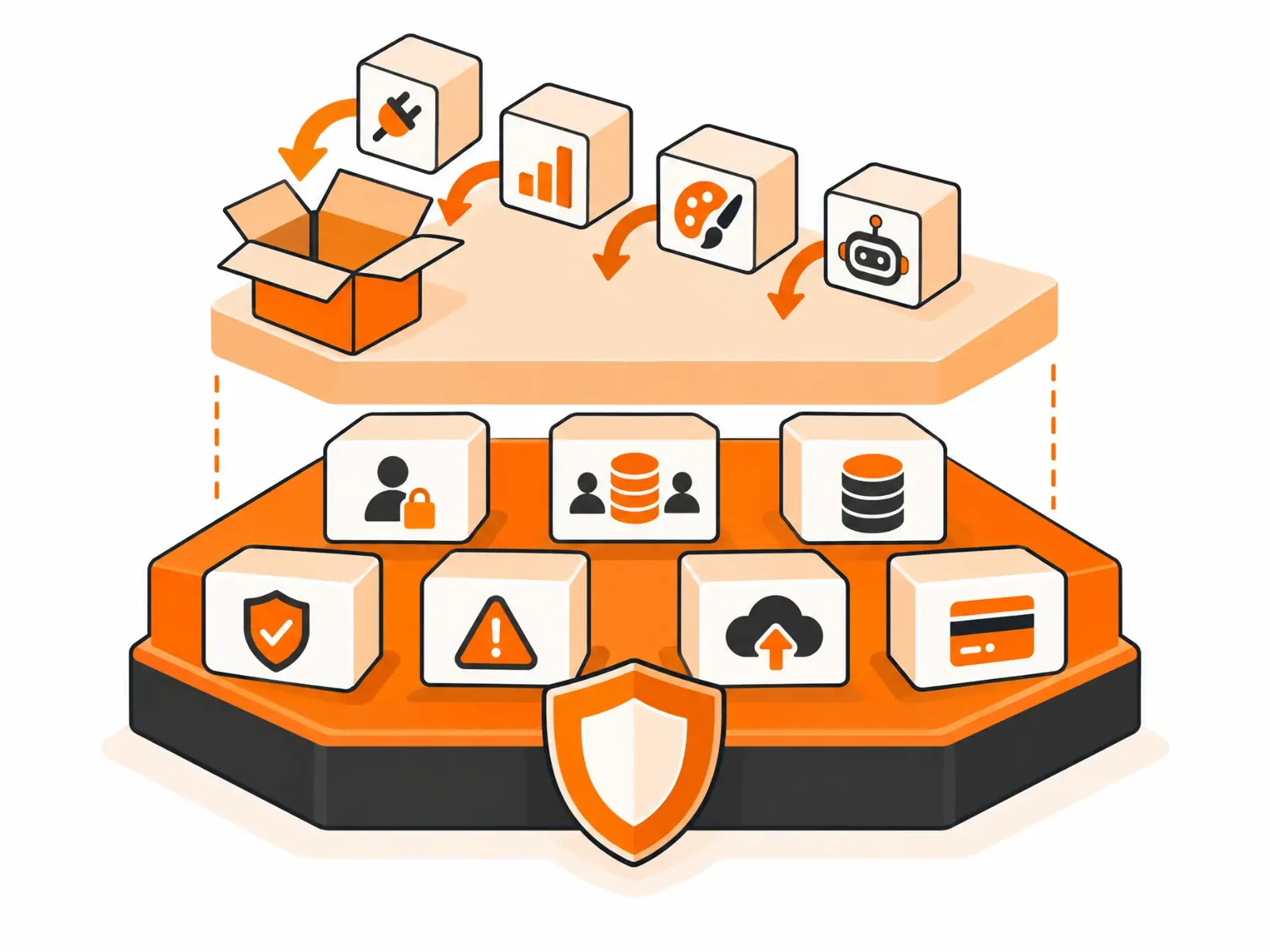
| Safe to cut or postpone | Never cut, even in an MVP |
|---|---|
| Secondary workflows and nice-to-have features | Secure authentication and password reset |
| Advanced reporting and dashboards | Tenant data separation (one customer can never see another's data) |
| Most integrations (start with the one customers can't live without) | A data model shaped around how customers actually work |
| Native mobile apps (a responsive web app often comes first) | Basic roles: at least admin and member |
| Self-serve billing (manual invoicing works for the first customers) | Error handling, logging and alerts on critical failures |
| Custom branding and themes | Automated backups you've actually tested restoring |
| AI features that don't strengthen the core workflow | Secrets kept out of the code and the browser |
Note the billing row: you can delay self-serve billing, but design the data model so subscriptions and plans can be added without a rewrite. For the full list of what "ready for real users" means, see what production-ready actually means for a SaaS product.
Choosing a Tech Stack for Your SaaS MVP
Pick proven, well-supported technology your team (or your partner) knows well. Common, sensible choices include React or Next.js on the front end, Node.js or Python on the back end, PostgreSQL for data, and a managed cloud platform. An MVP is the wrong place to experiment with unfamiliar tools. Speed comes from familiarity, not novelty. If you're comparing full-stack combinations, see MERN vs. MEAN vs. LAMP.
How Long Does It Take to Build a SaaS MVP?
For a focused SaaS MVP, plan on roughly 3 to 5 months, including discovery, design, development, testing and a beta launch. A rough split looks like this:
| Phase | Typical duration | What comes out of it |
|---|---|---|
| Discovery and validation | 2–3 weeks | Validated problem, scope, success metrics, pricing model |
| Design and prototype | 2–3 weeks | Tested clickable prototype |
| Development | 8–12 weeks | Working product in short sprints |
| Testing and beta launch | 2–3 weeks | Stable release with first real users |
Integrations with older systems, compliance requirements and AI features are the usual reasons timelines stretch.
How Much Does a SaaS MVP Cost in Canada?
| MVP scope | Typical range (CAD) | What drives the number |
|---|---|---|
| Focused MVP: one core workflow, one user type | $40,000 – $85,000 | Discovery, design, core build, testing |
| Broader MVP: several roles, integrations | $85,000 – $150,000 | Integrations, permissions, reporting |
| Regulated or AI-heavy MVP | $150,000+ | Compliance work, security reviews, AI evaluation |
These are directional ranges. The costs founders most often underestimate are discovery, security and the first months after launch, when real feedback creates real work. A fixed scope agreed before the build protects you from open-ended costs; we compare the options in fixed-scope vs. time and materials. For wider budgeting in Canada, see SaaS product design and development in Canada.
Ways to keep MVP costs down
- Validate demand with interviews and a prototype before building.
- Use proven services for payments, email and authentication instead of building your own.
- Start with a responsive web app before native mobile apps.
- Hand-handle low-volume tasks (onboarding, invoicing) for the first customers instead of automating them.
How to Know Whether Your MVP Worked
Track a small set of numbers against the targets you set before launch:
- Activation. The share of new sign-ups who complete the core workflow for the first time.
- Retention. How many active users are still using the product after one, four and twelve weeks.
- Conversion to paid. How many trial or free users become paying customers.
- Churn. How many paying customers cancel each month, and why.
- Qualitative signal. Would users be genuinely disappointed if the product disappeared? Ask them.
If the numbers miss, that's information, not failure. Look at where people drop off and why before deciding whether to fix the onboarding, narrow the audience, change the pricing or rethink the core problem.
Common SaaS MVP Mistakes
- Building before talking to customers.
- Trying to serve several audiences at once.
- Treating user accounts, data separation and security as things to add later.
- Adding AI because it's expected, not because it strengthens the core workflow.
- Launching without analytics, so there's no way to learn from real usage.
- Never deciding what success looks like, so the MVP drifts into a full build.
No-Code, AI Tools, Freelancers or an Agency?
No-code and AI coding tools are excellent for validating an idea quickly and cheaply, and often the right first step. They tend to struggle once real customers, real data and security reviews arrive; we cover that trade-off in Vibe Coding vs. Professional App Development. If you already have an AI-built prototype with users, read whether you need to start over before rebuilding anything.
Freelancers can work well for a small, well-defined MVP if you can manage the project yourself. An agency costs more per hour but brings product, design, engineering and QA together. Whichever you choose, make sure you own the code, repositories and cloud accounts from day one.
From MVP to Production-Ready Product
Once the MVP proves demand, the next phase is hardening and growth: performance work, deeper security, the integrations customers keep asking for, and features that improve retention. Teams that protected the foundations in the MVP can grow from it. Teams that didn't often have to rebuild parts of it first.
How App-Scoop Builds SaaS MVPs
We start with a paid, fixed-fee Execution Blueprint: a risk audit, a clickable prototype you can test with users, and a fixed scope, timeline and price. The build runs in two-week sprints against that Blueprint, with our Zero-Defect Guarantee covering what's documented. The typical path to production is about 120 days, depending on scope. If you're planning a SaaS MVP, see how we approach production-ready SaaS development, or get in touch.
Frequently Asked Questions
It's the process of building the first production version of a subscription software product, with only the features needed to solve one core problem well, so you can test whether customers will use it and keep paying for it.
What makes a SaaS MVP different from a regular MVP?
A SaaS MVP has to prove recurring value: that customers keep using the product and are willing to pay again, not just once. It also has to handle several customers' data safely in one system.
What features must be included in a SaaS MVP?
The core workflow that delivers value, plus the foundations: secure sign-in, tenant data separation, basic roles, error handling and monitoring, and tested backups. Most other features can wait.
How long does it take to build a SaaS MVP?
Typically 3 to 5 months for a focused MVP, including discovery, design, development, testing and a beta launch. Broader or regulated MVPs take longer.
How much does a SaaS MVP cost in Canada?
Roughly CAD $40,000–$85,000 for a focused MVP, $85,000–$150,000 for a broader one with several roles and integrations, and more for regulated or AI-heavy products.
What hidden costs do founders usually underestimate?
Discovery, security, testing, hosting and third-party services, and the first few months after launch, when user feedback turns into real development work.
What's the difference between a prototype, a proof of concept and an MVP?
A proof of concept tests whether something can be built. A prototype tests the experience with testers. An MVP is a real, production-ready product used by real customers.
Should my SaaS MVP include billing?
It should be designed for billing even if it doesn't automate it yet. Many teams invoice their first customers manually, but the data model should already support plans and subscriptions.
Should a SaaS MVP be single-tenant or multi-tenant?
Usually multi-tenant, with strict data separation between customers. It's cheaper to run and update. Single-tenant setups make sense when specific customers require full isolation.
Can I build a SaaS MVP with no-code or AI tools?
You can build a prototype or an early version, and it's a smart way to test demand. For a product that handles real customer data and payments, most teams need custom development for security, reliability and scale.
Should my MVP be a web app or a mobile app?
Most B2B SaaS MVPs start as a responsive web app, which is faster and cheaper. Build mobile first only if your users mainly work on phones or need device features such as the camera or GPS.
When is a SaaS MVP ready to launch?
When the core workflow works reliably end to end, the foundations (security, data separation, monitoring, backups) are in place, and you can measure how people use it.
What should I do after the MVP launches?
Compare results with the targets you set, talk to users, fix where they get stuck, and only then expand features. Growth work builds on what the data shows is valuable.
How do I choose a SaaS MVP development partner?
Look for shipped SaaS products you can log into, experience with multi-tenancy and billing, a clear discovery process, honest scope advice, a defined post-launch plan and written confirmation that you own the code.
Have a project in mind?
Let's talk about how we can build it. Free consultation, no obligation.
Get a Free Consultation