
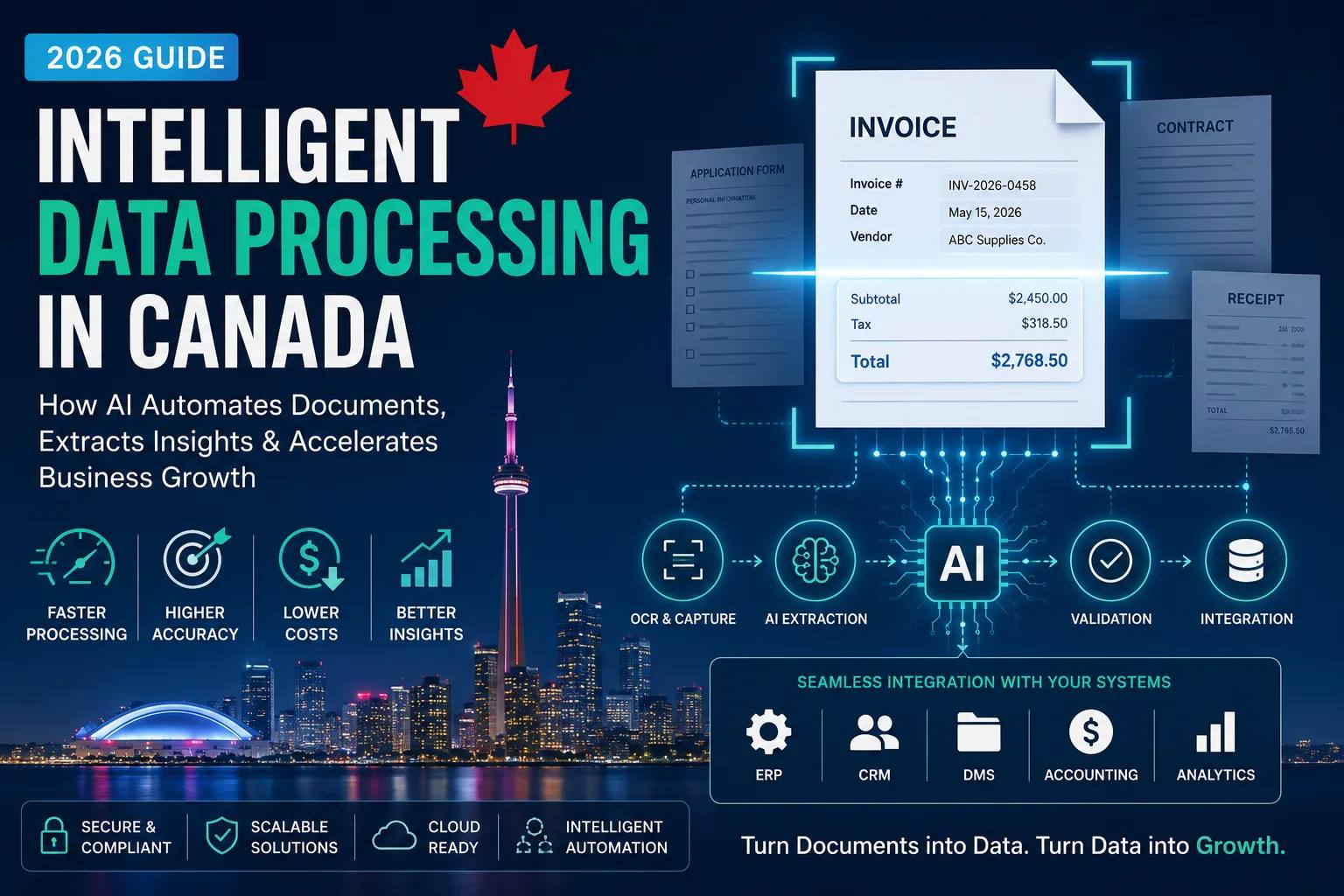
Intelligent Data Processing Canada (2026 Guide)
Businesses today generate enormous amounts of data from invoices, contracts, emails, forms, receipts, reports, customer records, and other documents. Processing this information manually is time-consuming, expensive, and prone to human error.
This is where Intelligent Data Processing (IDP) comes in. By combining Artificial Intelligence (AI), Optical Character Recognition (OCR), Machine Learning (ML), and Natural Language Processing (NLP), IDP solutions automatically extract, classify, validate, and organize information from both structured and unstructured documents.
Across Canada, organizations are adopting intelligent data processing to improve operational efficiency, reduce costs, accelerate workflows, and make better business decisions.
What Is Intelligent Data Processing?
Intelligent Data Processing is an AI-powered approach to capturing and processing information from various document types without requiring extensive manual intervention.
Unlike traditional OCR systems that simply convert images into text, modern IDP platforms can:
- Extract key information from invoices and receipts
- Read handwritten or scanned documents
- Classify documents automatically
- Validate extracted information
- Route data into business systems
- Detect inconsistencies or missing fields
- Generate insights for decision-making
The result is faster, more accurate, and scalable document management.
Why Canadian Businesses Are Investing in Intelligent Data Processing
Many organizations still rely on employees to manually review documents and enter information into ERP systems, CRMs, or spreadsheets.
Common challenges include:
- High processing costs
- Data entry errors
- Slow approval cycles
- Difficulty handling large document volumes
- Compliance risks
- Delayed reporting and analytics
By implementing intelligent automation, businesses can process thousands of documents quickly while improving accuracy and consistency.
Key Benefits of Intelligent Data Processing
1. Faster Document Processing
AI-powered systems can process invoices, applications, contracts, and forms in seconds instead of hours, significantly reducing turnaround times.
2. Reduced Manual Data Entry
Employees no longer need to copy information from one system to another, allowing them to focus on higher-value tasks.
3. Improved Accuracy
Machine learning models help minimize human errors by consistently extracting and validating data according to predefined business rules.
4. Lower Operational Costs
Automation reduces labor-intensive processes and helps organizations handle increasing document volumes without proportional staffing increases.
5. Better Compliance and Audit Readiness
Digitized records, automated validation, and standardized workflows make it easier to meet regulatory requirements and maintain audit trails.
6. Enhanced Business Intelligence
Once information is digitized and structured, organizations can analyze trends, generate reports, and make data-driven decisions more effectively.
Common Use Cases
Invoice Processing
Automatically extract supplier names, invoice numbers, due dates, taxes, and payment amounts before sending data to accounting systems.
Accounts Payable Automation
Reduce approval bottlenecks by validating invoices and routing them to appropriate stakeholders.
Contract Management
Identify clauses, renewal dates, obligations, and key terms from lengthy agreements.
Insurance Claims Processing
Extract policy information, customer details, and claim documentation to accelerate assessments.
Healthcare Documentation
Digitize patient records, referral forms, and administrative paperwork to improve operational efficiency.
Loan and Mortgage Processing
Financial institutions can automate document verification and accelerate application reviews.
Customer Onboarding
Extract information from identification documents, applications, and compliance forms while reducing manual review time.
Technologies Behind Intelligent Data Processing
Artificial Intelligence (AI)
AI enables systems to understand document structures, recognize patterns, and improve processing accuracy over time.
Optical Character Recognition (OCR)
OCR converts printed or scanned documents into machine-readable text for further analysis.
Machine Learning
Machine learning models continuously improve extraction accuracy by learning from historical examples and corrections.
Natural Language Processing (NLP)
NLP helps AI understand context, identify entities, summarize text, and interpret unstructured information.
Computer Vision
Computer vision enables systems to recognize layouts, tables, signatures, checkboxes, and handwritten content.
Industries Benefiting from Intelligent Data Processing
Organizations across Canada are adopting IDP solutions in sectors such as:
- Banking and financial services
- Healthcare
- Insurance
- Legal services
- Government
- Manufacturing
- Logistics
- Retail and e-commerce
- Human resources
- Real estate
- Education
These industries often handle large volumes of documents where automation delivers significant efficiency gains.
Integrating IDP with Existing Business Systems
Intelligent Data Processing becomes even more powerful when integrated with existing enterprise software.
Common integrations include:
- Customer Relationship Management (CRM) platforms
- Enterprise Resource Planning (ERP) systems
- Accounting software
- Document Management Systems (DMS)
- Workflow automation platforms
- Business Intelligence dashboards
- Cloud storage solutions
- Customer support platforms
These integrations ensure extracted information flows seamlessly into operational processes.
Best Practices for Successful Implementation
Start with High-Volume Processes
Identify document-heavy workflows that consume significant employee time and prioritize automation opportunities.
Ensure Data Quality
High-quality input documents improve extraction accuracy and reduce downstream errors.
Keep Humans in the Loop
For critical business decisions, incorporate review workflows where employees validate AI-generated outputs when necessary.
Prioritize Security
Implement encryption, access controls, audit logs, and compliance policies to protect sensitive business information.
Continuously Optimize Models
Monitor performance metrics and retrain AI models as document formats and business requirements evolve.
Emerging Trends in Intelligent Data Processing
The future of IDP is being shaped by innovations such as:
- Generative AI-assisted document understanding
- Multimodal AI capable of processing text and images together
- Real-time document classification
- AI-powered business process automation
- Intelligent knowledge extraction
- Predictive analytics from processed documents
- End-to-end autonomous workflow orchestration
These capabilities are enabling organizations to automate increasingly complex operations.
Why Custom Intelligent Data Processing Solutions Matter
Every business handles documents differently. Off-the-shelf automation tools may not fully support industry-specific requirements or proprietary workflows.
Custom IDP solutions allow organizations to:
- Process specialized document formats
- Integrate with internal software systems
- Apply organization-specific business rules
- Scale automation as operations grow
- Improve security and governance
- Generate customized reports and analytics
Tailored implementations ensure technology aligns with business objectives while maximizing return on investment.
Conclusion
Intelligent Data Processing is transforming how Canadian businesses manage information. By combining AI, OCR, machine learning, and automation, organizations can eliminate repetitive manual tasks, improve data accuracy, reduce costs, and accelerate decision-making.
As digital transformation continues, businesses that invest in intelligent document processing and AI-powered automation will be better positioned to scale efficiently, enhance customer experiences, and gain a competitive advantage. Whether processing invoices, contracts, claims, or customer records, IDP provides a smarter way to turn information into actionable business value.
Categories: Uncategorized
Have a project in mind?
Let's talk about how we can build it. Free consultation, no obligation.
Get a Free Consultation