
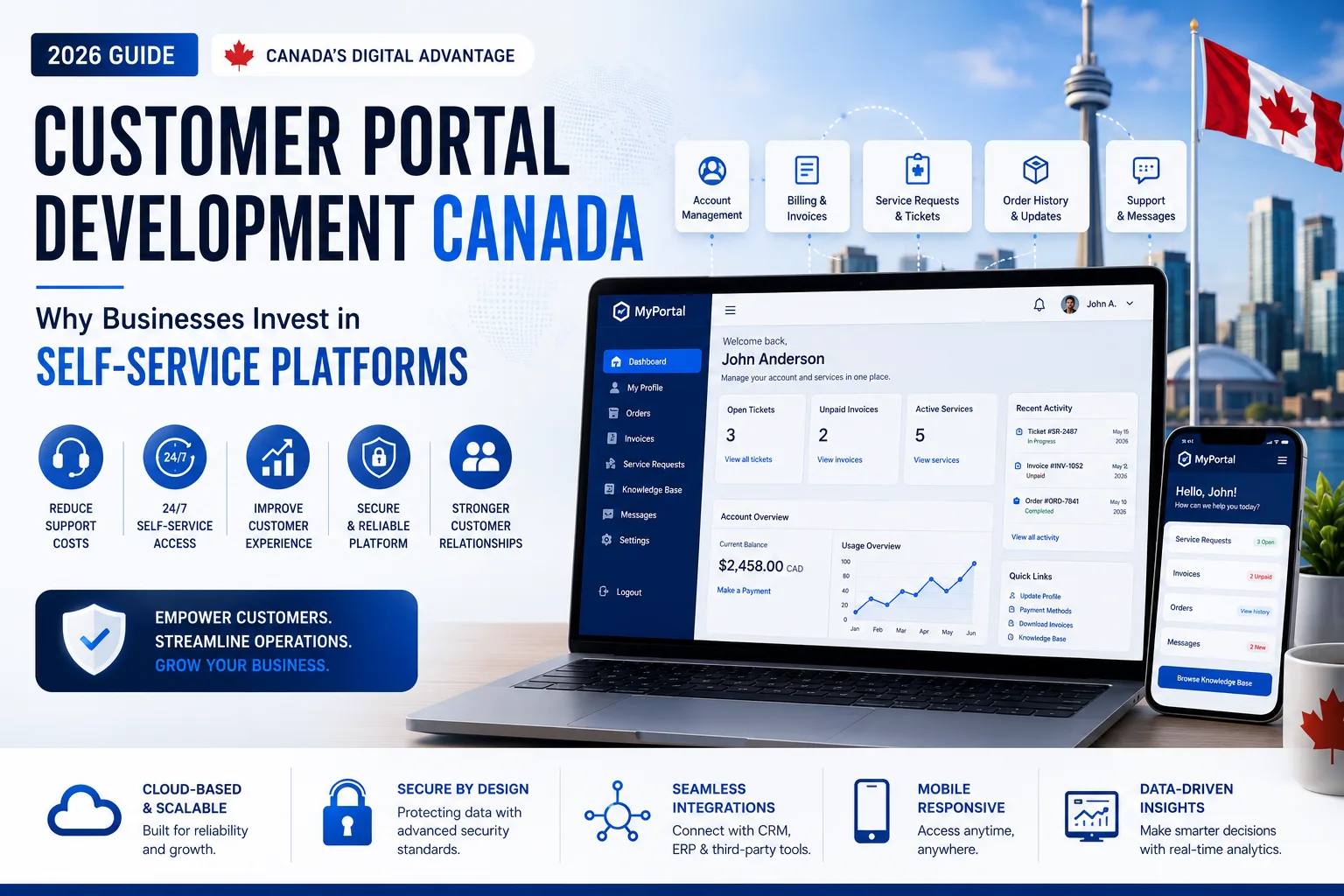
Customer Portal Development Canada
Businesses across Canada are rapidly shifting toward digital-first customer experiences. One of the biggest changes driving this shift is the rise of customer portal development, where companies build secure self-service platforms that allow customers to manage accounts, access services, and resolve issues without needing direct support.
In 2026, customer expectations are higher than ever. Users want instant access, transparency, and control. This is exactly why customer portal solutions are becoming a core part of modern digital strategy.
What is Customer Portal Development?
Customer portal development refers to building a secure web-based platform where customers can log in and independently interact with a business.
A well-designed portal typically includes:
- Account and profile management
- Service requests and ticket tracking
- Billing and invoice access
- Order history and updates
- Knowledge base or FAQs
- Secure messaging or support chat
These portals are part of modern client portal software ecosystems designed to improve efficiency and customer satisfaction.
Why Businesses in Canada Are Investing in Customer Portals
Companies in Canada are increasingly adopting self-service platforms because they solve multiple operational challenges.
1. Reduced Support Costs
Customer portals reduce dependency on support teams by allowing users to solve common issues themselves.
2. Improved Customer Experience
Customers get 24/7 access to their data and services without waiting for assistance.
3. Faster Service Delivery
Automated workflows help users get instant updates on requests, orders, and invoices.
4. Better Data Management
All customer interactions are stored in one centralized system.
5. Competitive Advantage
Businesses offering smooth digital experiences stand out in crowded markets.
Key Features of a Modern Customer Portal
A high-quality self-service portal development project usually includes:
- Secure login and authentication
- Role-based access control
- Real-time dashboards
- Payment and billing integration
- API connectivity with CRM/ERP systems
- Mobile-responsive interface
- Multi-language support
These features ensure a seamless and scalable digital experience for users.
Types of Customer Portals
Different industries in Canada use different types of portals:
1. B2B Client Portals
Used by SaaS companies, agencies, and enterprise service providers.
2. E-commerce Customer Portals
Allow customers to track orders, returns, and payments.
3. Healthcare Portals
Used for appointment booking, reports, and patient communication.
4. Financial Service Portals
Enable secure access to accounts, transactions, and documents.
Benefits of Customer Portal Development
Investing in a secure web portal delivers long-term business value:
1. 24/7 Self-Service Access
Customers don’t depend on business hours for support.
2. Scalability
Businesses can handle more customers without increasing support staff.
3. Improved Efficiency
Automated systems reduce manual workload.
4. Stronger Customer Relationships
Transparency builds trust and retention.
5. Data-Driven Insights
Businesses can analyze user behavior and improve services.
Challenges in Building Customer Portals
While powerful, portal development comes with challenges:
- Ensuring strong security and data protection
- Integrating with existing systems (CRM/ERP)
- Designing intuitive user experience
- Managing scalability for growing users
- Maintaining performance under heavy traffic
These challenges can be handled effectively with proper architecture and experienced development teams.
Best Practices for Customer Portal Development
To build a successful portal, businesses should:
- Focus on user experience first (UX/UI design)
- Implement strong security protocols
- Use cloud-based infrastructure for scalability
- Integrate with existing business systems
- Continuously improve based on user feedback
How App Development Companies Help
Professional development teams design and build scalable portals tailored to business needs.
Companies like App-Scoop Solutions specialize in:
- Custom customer portal development
- Secure web application development
- CRM and ERP integrations
- Cloud-based platform architecture
- UI/UX design for digital platforms
These solutions help businesses deliver seamless digital experiences while improving internal efficiency.
Conclusion
Customer portal development is no longer optional—it is a key part of modern digital transformation. Businesses in Canada are adopting self-service platforms to reduce operational costs, improve customer experience, and stay competitive in 2026.
A well-built portal transforms how companies interact with customers, making services faster, smarter, and more scalable.
Categories: Uncategorized
Have a project in mind?
Let's talk about how we can build it. Free consultation, no obligation.
Get a Free Consultation