
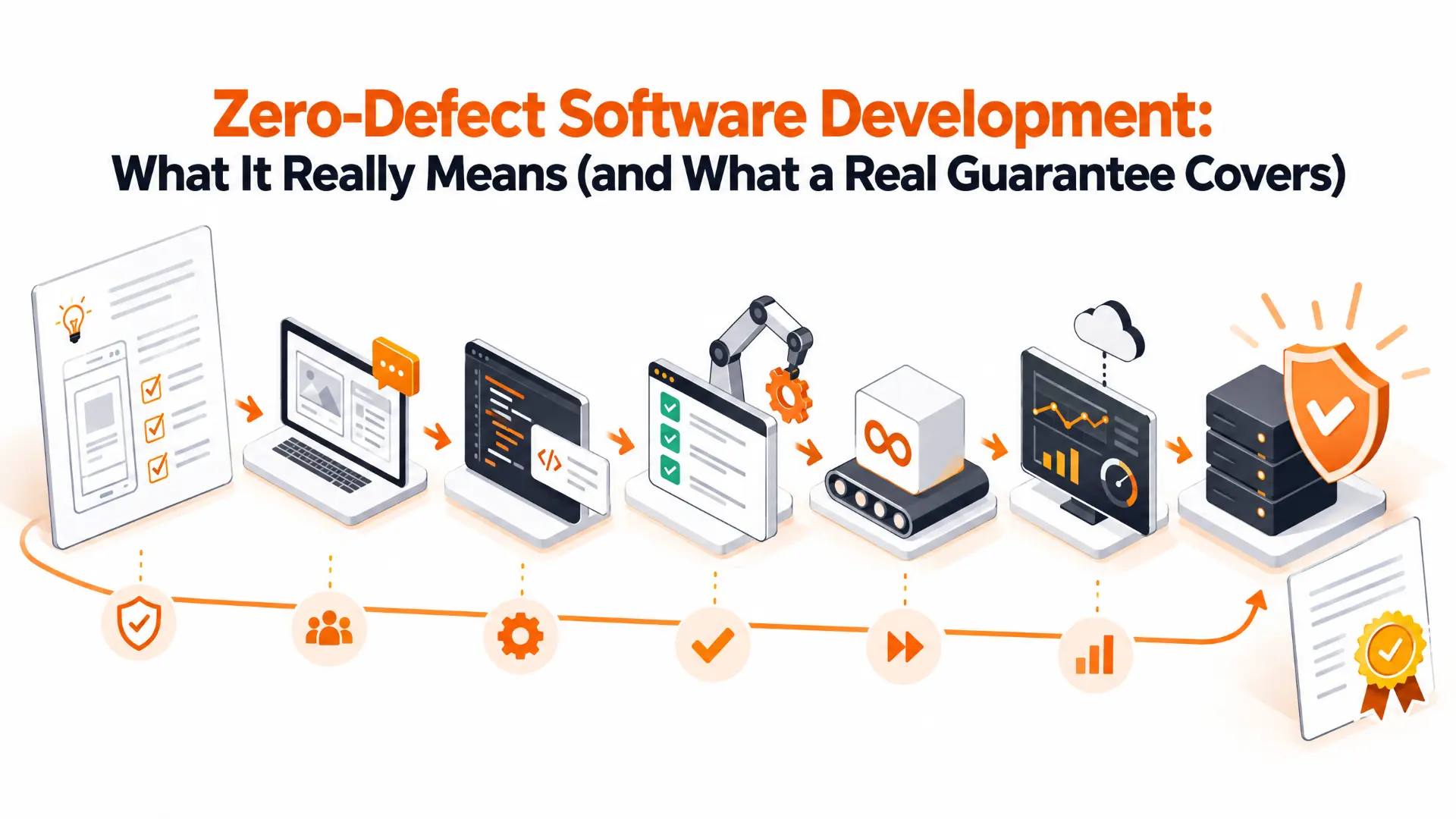
Zero-Defect Software Development: What It Really Means (and What a Real Guarantee Covers)
Every experienced engineer will tell you there's no such thing as bug-free software. So when a development company talks about "zero defects," it's fair to be sceptical. Is it a marketing slogan, or does it mean something?
It can mean something very concrete, if it's defined properly. "Zero defects" has a long history in quality management, and applied to software it describes a clear standard: the product does what was agreed, defects are treated as process failures rather than normal, and anything that doesn't work as documented gets fixed. This guide explains where the idea came from, what it can and can't promise, the practices that make it achievable, and how to judge a zero-defect guarantee before you rely on one.
Key takeaways
- Zero defects began as a quality-management standard in the early 1960s, credited to Philip Crosby at the Martin Company. Its core idea is prevention: do it right the first time instead of inspecting problems out later.
- In software, it doesn't mean "no bugs ever." It means the software conforms to documented requirements, and failures to do so are fixed, not accepted as normal.
- It depends on clear, testable requirements. You can't guarantee against a spec that was never written down.
- The practices behind it are well known: prototypes, acceptance criteria, code review, automated testing, CI/CD, monitoring and root-cause analysis.
- A credible guarantee states what's covered (documented functionality), for how long, under what conditions, and how "fixed" or "stable" is measured.
Where "Zero Defects" Comes From
The idea is credited to Philip B. Crosby, a quality manager on the Pershing missile program at the Martin Company in the early 1960s. The program set out to sharply reduce defects through prevention, and Martin reported a 54% reduction in defects in hardware under government audit during its first two years. Crosby later popularized the idea in his 1979 book Quality Is Free, which argued that preventing defects costs less than fixing them.
Crosby summarized his thinking in four "absolutes" of quality:
- Quality means conformance to requirements, not vague "goodness."
- The system of quality is prevention, not inspection after the fact.
- The performance standard is zero defects, not "close enough."
- Quality is measured by the price of nonconformance: the cost of getting it wrong.
Each of these translates surprisingly well to building software.
What Zero Defects Means in Software Today
Applied to software, zero defects is a standard and a promise, not a claim of perfection:
- The standard: every feature is defined with clear acceptance criteria, and the team works to meet them the first time through design, review and testing, rather than relying on users to find problems.
- The promise: if something doesn't work as documented, it's treated as a defect and fixed, not negotiated as a new feature or billed as extra work.
That's why the definition of "documented" matters so much. A zero-defect standard only works when the requirements are written down clearly enough to test against.
What Zero Defects Doesn't Mean
- It doesn't mean software that never has a bug. Complex systems, new devices and third-party services guarantee surprises. The difference is how the team prevents them and how quickly they're fixed.
- It doesn't mean every issue is equally urgent. Critics of zero defects point out that treating every defect the same can waste effort. In practice, defects are still prioritized by impact: a payment failure gets fixed before a typo.
- It doesn't cover new ideas. A feature you'd like to add, or a change of mind after launch, is a change request, not a defect.
Defect, Change Request or Enhancement?
| Type | What it is | Example | Who pays under a zero-defect guarantee |
|---|---|---|---|
| Defect | The software doesn't do what was documented | The documented export button produces a corrupt file | The developer fixes it at no charge |
| Change request | You want something different from what was documented | Changing the export format from CSV to Excel | Estimated and approved like any new work |
| Enhancement | A new capability that wasn't in scope | Adding scheduled automatic exports | Planned as new work |
| External issue | A problem caused outside the agreed system | A third-party API outage, or changes made by another team | Investigated, then handled case by case |
Why Preventing Defects Costs Less Than Fixing Them
The later a defect is found, the more it costs. A misunderstanding caught while reviewing a prototype takes minutes to fix. The same misunderstanding caught after launch can mean rework across the database, interface and tests, plus support tickets, lost trust and, in the worst cases, security incidents or churned customers. That's Crosby's argument in software terms: quality isn't an extra cost, because the cost of poor quality is always higher.
The Practices Behind Zero-Defect Software Development
Before code is written
- Clear, testable requirements. Every feature has acceptance criteria that say exactly how you'll know it works.
- A clickable prototype. Users and stakeholders test the flows before development, when changes are cheap.
- Architecture review. Senior engineers decide data models, security and integrations up front, where mistakes are most expensive.
While building
- Code review on every change. A second experienced engineer reviews structure, security and performance before anything merges.
- Automated testing. Unit, integration and end-to-end tests cover critical flows such as sign-up, payments and core workflows, and run on every change.
- Continuous integration and delivery. Every change is built, tested and deployed the same way, through development, staging and production.
- Static analysis and security scanning. Tools catch common mistakes and vulnerable dependencies automatically.
After launch
- Monitoring and alerting. The team knows about problems before customers report them.
- Root-cause analysis. Every defect that slips through leads to a new test, alert or process change, so the same failure can't happen twice.
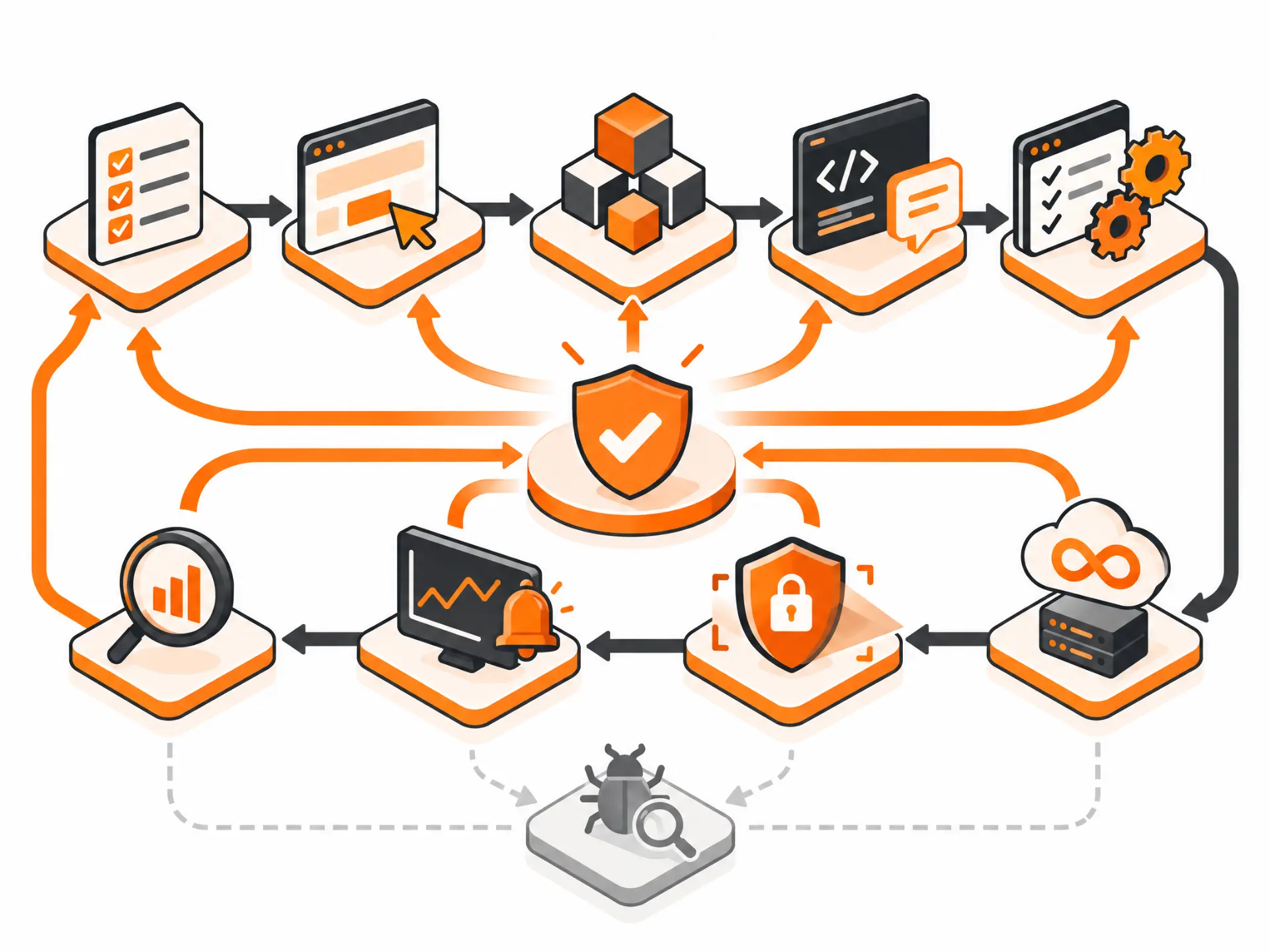
Many of these overlap with what makes software production-ready; our guide to what production-ready means for a SaaS product covers the operational side in more depth.
How to Measure Quality
- Escaped defects: issues found after release rather than before it.
- Defects by severity: how many critical, major and minor issues appear in each release.
- Time to fix: how long critical issues take to resolve.
- Automated test coverage of critical user flows (more useful than a single overall coverage percentage).
- Change failure rate: how often a release has to be rolled back or hot-fixed.
Zero Defects and AI-Generated Code
AI coding tools make writing code faster, but they don't remove the need for requirements, review and testing; if anything they increase it, because AI can produce convincing code that misses edge cases or security details. A zero-defect approach uses AI for speed while keeping senior review and automated tests in charge. If you already have an AI-built product, read whether you need to start over.
How to Judge a Zero-Defect Guarantee
Before relying on any software guarantee, ask:
- What exactly is covered? Look for "documented functionality": the features and acceptance criteria written down before the build.
- How long does it last? Many agencies offer a fixed 30- or 90-day bug-fix window. Check whether there's a time limit.
- What conditions apply? For example, that changes are made through the agreed process rather than by other teams.
- How are "fixed" and "stable" measured? There should be a written definition, not just a promise.
- What's excluded? Typically new features, changes of mind and problems caused by third-party services.
How App-Scoop's Zero-Defect Guarantee Works
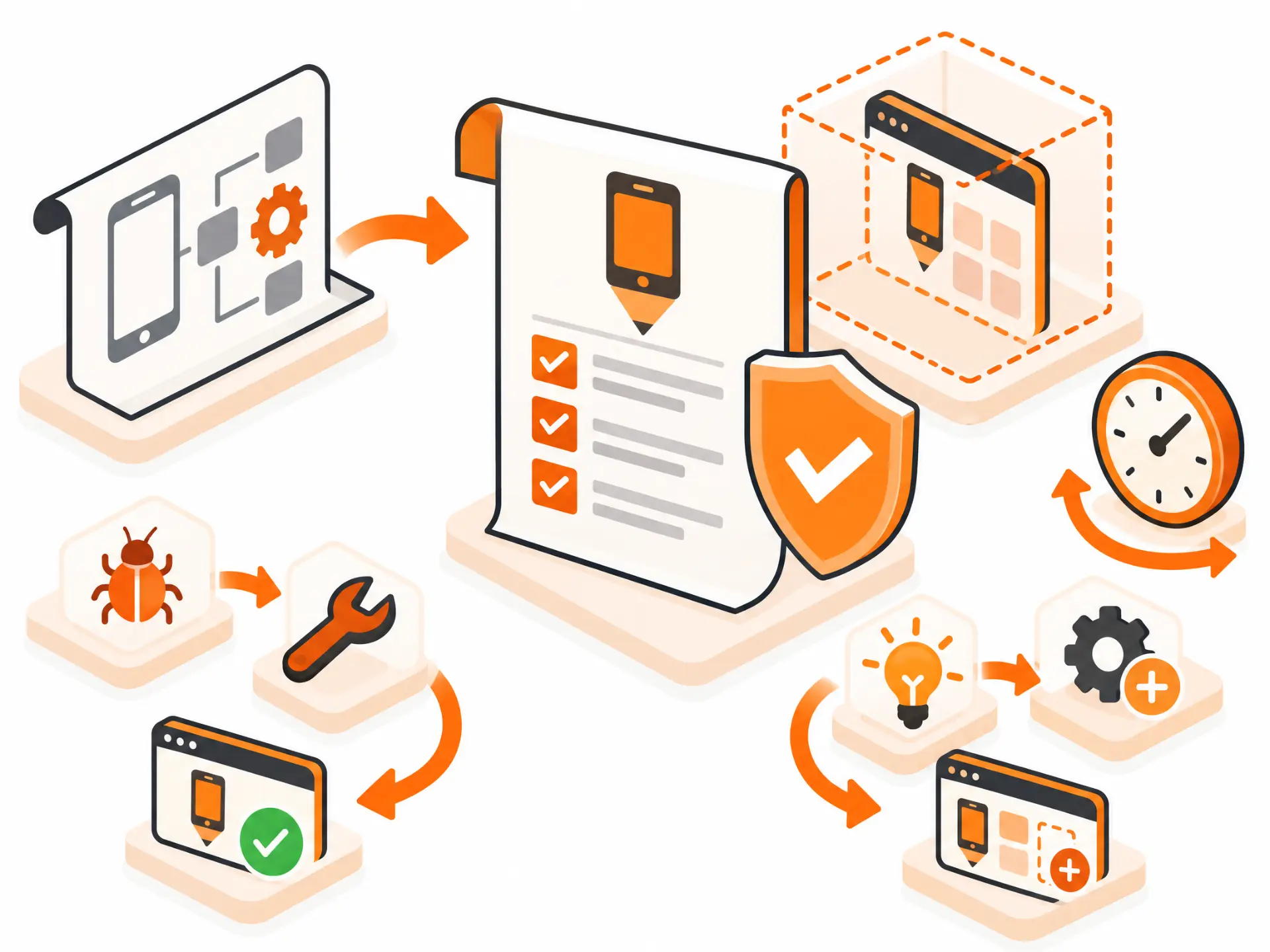
Our guarantee is simple: if it doesn't work as documented, we fix it free until it's stable. Most agencies offer a 30- or 90-day bug-fix window, then the clock runs out; ours has no countdown. It works because of what happens first: every feature is written down in your Execution Blueprint, with a clickable prototype and acceptance criteria, so there's no argument about what "done" means. The guarantee covers documented functionality when the agreed implementation process is followed, and the full terms, including how "stable" is measured, are in your Blueprint.
If you're comparing partners, our guide on how to choose a B2B SaaS development agency includes the questions to ask about guarantees and post-launch support. Or see how we approach production-ready SaaS development.
Year-End Offer: Build It Right, Starting in January
Through Cyber Monday, November 30, 2026, we're offering special year-end pricing on Execution Blueprints and SaaS or app builds booked this month, all backed by our Zero-Defect Guarantee, plus priority start dates in January.
Book a free 30-minute strategy call to see what applies to your project. Book a strategy call →
Frequently Asked Questions
See how testing and security fit into the full life cycle in What Is Software Development?.
What is zero-defect software development?
An approach where software is built to meet clearly documented requirements the first time, using prevention practices such as prototypes, code review and automated testing, and where anything that doesn't work as documented is fixed rather than accepted as normal.
Is zero-defect software actually possible?
Software that never has a bug isn't realistic. Software that reliably conforms to its documented requirements, with defects prevented early and fixed when they appear, is achievable.
Who came up with the idea of zero defects?
Philip B. Crosby, a quality manager on the Martin Company's Pershing missile program in the early 1960s. He later popularized it in his 1979 book Quality Is Free.
What's the difference between a defect and a change request?
A defect is when software doesn't do what was documented. A change request is when you want something different from what was documented. Defects are fixed under a guarantee; changes are estimated as new work.
Does a zero-defect approach slow development down?
It adds effort up front (requirements, prototypes, reviews and tests) but usually saves time overall, because fewer problems reach users and less rework is needed later.
How do you measure software quality?
Common measures include escaped defects, defects by severity, time to fix critical issues, test coverage of critical flows and change failure rate.
What does a typical software warranty cover?
Many agencies fix defects in documented functionality for a fixed period, often 30 or 90 days after launch. Always check what's covered, for how long and under what conditions.
How does App-Scoop's Zero-Defect Guarantee work?
If something doesn't work as documented, we fix it free until it's stable, with no fixed countdown. It covers documented functionality when the agreed process is followed; full terms are in your Blueprint.
Does zero defects apply to code written with AI tools?
Yes. AI can speed up coding, but the same standards apply: clear requirements, senior code review and automated tests decide whether the code is ready.
Have a project in mind?
Let's talk about how we can build it. Free consultation, no obligation.
Get a Free Consultation