
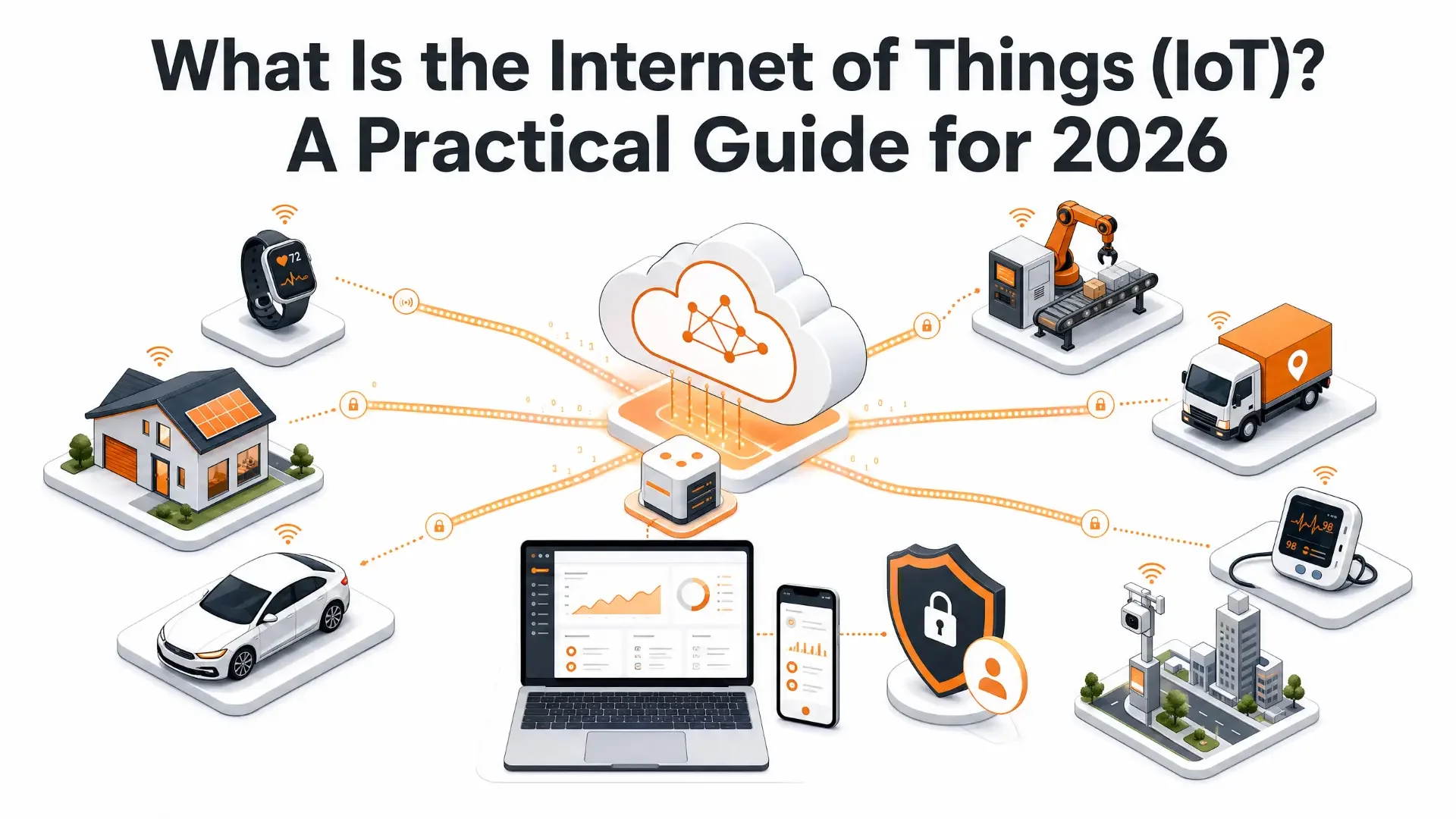
What Is the Internet of Things (IoT)? A Practical Guide for 2026
Your watch counts your steps and sends them to your phone. A delivery truck reports its location and engine temperature every few seconds. A factory machine warns its maintenance team days before a part fails. None of these feel remarkable anymore, and that's the point: the Internet of Things has quietly become part of how homes, businesses and cities run.
This guide explains what the Internet of Things is, how it works from sensor to screen, the architecture and protocols behind it, real examples across industries, why it matters for businesses, the risks to plan for, and how to approach an IoT project in a practical way.
Key takeaways
- The Internet of Things (IoT) is the network of physical devices (sensors, machines, vehicles, wearables, appliances) that collect data and exchange it over the internet, often with little or no human involvement.
- There were 21.1 billion connected IoT devices at the end of 2025, according to IoT Analytics, a figure that excludes phones, laptops and tablets. It forecasts 39 billion by 2030.
- Every IoT system has the same building blocks: devices with sensors or actuators, connectivity, a place to process data (edge or cloud), and an application people use.
- The business value comes from the data: efficiency, predictive maintenance, better decisions and new services. The biggest risks are security, privacy and integration.
- Successful IoT projects start with one clear business problem, run a pilot, and design security and data handling in from day one.
What Is the IoT?
The Internet of Things is the network of physical objects that are embedded with sensors, software and connectivity so they can collect data and exchange it with other devices and systems over the internet. A "thing" can be almost anything: a fitness tracker, a thermostat, a pallet tracker, a medical device, a wind turbine or a city's traffic light.
The idea is older than the name. In the early 1980s, students at Carnegie Mellon University connected a campus Coke machine to the network so they could check whether it was stocked and cold before walking over. The term "Internet of Things" is generally credited to Kevin Ashton, who used it in 1999 to describe linking physical objects to the internet using RFID tags. What changed since then is cost and scale: cheap sensors, low-power wireless, cloud computing and smartphones made connecting everyday objects practical.
Scale is now enormous. IoT Analytics counted 21.1 billion connected IoT devices worldwide at the end of 2025, up 14% from 18.5 billion in 2024, and forecasts 39 billion by 2030.
How Does IoT Work?
At a high level, every IoT system has three parts:
- Smart devices: objects with sensors (to measure things), sometimes actuators (to act on the world), a small processor and a way to connect.
- An IoT application: software, usually in the cloud, that receives device data, stores it, analyzes it and decides what should happen next.
- A user interface: the mobile app, web dashboard or alert that lets people see what's happening and control devices.
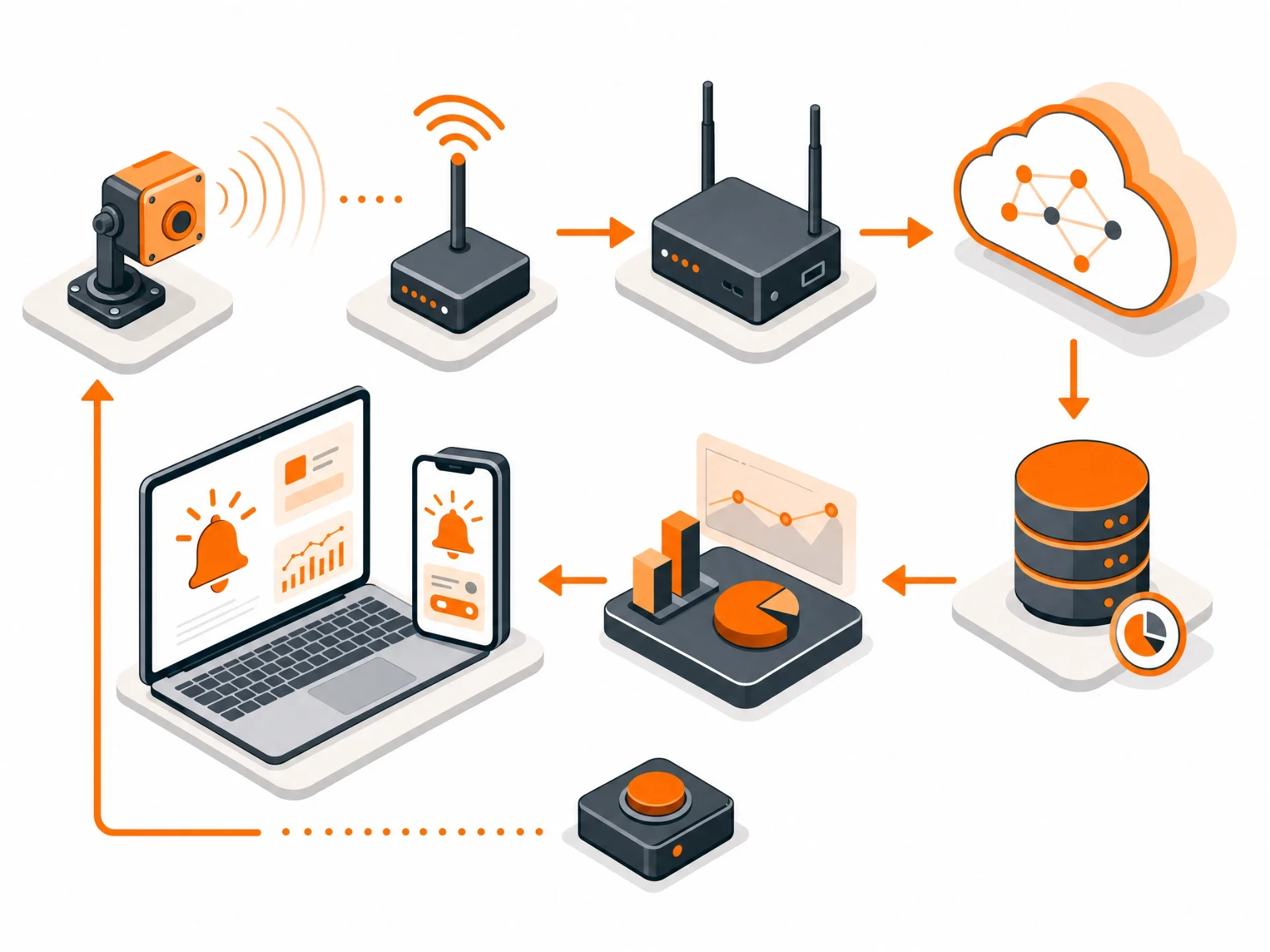
How IoT devices work, step by step
- Sense. A sensor measures something: temperature, motion, location, heart rate, vibration.
- Connect. The device sends the data over Wi-Fi, Bluetooth, cellular or another network, often through a gateway.
- Process. Data is filtered and analyzed, either on the device or a nearby gateway (edge computing) or in the cloud.
- Act. The system triggers an action: an alert, an automatic adjustment through an actuator, or an update to another system.
- Display. People see the results in a mobile app or dashboard and can respond or change settings.
Components of an IoT System
| Component | What it does | Examples |
|---|---|---|
| Devices (sensors and actuators) | Measure the physical world and act on it | Temperature sensors, GPS trackers, smart locks, wearable heart-rate monitors |
| Connectivity | Moves data between devices and systems | Wi-Fi, Bluetooth Low Energy, cellular (LTE-M, NB-IoT, 5G), LoRaWAN, Zigbee |
| Gateway | Collects data from nearby devices and forwards it securely | Industrial gateways, smart-home hubs, a smartphone acting as a gateway |
| Data processing | Stores, analyzes and acts on the data | Edge devices, cloud platforms, databases, analytics and AI models |
| Application and user interface | Lets people monitor and control the system | Mobile apps, web dashboards, alerts, reports |
| Security layer | Protects devices, data and connections throughout | Device identity, encryption, secure updates, access control |
IoT Architecture
IoT systems are often described in layers. Different sources use three, four or five; the five-layer view below is a common way to see how the pieces fit.
Layers and functions
| Layer | Function |
|---|---|
| 1. Perception (device) layer | Sensors and actuators collect data from, and act on, the physical world. |
| 2. Network (transport) layer | Moves data from devices to gateways and the cloud using wireless or wired networks. |
| 3. Processing (middleware) layer | Stores, filters and analyzes data at the edge or in the cloud, and manages devices. |
| 4. Application layer | Delivers the service people use: a smart-home app, a fleet dashboard, a patient-monitoring tool. |
| 5. Business layer | Turns data into decisions, reports, business models and value for the organization. |
Sensors and Actuators in IoT
Role of sensors in IoT
Sensors are the senses of an IoT system. They convert something physical, such as heat, movement or light, into data a computer can use. The quality, accuracy and battery life of sensors largely decide how useful an IoT system is.
Types of sensors in IoT
| Sensor type | What it measures | Typical use |
|---|---|---|
| Temperature and humidity | Heat and moisture | Cold-chain logistics, smart buildings, agriculture |
| Motion and proximity | Movement and presence | Security, occupancy, smart lighting |
| Accelerometer and gyroscope | Movement, orientation, vibration | Wearables, vehicles, machine health monitoring |
| GPS and location | Position | Fleet and asset tracking |
| Pressure | Air or fluid pressure | Industrial equipment, tire pressure, weather |
| Optical and image | Light, images | Quality inspection, smart cameras |
| Gas and air quality | Gases and particles | Safety monitoring, indoor air quality |
| Biometric | Heart rate, blood oxygen, glucose | Health wearables and remote patient monitoring |
Role of actuators in IoT systems
Actuators do the opposite of sensors: they turn a digital decision into physical action. A smart thermostat switching on the heat, a valve closing in a water system, or a lock opening when an authorized phone approaches are all actuators at work. Sensors and actuators together let an IoT system not just observe, but respond.
The Technologies That Make IoT Possible
- Low-cost sensors and chips. Cheaper, smaller and more power-efficient hardware made it affordable to connect everyday objects.
- Connectivity. Wi-Fi and Bluetooth Low Energy for short range; cellular IoT (LTE-M, NB-IoT and 5G) and LoRaWAN for wide areas; Zigbee and Thread for smart homes.
- Edge computing. Processing data on or near the device reduces delay and bandwidth, and keeps working when the connection drops.
- Cloud computing. Cloud platforms store and process huge volumes of device data and manage millions of devices at once.
- Machine learning and AI. Models find patterns in sensor data to predict failures, detect anomalies and automate decisions.
- Mobile apps. Smartphones act as both the control panel and, through Bluetooth, the gateway for many consumer devices.
IoT Communication Protocols
Protocols are the agreed rules devices use to talk to each other. They're usually grouped by layer.
| Layer | Common protocols | Why they're used |
|---|---|---|
| 1. Application layer | MQTT, CoAP, HTTP/HTTPS, AMQP | MQTT is lightweight and widely used for device messaging; CoAP suits very constrained devices; HTTPS and AMQP suit app and enterprise integration |
| 2. Transport layer | TCP, UDP | TCP for reliable delivery; UDP for low overhead where some loss is acceptable |
| 3. Network support | IPv6, 6LoWPAN, Wi-Fi, Bluetooth Low Energy, Zigbee, Thread, LoRaWAN, cellular IoT | Addressing and moving data across short-range, low-power and wide-area networks |
Examples of IoT Devices and Applications
- Connected cars: vehicles that report location, diagnostics and driving data, and receive software updates over the air.
- Connected homes: smart thermostats, lights, locks, cameras and appliances controlled from a phone or voice assistant.
- Smart cities: traffic signals, parking sensors, street lighting and air-quality monitors that help cities run more efficiently.
- Smart buildings: occupancy, energy and HVAC systems that adjust automatically to cut costs and improve comfort.
- Healthcare and wearables: fitness trackers, continuous glucose monitors and remote patient monitoring. Our Cambian Connect app, for example, syncs biometric data from consumer health devices so people can track blood pressure and heart rate.
- Agriculture: soil-moisture sensors and connected irrigation that save water and improve yields.
What Is Industrial IoT?
Industrial IoT (IIoT) applies the same ideas to industry, where the stakes are uptime, safety and cost:
- Manufacturing: machine sensors enable predictive maintenance, quality monitoring and less unplanned downtime.
- Automotive: connected production lines, plus vehicle data that improves design and service.
- Logistics and transport: real-time tracking of fleets, containers and cold-chain conditions.
- Retail: smart shelves, inventory tracking and in-store analytics.
- Energy and mining: remote monitoring of equipment in hard-to-reach places, where every hour of downtime is expensive.
Why Is IoT Important?
Improved efficiency
Automating monitoring and routine adjustments frees people from manual checks and keeps processes running smoothly.
Data-driven decision-making
Continuous, real-world data replaces guesswork and periodic sampling, so decisions rest on what's actually happening.
Cost savings
Predictive maintenance, lower energy use and less waste reduce operating costs, often enough to pay for the system.
Enhanced customer experience
Connected products can personalize service, fix problems before customers notice and offer features competitors can't.
Faster innovation and new business models
Device data opens new services, such as usage-based pricing, remote monitoring subscriptions and product-as-a-service models.
Turning data into action with AI
Machine learning turns large volumes of sensor data into predictions and automated actions. Our AI workflow automation and intelligent data processing work often starts from exactly this kind of data.
How IoT Improves Everyday Life
For individuals, IoT shows up as convenience, safety and health: homes that adjust heating automatically, cars that warn of maintenance needs, wearables that flag an irregular heart rhythm, and city transit apps that show exactly when the next bus arrives.
Advantages and Disadvantages of IoT
| Advantages | Disadvantages |
|---|---|
| Real-time visibility into assets, people and processes | Security vulnerabilities in poorly protected devices |
| Automation that saves time and reduces errors | Privacy concerns around personal and location data |
| Predictive maintenance and lower operating costs | Interoperability problems between vendors and standards |
| Better decisions based on continuous data | Upfront costs for hardware, connectivity and integration |
| New products, services and revenue models | Complexity of managing devices, updates and data at scale |
Risks and Challenges in IoT
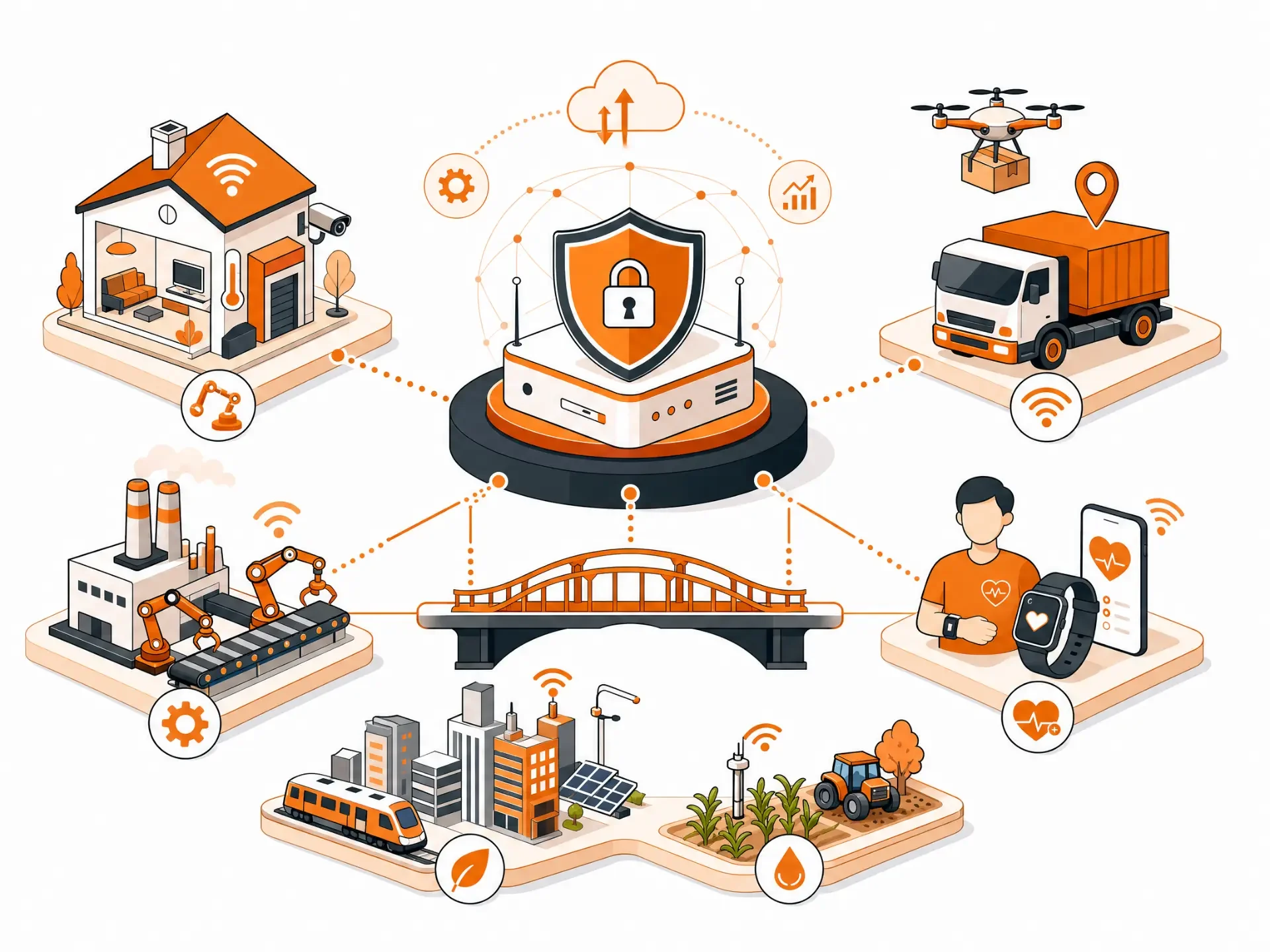
- Security. Every connected device is a potential entry point. Default passwords, unpatched firmware and unencrypted traffic are common weaknesses. Rules are tightening: the UK's product security law bans universal default passwords on consumer connected devices, the EU's Cyber Resilience Act is phasing in security requirements for connected products, and the US has launched the voluntary Cyber Trust Mark labelling program.
- Privacy. IoT devices can collect sensitive data, from health readings to location history. In Canada, PIPEDA and provincial privacy laws apply; in Europe, the GDPR.
- Interoperability. Devices from different vendors don't always work together, although standards such as Matter are improving this in smart homes.
- Data volume and integration. Huge streams of data are only valuable if they connect to the systems people already use.
- Power and maintenance. Battery life, firmware updates and replacing devices in the field are ongoing costs.
This is general information, not legal advice.
How Should Businesses Approach IoT?
- Start with one business problem. For example, reducing equipment downtime or tracking cold-chain shipments, not "doing IoT."
- Run a focused pilot. A small number of devices, one site and clear success metrics.
- Choose connectivity and hardware to fit the environment. Range, battery life, data volume and cost decide whether Wi-Fi, Bluetooth, cellular or LoRaWAN makes sense.
- Use proven cloud services. Managed IoT services such as AWS IoT Core handle device connections and security at scale, so you don't build that layer yourself.
- Design security and privacy in from day one. Unique device identities, encryption, secure updates and least-privilege access.
- Plan the software people will actually use. The mobile app and dashboard are where IoT delivers value; see our mobile app development, custom dashboard and API & system integration services.
- Scale in stages. Expand only after the pilot proves the value, and budget for maintenance and updates.
IoT Jobs and Skills
IoT projects bring together several specialties: embedded and firmware engineers who program devices, mobile and web developers who build the apps people use, cloud and data engineers who handle the data pipeline, data scientists who build predictive models, and security specialists who protect the whole system. For businesses, that mix is a big reason IoT projects often work best with a partner who covers the software side end to end.
The Future of IoT
- AI at the edge: more intelligence running directly on devices for faster, more private decisions.
- Better cellular IoT: 5G and lower-power cellular options connecting more devices over wider areas.
- Common standards: Matter in smart homes, and more open standards in industry, making devices work together.
- Digital twins: virtual models of machines, buildings and cities kept up to date by live sensor data.
- Satellite connectivity: IoT devices in remote locations connecting directly to satellites.
- Security by regulation: minimum security requirements becoming law in more markets.
With IoT Analytics forecasting more than 50 billion connected devices by 2035, the question for most businesses is less whether to use IoT than where it creates the most value.
How App-Scoop Builds IoT Software
We build the software side of IoT: companion mobile apps for iOS and Android, web dashboards, secure cloud backends, data pipelines and integrations with the systems you already use. Our work includes Cambian Connect, which syncs data from consumer health devices, and the Becker Mining app, built with IoT capabilities for a global industrial customer. Every project starts with a fixed-fee Blueprint that defines scope, architecture and a fixed price. See our mobile app development and web application services, or book a strategy call.
Frequently Asked Questions
Explore embedded software, team roles and the development life cycle in What Is Software Development?.
Learn how connected-device alerts reach users in our push notification guide.
What is IoT in simple terms?
The Internet of Things is everyday physical objects, such as watches, thermostats, cars and machines, that have sensors and an internet connection so they can collect data and share it with apps and other systems.
What are some examples of IoT devices?
Fitness trackers and smartwatches, smart thermostats and locks, connected cars, fleet GPS trackers, industrial machine sensors, smart meters and remote patient-monitoring devices.
How does IoT work?
Sensors collect data, the device sends it over a network (often through a gateway), software at the edge or in the cloud analyzes it, and the system triggers actions or shows results in an app or dashboard.
What are the layers of IoT architecture?
A common five-layer model is perception (devices), network, processing (middleware), application and business. Simpler models combine these into three or four layers.
What's the difference between IoT and Industrial IoT?
IoT covers all connected devices, including consumer products. Industrial IoT focuses on industry (manufacturing, energy, logistics, mining), where reliability, safety and uptime are the priorities.
What's the difference between sensors and actuators?
Sensors measure the physical world and turn it into data. Actuators take a digital decision and turn it into physical action, such as opening a valve or switching on a heater.
Which protocols does IoT use?
Common ones include MQTT and CoAP for device messaging, HTTPS for apps, TCP and UDP for transport, and Wi-Fi, Bluetooth Low Energy, Zigbee, Thread, LoRaWAN and cellular IoT for connectivity.
How many IoT devices are there?
IoT Analytics counted 21.1 billion connected IoT devices at the end of 2025 and forecasts 39 billion by 2030. Its count excludes phones, laptops and tablets.
Is a smartphone an IoT device?
Usually not counted as one. Industry counts such as IoT Analytics' exclude smartphones, but phones often act as the app and the gateway that IoT devices connect through.
Is IoT secure?
It can be, but security has to be designed in: unique device credentials, encryption, secure firmware updates and access control. Poorly secured devices are a common target for attacks.
What is edge computing in IoT?
Processing data on or near the device instead of sending everything to the cloud. It reduces delay and bandwidth, and keeps systems working during connection problems.
How much does it cost to build an IoT app?
It depends on the devices, integrations and compliance needs. The software side, such as a companion app and dashboard, typically starts around CAD $45,000–$85,000 for a standard build, with regulated or complex systems costing more. Hardware is a separate cost.
Have a project in mind?
Let's talk about how we can build it. Free consultation, no obligation.
Get a Free Consultation