
Mobile App Backend Development Canada | Scalable Cloud Apps
Modern mobile apps are no longer just about design and user experience—the real power lies in the backend architecture that drives performance, scalability, and reliability.
In Canada, where businesses are rapidly adopting digital transformation, mobile app backend development has become a critical part of building successful applications that can handle millions of users securely and efficiently.
What is Mobile App Backend Development?
Mobile app backend development refers to the server-side systems that power mobile applications. It includes everything that happens behind the scenes, such as:
- Data storage and management
- User authentication
- Business logic processing
- API development
- Cloud infrastructure handling
The backend ensures that the mobile app works smoothly, even under heavy usage.
Why Backend Development is Crucial for Mobile Apps
Without a strong backend, even the best-designed mobile app will fail.
Key reasons it matters:
- Ensures fast app performance
- Handles large-scale user traffic
- Protects sensitive user data
- Enables real-time features (chat, notifications, tracking)
- Supports cross-platform functionality (iOS & Android)
In short, the backend is the engine of your mobile application.
Common Backend Architecture for Mobile Apps
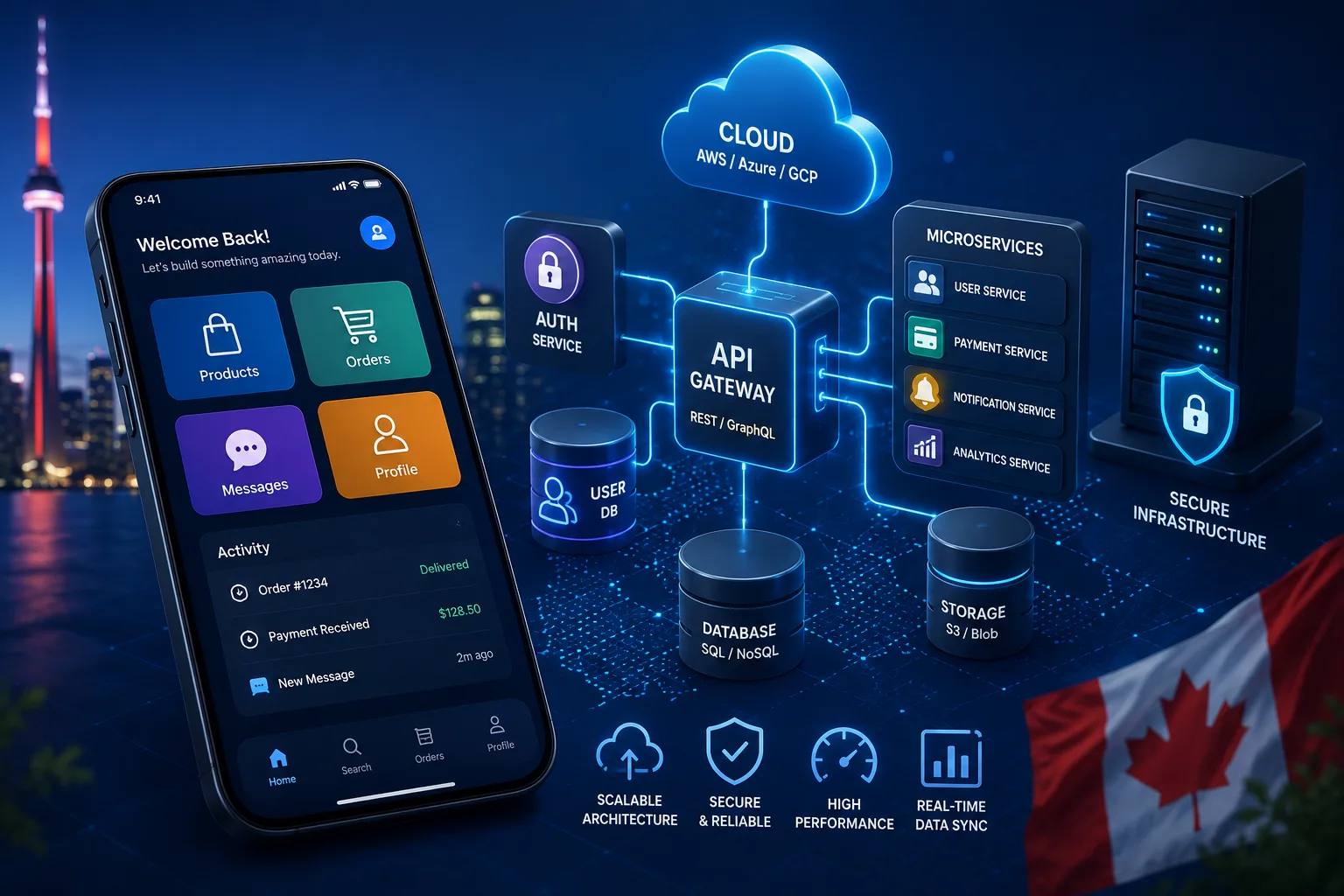
A modern mobile backend typically follows a scalable cloud-based architecture.
1. Client-Server Model
The mobile app (client) communicates with backend servers through APIs.
2. API Layer
APIs act as the bridge between frontend and backend:
- REST APIs (most common)
- GraphQL APIs (flexible data fetching)
3. Database Layer
Stores all application data:
- SQL databases (MySQL, PostgreSQL)
- NoSQL databases (MongoDB, DynamoDB)
4. Cloud Infrastructure
Backend services are hosted on cloud platforms like:
- AWS
- Microsoft Azure
- Google Cloud Platform
5. Microservices Architecture (Advanced)
Instead of one large backend, apps are split into small services like:
- Authentication service
- Payment service
- Notification service
Key Technologies Used in Mobile App Backend Development
Backend development in Canada typically uses modern, scalable tech stacks:
Programming Languages:
- Node.js
- Python (Django / FastAPI)
- Java (Spring Boot)
- Go (for high-performance systems)
Backend Frameworks:
- Express.js
- NestJS
- Django
- Spring Boot
DevOps Tools:
- Docker
- Kubernetes
- CI/CD pipelines (GitHub Actions, Jenkins)
Cloud Backend vs Traditional Backend
Cloud Backend (Modern Approach)
- Auto-scaling
- Pay-as-you-use pricing
- High availability
- Easy integration with APIs
Traditional On-Premise Backend
- Full control over infrastructure
- Higher maintenance cost
- Limited scalability
Today, most Canadian companies prefer cloud-based backend systems due to flexibility and cost efficiency.
Security Best Practices in Backend Development
Security is a top priority, especially for apps handling sensitive data.
Key practices include:
- JWT-based authentication
- OAuth 2.0 login systems
- Data encryption (in transit & at rest)
- Rate limiting APIs
- Secure cloud configuration
- Regular vulnerability testing
Canada’s data protection regulations also require strong compliance mechanisms for handling user data.
Challenges in Mobile App Backend Development
Despite advancements, backend development still comes with challenges:
1. Scalability Issues
Handling sudden traffic spikes can crash poorly designed systems.
2. Latency Problems
Slow API responses affect user experience.
3. Data Management Complexity
Large-scale apps deal with massive and complex datasets.
4. Security Risks
APIs are common targets for cyberattacks.
5. Maintenance Overhead
Continuous updates and monitoring are required.
Benefits of Strong Backend Architecture
A well-built backend provides:
- Faster application performance
- Better user experience
- Easy scalability for future growth
- Reduced downtime
- Strong data security
This is why companies invest heavily in backend engineering teams.
Use Cases in Canada
E-Commerce Apps
- Order processing systems
- Inventory management
- Payment gateways
Healthcare Apps
- Patient data storage
- Appointment scheduling
- Telemedicine systems
Fintech Apps
- Secure transactions
- Fraud detection systems
- Real-time analytics
SaaS Platforms
- Multi-user dashboards
- Subscription management
- Cloud-based services
Future of Mobile Backend Development in Canada (2026 and Beyond)
The future is moving toward:
1. Serverless Architectures
Developers focus only on code while cloud providers manage infrastructure.
2. AI-Powered Backends
Smart automation for:
- Data processing
- Predictive analytics
- User personalization
3. Edge Computing
Faster processing by moving computation closer to users.
4. Real-Time APIs
Instant updates for chat, gaming, and live tracking apps.
Conclusion
Mobile app backend development in Canada is evolving rapidly with cloud computing, microservices, and AI-driven systems. A strong backend is no longer optional—it is the foundation of every scalable and successful mobile application.
Businesses that invest in secure, scalable, and high-performance backend architecture today will lead the digital future tomorrow.
Categories: Uncategorized
Have a project in mind?
Let's talk about how we can build it. Free consultation, no obligation.
Get a Free Consultation