
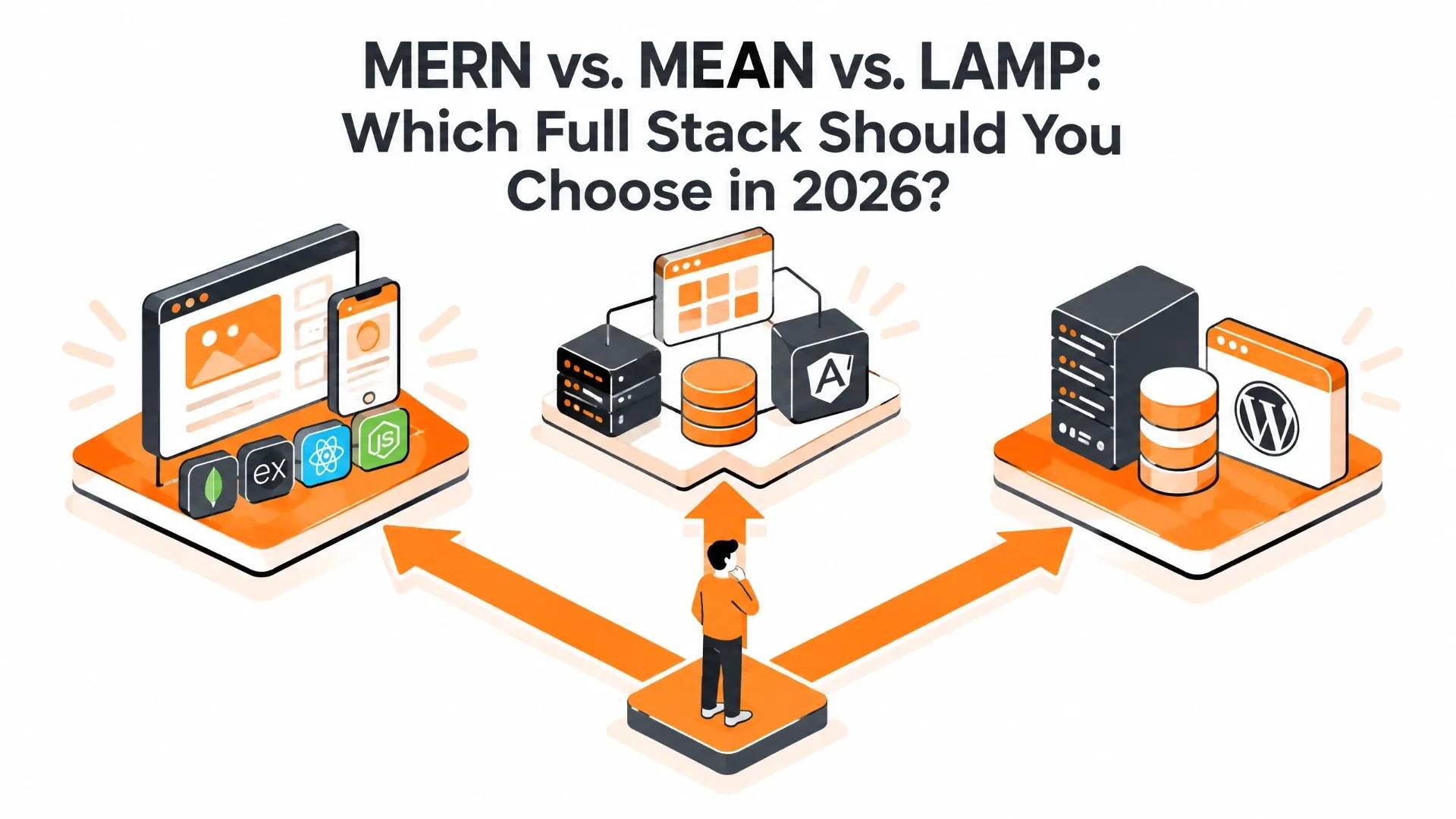
MERN vs. MEAN vs. LAMP: Which Full Stack Should You Choose in 2026?
Ask three developers which stack is “best” and you'll get three confident, contradictory answers. That's because the question itself is slightly off. There isn't a best stack—there's a stack that fits your project, your team, and your timeline, and one that doesn't. Getting this decision wrong early tends to show up later as a slower app, a harder hiring search, or a rebuild nobody budgeted for.
Here's an honest look at the three stacks that come up most often in this conversation: MERN, MEAN, and LAMP. Real trade-offs, not a sales pitch for any one of them.
TL;DR
- MERN (MongoDB, Express, React, Node.js) is the strongest default for consumer-facing apps that need a polished, interactive interface—social apps, marketplaces, and dashboards.
- MEAN (MongoDB, Express, Angular, Node.js) trades some of React's flexibility for Angular's built-in structure—a common pick for large enterprise applications with big teams and strict conventions.
- LAMP (Linux, Apache, MySQL, PHP) is the oldest of the three and is still genuinely the right call for content-heavy sites, many e-commerce platforms, and anything that fits an existing CMS like WordPress.
- The deciding factors are rarely purely technical. Talent availability, how relational your data actually is, and how long the application needs to last matter as much as raw performance benchmarks.
What Each Stack Actually Is
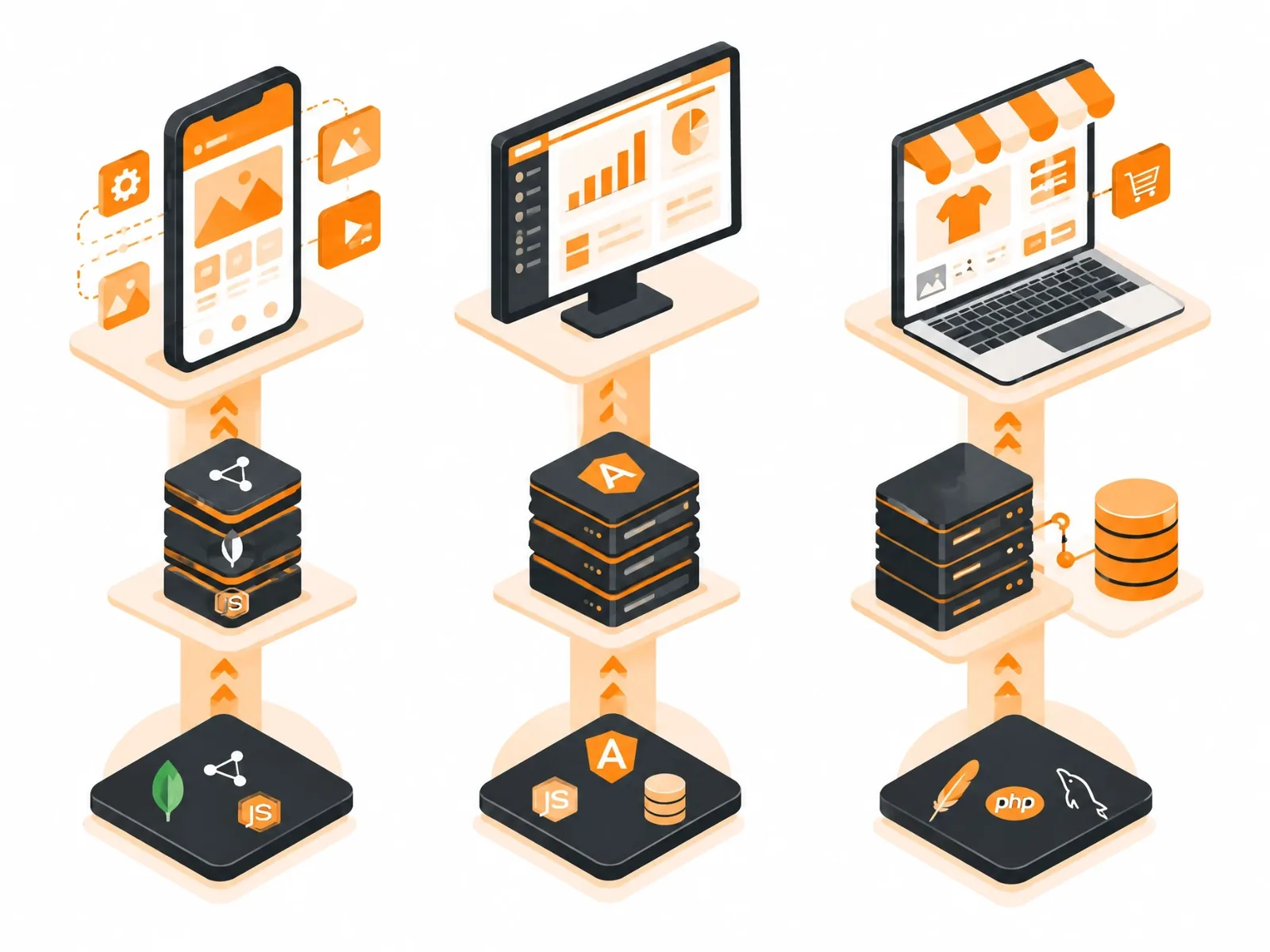
- MERN: MongoDB (database) + Express.js (backend framework) + React (frontend library) + Node.js (runtime). One language—JavaScript—end to end.
- MEAN: The same MongoDB + Express + Node.js foundation, swapping React for Angular on the frontend. It is also all JavaScript (technically TypeScript on the Angular side), but with a more structured, opinionated frontend framework.
- LAMP: Linux (operating system) + Apache (web server) + MySQL (relational database) + PHP (server-side language). The oldest of the three by a wide margin, and the foundation under a huge share of the web, including WordPress.
MERN vs. MEAN vs. LAMP: Side by Side
| Factor | MERN | MEAN | LAMP |
|---|---|---|---|
| Language(s) | JavaScript end to end | JavaScript/TypeScript end to end | PHP backend, separate frontend |
| Database type | NoSQL (MongoDB) | NoSQL (MongoDB) | Relational (MySQL) |
| Frontend framework | React—flexible, unopinionated | Angular—structured, opinionated | None built in—typically server-rendered HTML |
| Best at | Rich, interactive interfaces | Large-scale, structured applications | Content sites, CMS platforms, e-commerce |
| Learning curve | Moderate | Steeper due to Angular and TypeScript | Gentle, with a huge tutorial base |
| Talent availability | Very high; React is dominant | Good, more enterprise-leaning | Very high, especially outside pure startups |
| Best fit | Startups, consumer apps, SPAs | Enterprise dashboards, ERPs, large teams | Marketing sites, WordPress/Magento builds, transactional data |
MERN: The Startup Default
MERN's biggest advantage isn't really technical—it's talent. React is one of the world's most widely used frontend libraries, so finding developers, tutorials, and pre-built solutions is rarely the bottleneck. Combined with Node's event-driven backend, MERN handles real-time features such as chat, live dashboards, and notifications well. MongoDB's flexible schema also suits products that are still evolving quickly, which describes most early-stage startups.
Where it struggles: heavy server-side computation, because Node isn't built for that. Out of the box, MERN also produces a client-rendered app, which needs extra work—often a framework with server rendering—if SEO or fast initial loading matters a lot. MongoDB is also a poor fit if your data is deeply relational, with many tables that need to join in complex ways. That is not a MongoDB weakness so much as a mismatch; forcing relational data into a NoSQL shape usually costs you later.
MEAN: The Structured Enterprise Pick
Swap React for Angular and you get MEAN—the same JavaScript-everywhere foundation, but Angular brings a much more opinionated, batteries-included framework. Routing, form handling, HTTP services, and dependency injection are all built in, with TypeScript enforced by default. For a large team that needs everyone writing code the same way, that structure is a real asset.
The trade-off is the learning curve. Angular is harder to pick up than React, and finding experienced Angular developers is a narrower search than finding React developers. MEAN can also produce a heavier frontend at runtime unless it is optimized carefully. It is a strong choice specifically when the project is large enough, and the team big enough, that Angular's structure pays for itself—a sprawling internal dashboard, a multi-module enterprise SaaS product, or a banking or healthcare portal with many contributors. For a five-page MVP, it is usually more framework than the project needs.
LAMP: Underrated in 2026
LAMP gets treated like the old-timer at the party, but the numbers do not support writing it off. WordPress alone, which runs on LAMP, still powers a huge share of the web. If your project is content-heavy, needs a CMS that non-technical staff can actually use, or fits a mature platform like WordPress, Magento, or Drupal, LAMP will very likely get you to launch faster and more affordably than building the same thing from scratch in MERN or MEAN.
LAMP's relational database, MySQL, is also a genuine advantage—not just a legacy holdover—for anything transactional. Inventory systems, bookings, and financial records all benefit when data integrity and complex joins matter more than a flexible schema. Where LAMP actually falls behind is high-concurrency, real-time functionality. Its traditional request-per-process model does not handle thousands of simultaneous live connections as gracefully as Node's event-driven approach, though careful caching and tuning close much of that gap for most real-world traffic levels.
How to Actually Decide
How relational is your data, really?
If your application is fundamentally about records, transactions, and things that need to join together cleanly—orders, invoices, bookings, or inventory—a relational database, and by extension LAMP or a relational-database variant of MERN or MEAN, will save you pain later. If your data is more document-shaped and evolving, such as user profiles, content, or flexible product catalogues, MongoDB's flexibility is a genuine asset.
What does your content and CMS situation actually look like?
If a large part of the project is “non-technical staff need to publish and edit content regularly,” that alone often settles the question in LAMP's favour. Building a custom CMS from scratch in MERN or MEAN rarely beats an existing, mature platform.
How big is the team, and how long does this need to last?
A small, fast-moving team building something that might pivot in three months benefits from MERN's flexibility. A large team building something meant to run, largely unchanged, for years benefits from MEAN's imposed structure or LAMP's stability and maturity.
What is your actual talent pool?
The stack that is technically ideal but that you cannot hire for is not actually the right choice. React and PHP both have enormous talent pools; Angular's is real but noticeably smaller. This is a practical constraint, not a minor detail.
Where App-Scoop Fits In
We build in all three of these, along with several other combinations, through our Full Stack Development team. That means the recommendation you get is based on your actual project, not which stack happens to be easiest for a given agency to staff.
If part of your build is about connecting existing systems rather than building from scratch, that is a slightly different conversation. Read our breakdown of API integration vs. custom development if that sounds closer to your situation.
If you are trying to determine which stack fits your project, get in touch and we'll walk through it honestly.
Frequently Asked Questions
Which stack is fastest to build with?
For a small, fast-moving team, MERN typically has the shortest path to a working product, mainly because React's talent pool and library ecosystem are so large. LAMP can be just as fast, or faster, if the project fits an existing CMS like WordPress rather than needing custom development.
Is MERN better than MEAN?
Not universally—they solve similar problems differently. MERN's React is more flexible and has a shallower learning curve; MEAN's Angular is more structured and tends to suit larger teams and bigger, longer-lived applications. The better option depends on team size and project scope, not raw technical superiority.
Is LAMP outdated in 2026?
No. It remains one of the most widely deployed web stacks, powers a large share of the internet through WordPress and similar platforms, and is still a practical, cost-effective choice for content-driven sites and many e-commerce builds.
Can I switch stacks later if I outgrow my first choice?
It is possible but genuinely costly. Switching stacks usually means a substantial rewrite, not a simple migration. That is why the initial decision is worth getting right—or at least worth a real conversation with whoever is building it—instead of defaulting to whatever is currently trendy.
Do I need MongoDB, or can I use MySQL with MERN or MEAN?
You can swap MongoDB for a relational database such as PostgreSQL or MySQL in a Node-based stack. This is common when the data is genuinely relational. At that point it is no longer the classic MERN or MEAN combination by name, but the rest of the stack—Node, Express, React, or Angular—works the same way.
Which stack is best for an e-commerce site?
LAMP, in many cases. Mature platforms like Magento and WooCommerce, which is built on WordPress, run on LAMP and handle the bulk of standard e-commerce needs without custom development. A MERN or MEAN build makes more sense for e-commerce with a highly custom, app-like shopping experience that off-the-shelf platforms cannot deliver.
Does the choice of stack affect hosting cost?
Somewhat. LAMP hosting is typically the least expensive and most widely available because it has been the standard for decades. MERN and MEAN hosting is also affordable and well-supported by modern cloud providers, though Node-based applications may require slightly more configuration than a standard LAMP hosting package.
Have a project in mind?
Let's talk about how we can build it. Free consultation, no obligation.
Get a Free Consultation