
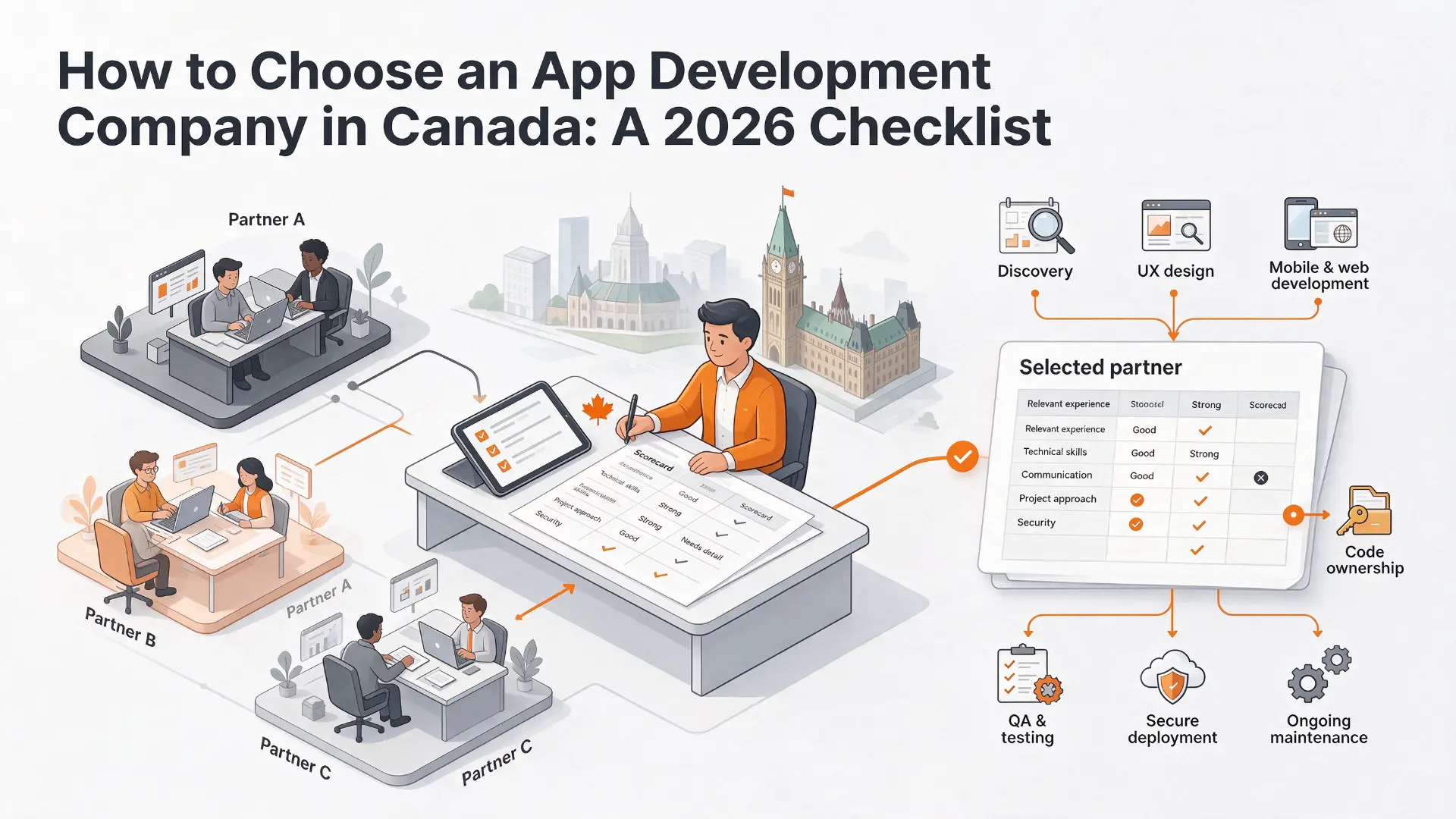
How to Choose an App Development Company in Canada: A 2026 Checklist
Picking an app development company is one of the few decisions in a software project that is expensive to reverse. Choose well and you get a partner who challenges your scope, ships a stable product and is still answering your calls a year after launch. Choose badly and you pay twice: once for the build, and again for the team that has to fix it.
This guide is written for Canadian founders, product owners and operations leaders who are about to hire a team to build a mobile or web app. It covers how to define what you need, which type of partner fits, the criteria that actually predict success, 12 questions to ask, the red flags to walk away from, what to check in a Canadian contract, typical costs in CAD and a scorecard you can copy into your own evaluation.
Key takeaways
- Define your goals, users, must-have features, budget range and deadline before you talk to any vendor. Good companies will ask about all of them.
- Shortlist four to six companies that have shipped something similar in complexity, not just in industry.
- Judge them on the named team, their discovery and QA process, security and privacy practices, pricing transparency, post-launch support and code ownership terms, not on the lowest quote.
- Walk away from a fixed price given before discovery, a team you never meet, vague answers on ownership and no plan for maintenance.
- In Canada, a contractor owns the copyright in code it writes unless the contract assigns it to you, so get a written IP assignment and a moral-rights waiver.
What Does an App Development Company Actually Do?
A full-service app development company takes a product from idea to a running app and keeps it running. The work usually includes:
- Discovery and planning: turning your idea into user flows, a prioritized feature list, an architecture plan, a timeline and a budget.
- UI and UX design: wireframes, clickable prototypes and the visual design system.
- Development: the mobile app (iOS, Android or cross-platform), the web app, the backend, APIs and integrations.
- Quality assurance: manual and automated testing on real devices, plus security and performance testing.
- Launch: App Store and Google Play submission, cloud setup, monitoring and analytics.
- Support and growth: bug fixes, operating-system updates, security patches and new features after launch.
Some firms do only part of this (design studios, offshore coding shops, freelancers). Knowing which parts you need is the first filter.
Why Choosing the Right Partner Matters
Most failed app projects do not fail because of bad code alone. They fail because the scope was never pinned down, nobody owned quality, the team changed halfway through, or the client discovered too late that the vendor controlled the code and the accounts. The right partner reduces each of those risks before a line of code is written. The wrong one makes them worse, and the cost shows up later as rework, delays and a product you cannot easily move to another team.
Step 1: Define What You Need Before You Contact Anyone
Vendors can only quote what you can describe. Write a one- or two-page brief that answers:
What business problem does the app solve, and how will you measure success?
Who are the users, and what are the three to five things they must be able to do in version one?
Which platforms: iPhone, Android, web, or all three?
What existing systems must it connect to (CRM, ERP, payments, identity)?
Is there personal, health or financial data, and which privacy rules apply (PIPEDA, Quebec's Law 25, provincial health privacy laws, HIPAA for US users)?
What is your budget range and your real deadline (an investor milestone, a trade show, a season)?
Who on your side will make decisions and be available every week?
You do not need a full specification. A clear brief lets you compare proposals on the same basis, and the way each company responds to it tells you a lot about them.
Step 2: Decide What Kind of Partner You Need
Agency vs freelancer vs in-house team
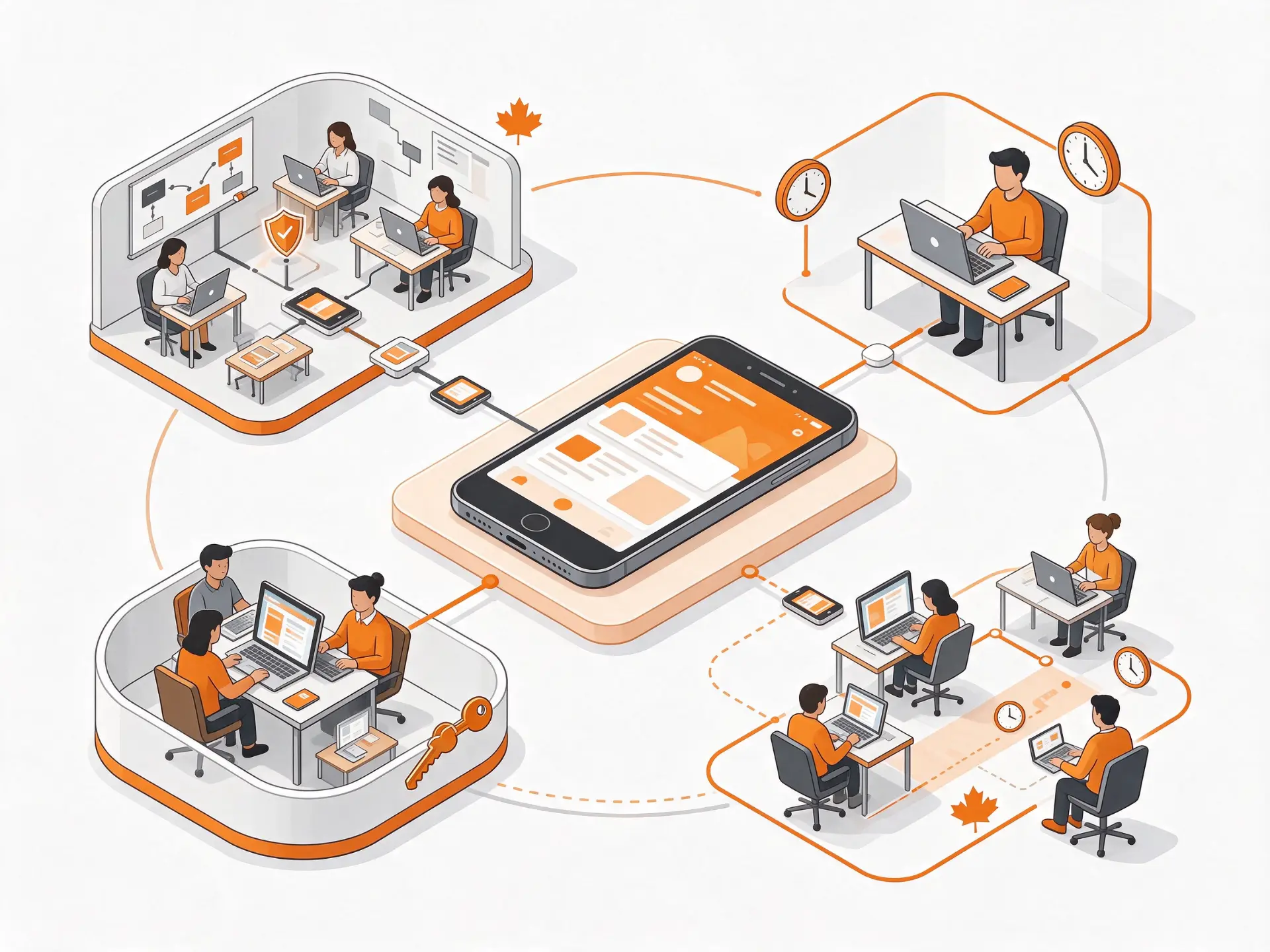
| Development company | Freelancer | In-house team | |
|---|---|---|---|
| Upfront cost | Medium to high | Lowest | Highest (salaries, hiring, benefits) |
| Speed to start | Fast (weeks) | Fast | Slow (months to hire) |
| Skills covered | Design, mobile, web, backend, QA, DevOps | Usually one or two | Whatever you hire |
| Continuity risk | Low if the team is named and documented | High: one person, one point of failure | Low once staffed |
| Quality ownership | Contracted QA process | Depends on the individual | Your responsibility |
| Best for | New products, MVPs, complex builds, fixed deadlines | Small, well-defined tasks | Long-term products once there is product-market fit |
Many Canadian companies combine models: a development company builds and launches the first versions, then hands over to an in-house team, or works alongside one.
Onshore, nearshore, offshore or hybrid?
- Onshore (Canadian team): same time zone, easy in-person meetings and a clear understanding of Canadian privacy rules, at the highest hourly cost.
- Nearshore (US or Latin America): good time-zone overlap at a moderate cost.
- Offshore (Asia, Eastern Europe): lowest rates, but limited overlap and more management effort on your side.
- Hybrid: a Canadian lead team for product, architecture and communication, with engineering support elsewhere. This balances cost with accountability, provided the people you meet are the people who own delivery.
Whichever model you pick, ask for at least three to four hours of daily overlap with your working day and one named person who is accountable for delivery.
Step 3: Build a Shortlist of Four to Six Companies
Ask founders and CTOs in your network who they used and whether they would hire them again.
Use review platforms such as Clutch and GoodFirms, and read the detailed reviews, not just the star rating.
Check local tech communities and associations such as BC Tech, Communitech or your provincial innovation network.
Look for companies that have published real case studies with results, and that explain how they work.
Filter for similar technical complexity rather than the same industry. A team that has built a secure, data-heavy healthcare app will handle a fintech app better than a team that built a simpler app in your exact sector.
Step 4: Evaluate Each Company Against These 10 Criteria

- 1. Relevant experience. Apps of similar complexity: integrations, offline use, payments, real-time features, regulated data.
- 2. A portfolio with outcomes. Live apps you can download, plus numbers: users, ratings, uptime, results for the client.
- 3. A named, senior team. Who will lead the project, who will design, build and test it, and whether any work is subcontracted.
- 4. A real discovery process. A structured phase that validates requirements, architecture and risks before the build price is fixed.
- 5. Quality assurance. Automated tests, code review on every change and testing on real devices, owned by a named person.
- 6. Security, privacy and compliance. Encryption, access control, secure development practices and experience with PIPEDA, Law 25 and, where relevant, HIPAA or SOC 2 reviews.
- 7. Pricing transparency. An itemized estimate with assumptions, and a clear engagement model (fixed scope, time and materials, or a mix).
- 8. Communication. A fixed rhythm of demos and updates, one point of contact, shared project tools and time-zone overlap.
- 9. Post-launch support. A written support plan with response times, plus a plan for operating-system updates.
- 10. Ownership terms. You own the code, designs, accounts and data from the start, and you can take the project elsewhere at any time.
What strong and weak vendors look like
| Criterion | Strong vendor | Weak vendor |
|---|---|---|
| Portfolio | Live apps and measurable results | Screenshots only, no numbers |
| Team | Named lead, developers and QA from the proposal | "Our expert team", no names |
| Estimate | Itemized, with written assumptions | One number, no scope |
| Process | Discovery, design, sprints, QA, launch, support | "We will figure it out as we go" |
| Ownership | Written IP assignment, code in your repository | Delays or avoids the question |
| Support | Response times in hours, maintenance plan | No plan after launch |
| References | Clients you can call | "We cannot share, NDA" |
Step 5: Ask These 12 Questions
1. Have you built something with similar technical complexity, and can I speak to that client?
What a good answer sounds like: A good answer names a comparable project and offers a reference call.
2. How do you validate requirements before you commit to a price?
What a good answer sounds like: Look for a paid or structured discovery phase, prototypes and a written scope.
3. Who exactly will work on my app, and will that change?
What a good answer sounds like: Names, roles and seniority, and a commitment to keep the core team.
4. Should this be native or cross-platform, and why?
What a good answer sounds like: The answer should depend on your users and features, not on what the company prefers to build.
5. What does your QA process look like?
What a good answer sounds like: Automated tests, code review, real-device testing and a defined definition of done.
6. How do you estimate cost and timeline, and what assumptions sit behind the number?
What a good answer sounds like: Assumptions in writing, a range rather than false precision, and a clear way to handle unknowns.
7. How do you handle scope changes?
What a good answer sounds like: A documented change process that shows the cost and time impact before work starts.
8. How will we communicate and track progress?
What a good answer sounds like: Regular demos, written updates, a shared board and one accountable contact.
9. Who owns the code, designs and accounts, and when?
What a good answer sounds like: You do, from the first payment: repositories, App Store and Google Play accounts and cloud accounts in your name.
10. How do you protect our data and meet Canadian privacy rules?
What a good answer sounds like: Specific practices (encryption, access control, data residency options) and experience with PIPEDA and Law 25.
11. How do you use AI coding tools, and how is that code reviewed?
What a good answer sounds like: AI is fine for speed; every change should still be reviewed and tested by a senior engineer.
12. What happens after launch, and what would you leave out of version one?
What a good answer sounds like: A support plan with response times, and honest advice on what to cut so you launch sooner.
Red Flags When Choosing an App Development Company
- A fixed price before any discovery. Without understanding the scope, the number is a guess, and you will pay for the gap later through change requests.
- Guaranteed delivery dates with no assumptions. Experienced teams name their risks.
- No questions about your users or business goals. They are selling hours, not outcomes.
- No named team, or a senior pitch followed by a junior team. Ask who writes the code.
- Undisclosed subcontracting. Ask directly whether any work goes to another company.
- Vague answers about code and account ownership. This is the hardest problem to fix later.
- No QA process or maintenance plan. Testing and support are where low quotes usually cut corners.
- Weak or unverifiable case studies, and no references. "NDA" can explain one project, not all of them.
- A price far below every other quote. Compare scope line by line before you celebrate.
- Slow or unclear communication during the sales process. It rarely improves after you sign.
One red flag may have an innocent explanation, so ask about it. Two or three from the same company are a reason to move on.
Step 6: Run a Paid Discovery or Small Test Project
Before you commit to the full build, pay your top one or two candidates for a short discovery phase or a small, well-defined piece of work. Two to four weeks is usually enough to produce a prioritized scope, clickable prototype, architecture plan and fixed price, or to build the riskiest technical piece of your app. You will learn more about how a company works from that short engagement than from any sales call, and the output is yours to keep whichever company you choose.
Step 7: Check the Contract (Canadian Specifics)
Have a lawyer review the agreement. These are the points that matter most for Canadian clients:
- Intellectual property assignment. Under Canadian copyright law, the author of code owns it unless it was created by an employee in the course of employment. An outside contractor therefore owns what it writes unless the contract assigns the rights to you. Ask for a full written assignment of copyright in the code, designs and documentation.
- Moral rights waiver. In Canada, moral rights cannot be assigned, only waived. Ask for a written waiver from the company and its developers.
- Accounts and access. Source code in your repository, and App Store, Google Play, cloud, domain and third-party accounts registered to your company.
- Payment milestones. Tie payments to delivered, working milestones rather than to dates.
- Warranty and defect fixing. How long bugs in delivered features are fixed at no charge.
- Change process. How scope changes are priced and approved.
- Termination and handover. What you receive if the relationship ends: code, documentation, credentials and a handover period.
- Confidentiality and data protection. An NDA, plus clauses on how personal information is handled, stored and deleted.
- Governing law. Ideally your own province.
How Much Does It Cost to Hire an App Development Company in Canada?
Prices depend on scope, platforms, integrations and compliance needs. As a guide, these are typical ranges for professional, production-ready builds in Canada:
| Project type | Typical range (CAD) | Typical timeline |
|---|---|---|
| Simple app or MVP | $25,000 – $45,000 | 2–4 months |
| Standard app with backend, integrations and payments | $45,000 – $85,000 | 3–5 months |
| Complex, regulated or AI-heavy app | $85,000+ | 5–8 months |
Costs beyond the build
- Apple Developer Program: US$99 per year. Google Play developer account: US$25 one-time.
- Hosting, databases, monitoring and third-party services (maps, SMS, email, AI APIs), billed monthly.
- Store commissions on digital sales and subscriptions.
- Maintenance and operating-system updates: plan a yearly budget for this from day one.
For a full breakdown, see our app development cost guide and mobile app maintenance costs in Canada. To understand pricing models, read fixed scope vs time and materials.
How Long Does Choosing a Company Take?
Plan for two to six weeks: a week to write your brief and build a shortlist, one to two weeks of calls and proposals, a few days of reference checks, and two to four weeks if you run a paid discovery. That time is small compared with the months a wrong choice can cost.
A Scorecard You Can Copy
Score each company from 1 to 5 on every criterion, multiply by the weight, and add up the total. Adjust the weights to your project: a healthcare app might weight security higher, a startup with a hard deadline might weight speed and process higher.
| Criterion | Weight | Company A | Company B | Company C |
|---|---|---|---|---|
| Relevant experience and portfolio results | 20% | |||
| Named senior team | 15% | |||
| Discovery and QA process | 15% | |||
| Security, privacy and compliance | 10% | |||
| Communication and time-zone overlap | 10% | |||
| Pricing transparency | 10% | |||
| Post-launch support | 10% | |||
| Ownership and contract terms | 10% | |||
| Weighted total | 100% |
Final Checklist Before You Sign
- You have spoken to at least one past client.
- You have met the people who will lead and build your project.
- The scope, assumptions and exclusions are in writing.
- Payments are tied to working milestones.
- The contract assigns all IP to you and includes a moral-rights waiver.
- Code, app store and cloud accounts will be in your company’s name.
- There is a written QA process and a defect warranty.
- There is a support plan with response times after launch.
- You know how scope changes are priced and approved.
- You know what you receive if you end the relationship.
How App-Scoop Works With Canadian Businesses
App-Scoop is a Vancouver-based app and SaaS development company. We built our process around the questions in this guide: every project starts with a fixed-fee Blueprint that defines scope, architecture, risks and a fixed price before development begins; you meet the named team that will build your product; code lives in your repositories from day one; and our Zero-Defect Guarantee means anything that does not work as documented is fixed at no charge until it is stable. We sign an NDA before the first technical conversation.
Explore our mobile app development, iOS, Android and web application services. If your app was started with AI tools or another vendor, read our AI-built MVP guide, or book a free strategy call and use the 12 questions above on us.
Frequently Asked Questions
How do I choose an app development company in Canada?
Write a short brief, shortlist four to six companies that have built something of similar complexity, ask each the same questions, check references, compare scope and ownership terms rather than just price, and run a paid discovery with your top choice before committing to the full build.
How much does it cost to hire an app development company in Canada?
Typical professional builds range from about CAD $25,000 to $45,000 for a simple app or MVP, $45,000 to $85,000 for a standard app with a backend and integrations, and $85,000 or more for complex or regulated apps. Hosting, store fees and maintenance are extra.
Is it better to hire a freelancer or an app development company?
A freelancer suits small, well-defined tasks. For a full product with design, mobile, backend, testing and support, a company gives you more skills, continuity and accountability.
Should I hire a local Canadian company or a remote team?
A Canadian or hybrid team gives you time-zone overlap, easier meetings and familiarity with Canadian privacy laws. Remote teams can cost less but need more management. Whichever you choose, insist on daily overlap and one accountable lead.
Who owns the code when I hire an app development company?
In Canada the contractor owns the copyright unless the contract assigns it to you, so your agreement should include a written IP assignment, a moral-rights waiver, and code and accounts held in your company's name.
What questions should I ask an app development company?
Ask about similar past projects and references, how they validate requirements, who will work on your app, native vs cross-platform, QA, how they estimate, how scope changes work, communication, ownership, privacy, AI-assisted coding and post-launch support.
What is the biggest red flag when hiring app developers?
A confident fixed price before any discovery, especially combined with vague answers about who will do the work and who owns the code.
How many quotes should I get?
Three to five detailed proposals are enough to compare scope, approach and price without slowing the decision down.
Fixed price or hourly: which is better?
Fixed scope works when requirements are clear, often after a discovery phase. Time and materials suits evolving products. Many teams fix the price of a defined first release and then move to a monthly model.
What should I prepare before contacting app developers?
Your goals, target users, must-have features, platforms, integrations, privacy requirements, budget range, deadline and the person who will make decisions.
How long does it take to build an app?
An MVP usually takes two to four months, a standard app three to five months, and complex or regulated apps five to eight months or more.
Can I switch app development companies in the middle of a project?
Yes, if you own the code and accounts and the project is documented. A new team will usually start with a code audit before continuing.
Should I use Clutch or GoodFirms to find app developers?
They are useful for building a shortlist. Read the detailed reviews and verify them with your own reference calls.
Have a project in mind?
Let's talk about how we can build it. Free consultation, no obligation.
Get a Free Consultation