
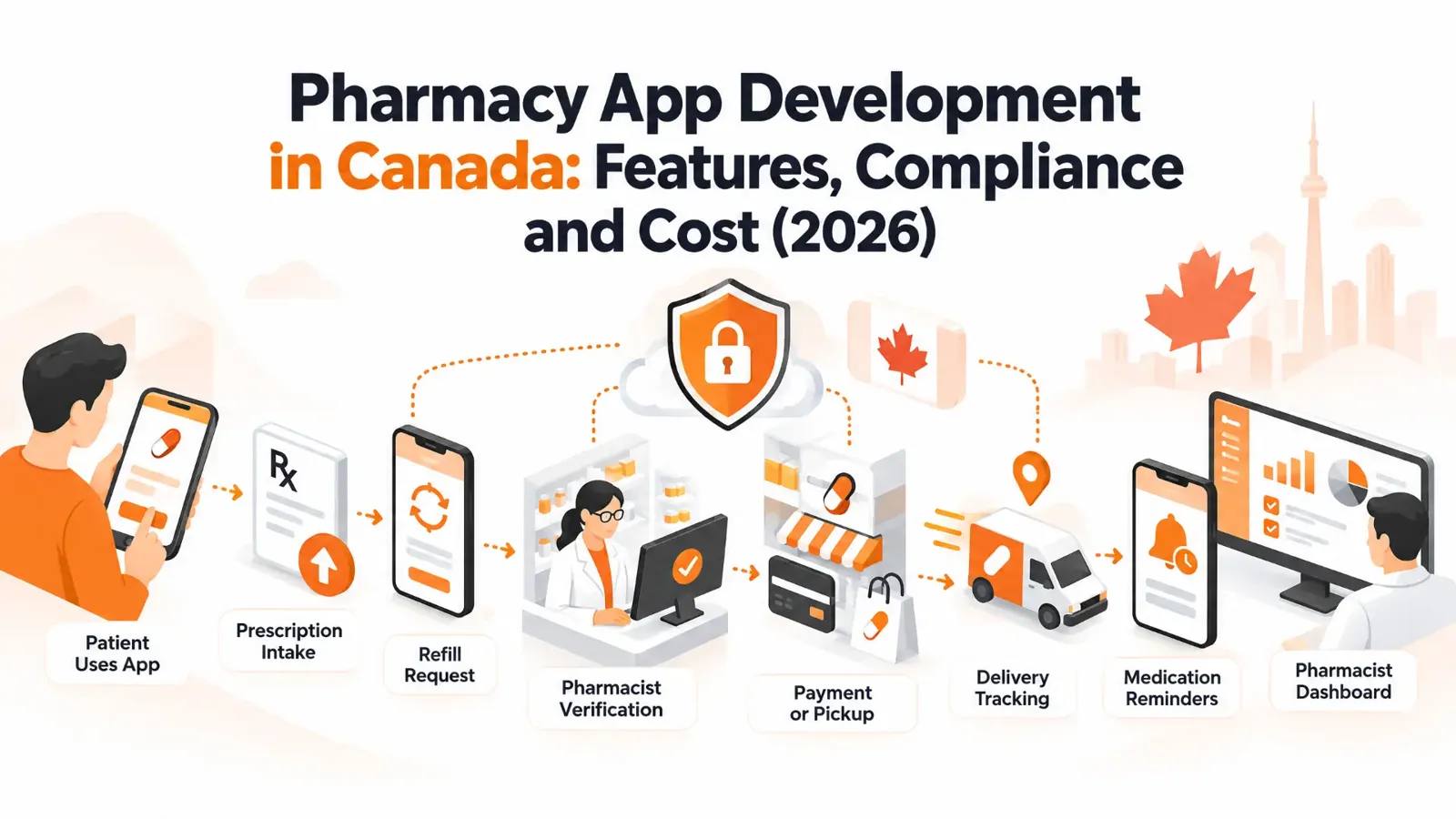
Pharmacy App Development in Canada: Features, Compliance and Cost (2026)
Canadians can bank, shop and book a doctor's appointment from their phones, yet a large share of prescriptions still reach pharmacies by fax. In May 2026 that gap became more visible: PrescribeIT, the national e-prescribing service run by Canada Health Infoway, shut down after failing to reach scale. Fewer than 5% of Canadian prescriptions were ever sent through it.
For pharmacies, pharmacy groups and health-tech startups, that leaves a real opportunity: patients want to refill, track and pick up prescriptions as easily as they order anything else, and pharmacists want fewer phone calls and cleaner workflows. This guide covers the types of pharmacy apps, the features that matter, the Canadian regulatory landscape, integrations, costs and timelines.
Key takeaways
- Pharmacy apps range from refill-and-pickup apps for a single pharmacy to online pharmacies with delivery, pharmacist consultations and appointment booking.
- In Canada, pharmacies and pharmacists are regulated provincially, so features such as prescribing for minor ailments, delivery and virtual consultations depend on the province.
- PrescribeIT ended on May 29, 2026. Canada Health Infoway has since published a national open e-prescribing standard, so plan for prescription intake by photo, fax and transfer today, and for standards-based e-prescriptions as vendors adopt them.
- Health information is among the most sensitive data you can handle: PIPEDA plus provincial health privacy laws apply, and Canadian hosting is usually expected.
- A pharmacy app MVP typically costs CAD $85,000–$150,000 and takes 5–8 months; full platforms with delivery, consultations and deep integrations cost more.
Types of Pharmacy Apps
| Type | What it does | Typical owner |
|---|---|---|
| Refill and pickup app | Refill requests, prescription status, pickup notifications, transfers | Independent pharmacy or regional chain |
| Online pharmacy with delivery | Prescription intake, payment, delivery tracking, pharmacist chat | Online pharmacy or chain expanding delivery |
| Pharmacist services app | Booking vaccinations and minor-ailment assessments, follow-ups | Pharmacies offering expanded scope services |
| Medication management app | Reminders, adherence tracking, caregiver access, medication lists | Pharmacies, health-tech companies, care providers |
| Pharmacy operations software | Queues, verification workflows, inventory, staff tools | Pharmacy groups, B2B software vendors |
Must-Have Features for Patients
- Secure account and identity. Sign-up with identity checks appropriate to prescription services, multi-factor authentication, and family or caregiver profiles.
- Prescription intake. Upload a photo of a paper prescription, request a transfer from another pharmacy, or receive prescriptions sent by the prescriber. Originals for some medications must still be presented in person.
- One-tap refills. Refill from the medication list, with clear status updates from requested to ready.
- Notifications and reminders. Ready-for-pickup alerts, refill reminders and dose reminders, with privacy-conscious wording on lock screens.
- Pickup, delivery and payment. Choose pickup or delivery where offered, pay in the app, and store insurance or benefits information for the pharmacy to process.
- Secure messaging with a pharmacist. Questions about side effects, interactions and timing, answered by a licensed pharmacist through an encrypted, logged channel.
- Medication profile. Current medications, allergies and history the patient can review and share.
- Appointment booking. Vaccinations, minor-ailment assessments and medication reviews, where the province allows them.
Must-Have Features for Pharmacists and Staff
- A prescription queue. Incoming requests sorted by status, priority and pickup time, with clear handoffs between technicians and pharmacists.
- Verification workflows. Pharmacist review and sign-off steps that mirror your professional obligations, recorded in an audit trail.
- Pharmacy management system integration. Prescriptions, patient records and claims live in the pharmacy management system (PMS). The app must sync with it, not create a parallel record.
- Inventory visibility. Stock checks before confirming refills, and alerts for shortages.
- Admin and reporting. Volumes, turnaround times, refill rates and app adoption, without exposing more personal health information than each role needs.
The Canadian Regulatory Landscape
This is where pharmacy apps in Canada differ most from guides written for the US or Europe. The points below are general information, not legal or regulatory advice; confirm your obligations with your provincial regulator and counsel.
Each province and territory has its own pharmacy regulator and rules for pharmacies, pharmacists, delivery and virtual services, with national coordination through the National Association of Pharmacy Regulatory Authorities (NAPRA). Pharmacist scope also varies: British Columbia, for example, lets pharmacists prescribe for certain minor ailments. Design features province by province rather than assuming one national rule set.
Canada Health Infoway launched PrescribeIT in 2017 to replace fax and paper prescriptions. Adoption stayed low, and Infoway shut the service down on May 29, 2026. Infoway has published a national open e-prescribing standard (made available on April 29, 2026) for provinces and vendors to adopt. For app builders, that means two things: support today's real-world intake (photo, fax and transfers), and design the prescription data model so it can accept standards-based e-prescriptions as your pharmacy management system and local prescribers adopt them.
Some medications carry stricter rules. In Alberta, for example, the Alberta College of Pharmacy noted that once PrescribeIT ended, prescriptions for Triplicate Prescription Program Type 1 medications would again need physical secure prescription pads unless another exemption applies. Your app shouldn't promise digital-only handling for medications that require originals or special processes.
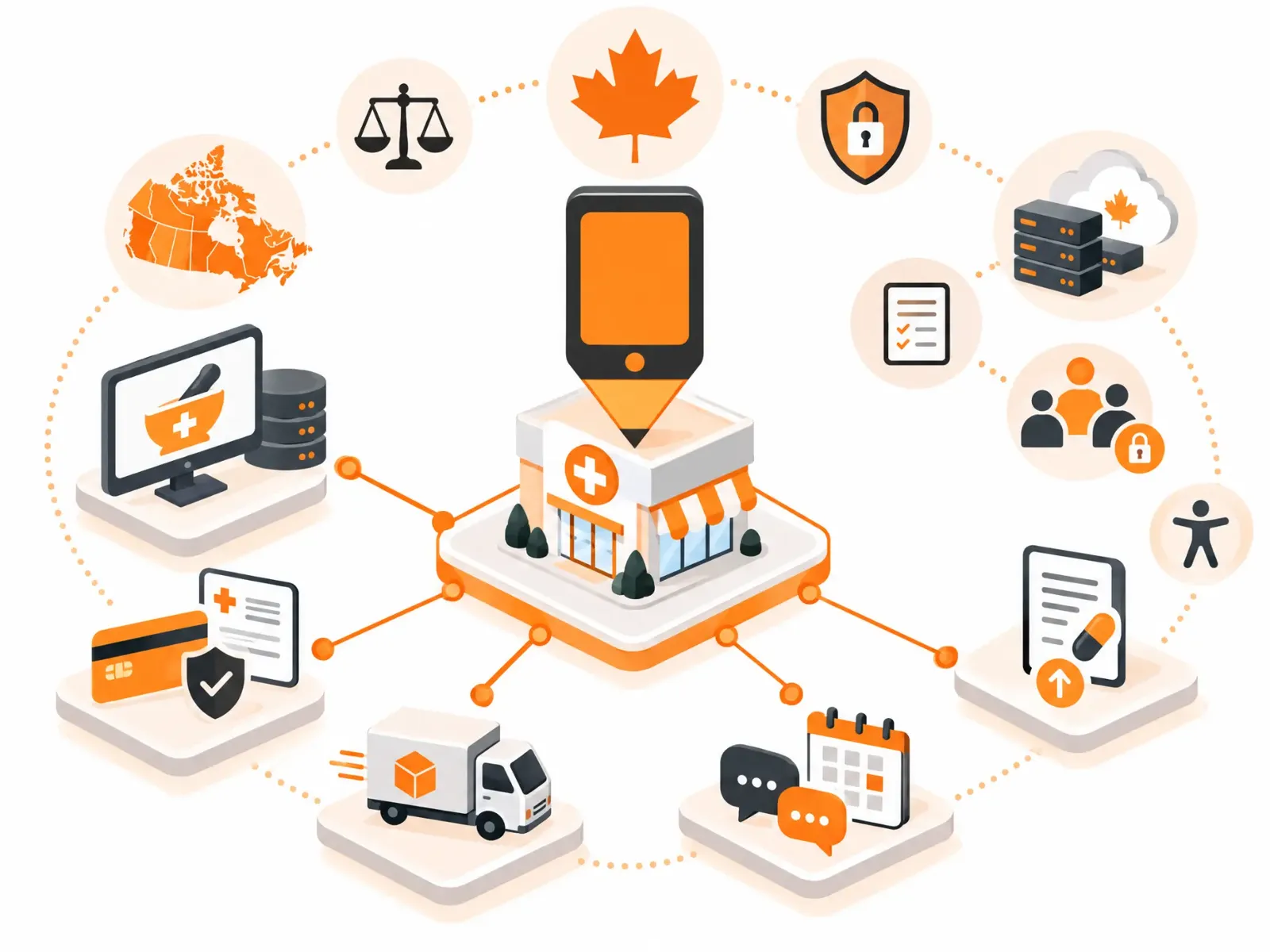
Personal health information is protected by PIPEDA for much private-sector activity and by provincial health privacy laws, such as Ontario's PHIPA and Alberta's Health Information Act. Expect consent management, access logging, breach procedures and Canadian data hosting. We cover the Ontario rules in more depth in our healthcare app development guide for Toronto.
Refill and pickup features are not medical devices. But if your app interprets symptoms, recommends treatments or calculates doses, it may fall under Health Canada's rules for software as a medical device. Decide early which side of that line your features sit on.
Canada restricts how prescription drugs can be advertised to the public. Keep marketing messages, push notifications and in-app promotions to pharmacy services rather than promoting specific prescription drugs, and have your regulatory adviser review campaign templates.
Quebec patients need a full French experience, and accessibility is essential for older patients and people managing chronic conditions: large text, screen-reader support and simple flows.
Key Integrations
- Pharmacy management system (PMS): the system of record for patients, prescriptions and claims. Integration depth is the biggest technical decision in any pharmacy app.
- Payments: card payments and saved payment methods, with insurance and benefits adjudication handled through the pharmacy's existing claims process.
- Delivery and logistics: in-house drivers or courier partners, with tracking and proof of delivery.
- Communications: secure messaging, SMS and email providers, and optionally video for consultations.
- Booking: scheduling for vaccinations and services, synced with staff calendars.
Our API & System Integration team handles these connections.
Security Requirements
- Encryption in transit and at rest, with Canadian data hosting.
- Multi-factor authentication, with role-based access for patients, technicians, pharmacists and administrators.
- Detailed audit logs of who viewed or changed health information.
- Privacy-safe notifications that don't reveal medication names on lock screens.
- Regular security testing, plus a documented breach-response process.
Pharmacy App Development Process
- Discovery and compliance review. Map workflows with pharmacists, confirm provincial rules and decide which features are in scope.
- UX design and prototype. Test refill, intake and messaging flows with real patients, including older users.
- Architecture and integrations. Choose hosting, design the data model for future e-prescribing, and integrate with the PMS.
- Development in short sprints. Build patient and pharmacist apps in parallel, with security built in from day one.
- Testing and pilot. Security testing, accessibility checks and a pilot in one or two locations before wider rollout.
- Launch and improvement. Monitor adoption, turnaround times and support requests, then expand features.
How Much Does Pharmacy App Development Cost in Canada?
| Scope | What's included | Typical range (CAD) | Timeline |
|---|---|---|---|
| Pharmacy app MVP | Patient app (iOS and Android), refills, photo intake, notifications, pickup, staff dashboard, one PMS integration | $85,000 – $150,000 | 5 – 8 months |
| Full pharmacy platform | Adds delivery, payments, pharmacist messaging, booking, multi-location support | $150,000 – $250,000 | 8 – 12 months |
| Online pharmacy or multi-pharmacy network | Multiple provinces, virtual consultations, advanced integrations and reporting | $250,000+ | 12+ months |
Pharmacy apps cost more than a typical app of similar size because of health-data security, compliance work and PMS integration. Cross-platform development keeps the patient app affordable across iOS and Android; see iOS vs Android vs cross-platform. Plan for roughly 15–20% of the build cost per year in maintenance, plus hosting and third-party services.
Common Challenges
- PMS integration limits, which can restrict what the app can show or change in real time.
- Different rules in each province, which complicates national rollouts.
- Patient adoption, especially among older patients, which needs simple design and staff support at the counter.
- Building delivery and payments without disrupting existing pharmacy workflows.
- Keeping notifications and marketing within advertising and privacy rules.
How App-Scoop Builds Healthcare Apps
App-Scoop has built healthcare products used by thousands of patients, including Cambian Connect, a HIPAA-compliant mobile health app that syncs data from consumer health devices, and the Cambian Booking Widget, a scheduling tool used by healthcare organizations. Every project starts with a fixed-fee Blueprint covering workflows, compliance and integrations before any code is written. See our mobile app development services, read building healthcare apps in Canada, or get in touch.
Frequently Asked Questions
How much does it cost to build a pharmacy app in Canada?
A pharmacy app MVP typically costs CAD $85,000–$150,000. A full platform with delivery, payments, messaging and booking is usually $150,000–$250,000, and multi-province online pharmacies cost more.
How long does pharmacy app development take?
About 5–8 months for an MVP and 8–12 months for a full platform, depending on integrations and compliance work.
Who regulates online pharmacies in Canada?
Pharmacies and pharmacists are regulated by each province and territory, with national coordination through NAPRA. Rules for delivery, virtual services and pharmacist scope vary by province.
Can patients send prescriptions through an app?
Usually yes, as a photo or transfer request, but some medications require original prescriptions presented in person. Pharmacists must verify every prescription.
What happened to PrescribeIT?
Canada Health Infoway shut down PrescribeIT on May 29, 2026, after low adoption. It has published a national open e-prescribing standard for provinces and vendors to adopt instead.
Which privacy laws apply to pharmacy apps?
PIPEDA for much private-sector activity, plus provincial health privacy laws such as Ontario's PHIPA and Alberta's Health Information Act. Most healthcare customers also expect Canadian data hosting.
Is a pharmacy app a medical device?
Refill, pickup and messaging features generally aren't. Features that interpret symptoms, recommend treatment or calculate doses may be regulated as software as a medical device by Health Canada.
Does a pharmacy app need to integrate with our pharmacy management system?
Yes. The PMS is the system of record for prescriptions and claims, and the app should sync with it rather than maintain separate records.
Should we build for iOS or Android first?
For patient apps in Canada, usually both through cross-platform development, since iOS accounts for about two-thirds of mobile traffic but many patients use Android.
Can we send medication reminders by push notification?
Yes, but keep lock-screen text privacy-safe and avoid promoting specific prescription drugs, which Canada restricts.
Have a project in mind?
Let's talk about how we can build it. Free consultation, no obligation.
Get a Free Consultation