
How Much Does Custom CRM Development Cost in 2026? (Canada Pricing Guide)
Most businesses start with an off-the-shelf CRM, and many should stay there. But at some point a pattern shows up: the team pays for dozens of seats, uses a fraction of the features, and still runs half the sales process in spreadsheets because the CRM doesn't fit how they actually sell. That's usually when someone asks what it would cost to build one.
The honest answer is "it depends," but it depends on a short list of things you can estimate. This guide gives realistic Canadian price ranges, explains what drives the number up or down, lists the costs that rarely appear in a first quote, and helps you decide whether custom, off-the-shelf or a hybrid makes the most sense.
Key takeaways
- A focused custom CRM typically costs CAD $40,000–$75,000; a mid-complexity CRM with automation and several integrations $75,000–$150,000; advanced or enterprise builds $150,000 and up.
- Integrations, data migration, mobile and offline access, security requirements and AI features move the price far more than screen count.
- Budget for costs outside the build: data clean-up, training, hosting, third-party APIs and roughly 15–20% of the build cost per year in maintenance.
- Custom becomes cost-effective when per-seat fees are high, your workflow is distinctive, or the CRM is central to how you compete. Otherwise, extending an existing CRM is often the better deal.
- In Canada, plan for CASL consent tracking, privacy law and, for some customers, Canadian data hosting.
Custom CRM Development Cost at a Glance
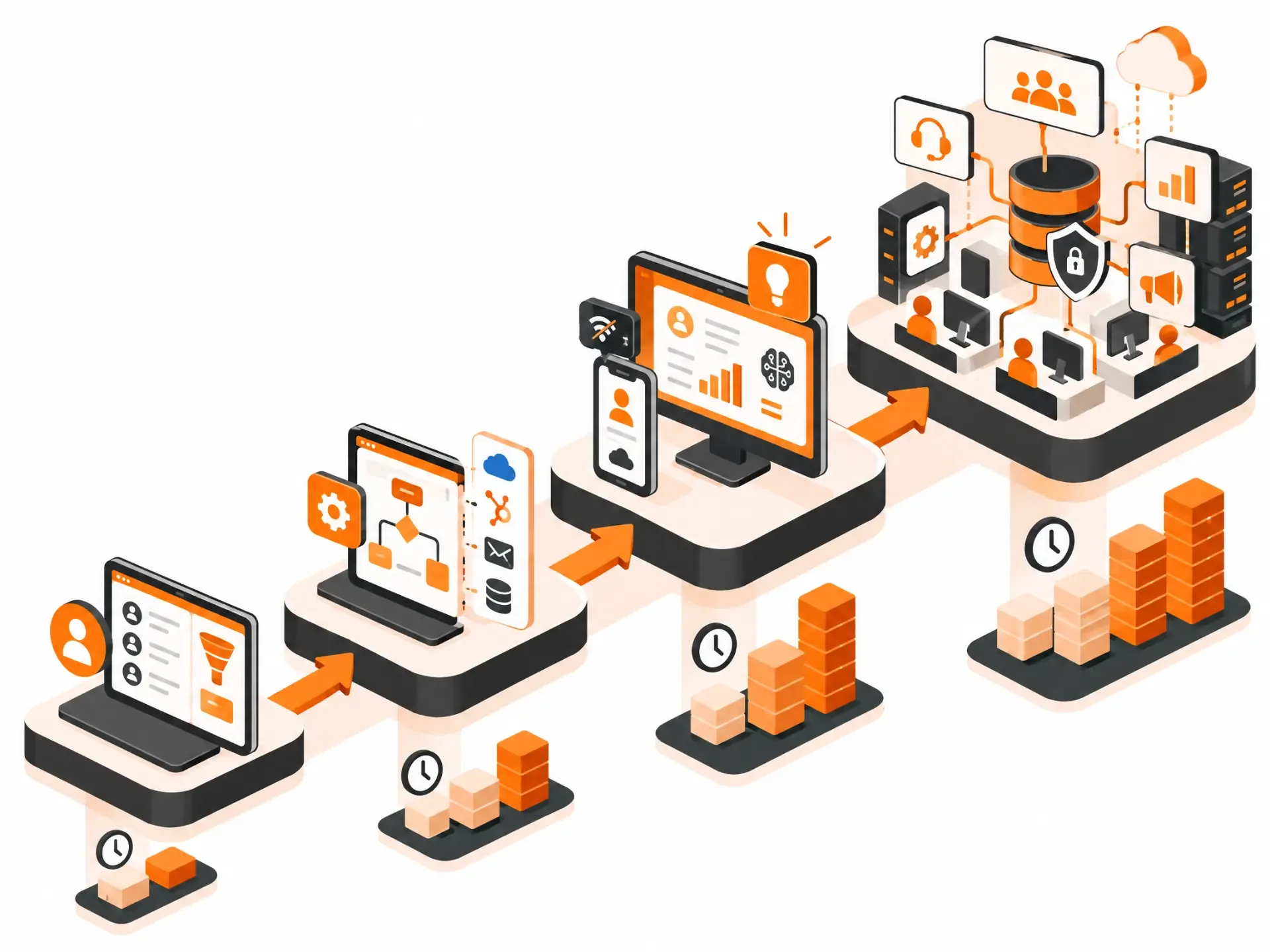
| CRM scope | What's typically included | Typical range (CAD) | Timeline |
|---|---|---|---|
| Focused CRM (MVP) | Contacts and companies, sales pipeline, tasks and reminders, email and calendar sync, basic reports, 1–2 integrations | $40,000 – $75,000 | 2 – 4 months |
| Mid-complexity CRM | Custom workflows and automation, role-based permissions, quoting, 3–5 integrations, dashboards, mobile access | $75,000 – $150,000 | 4 – 7 months |
| Advanced CRM | Multi-department use, complex automation, ERP integration, AI insights, advanced security, offline mobile | $150,000 – $250,000 | 7 – 12 months |
| Enterprise or regulated | Multi-region, multi-entity, strict compliance, high data volumes | $250,000+ | 12+ months |
Published estimates vary widely, and some guides even contradict themselves between their headline and their tables. The ranges above are directional for a Canadian agency build; a short paid discovery phase is the only way to turn a range into a reliable quote.
Where the Budget Goes
| Phase | Share of budget | What happens |
|---|---|---|
| Discovery and planning | 5 – 10% | Workflows, user roles, data model, integrations, scope and estimate |
| UX/UI design | 10 – 15% | Wireframes, prototypes tested with real users, visual design |
| Development | 50 – 60% | Front end, back end, integrations, automation, data migration scripts |
| QA and testing | 15 – 20% | Functional, integration, security and performance testing |
| Launch and project management | 5 – 10% | Deployment, training materials, handover, coordination throughout |
What Drives Custom CRM Cost
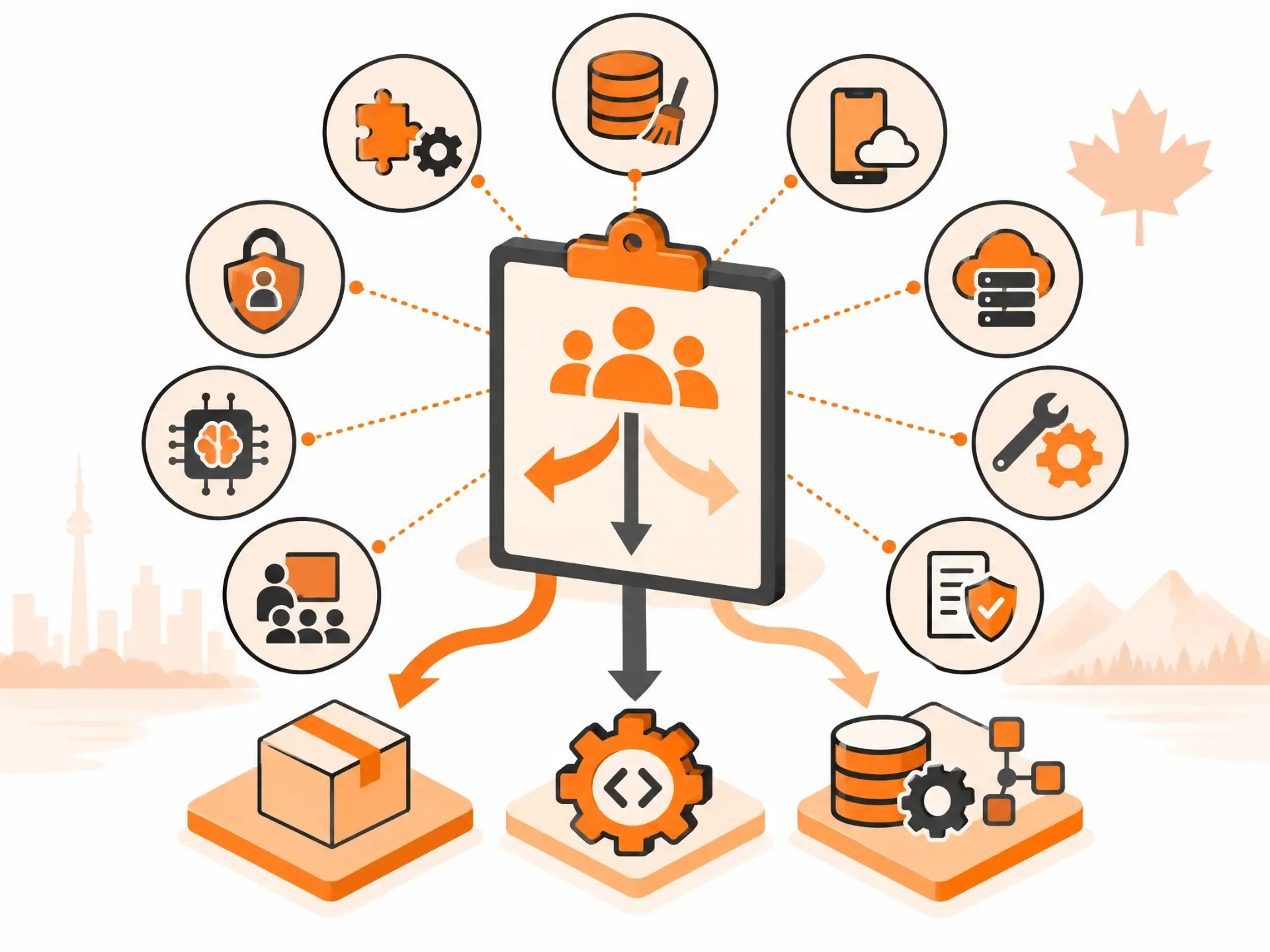
1. Scope and feature complexity
Contact management and a simple pipeline are straightforward. Costs rise with conditional automation (if a deal reaches stage X and is worth more than Y, notify Z and create a task), complex permission rules, custom calculations, multi-step approval flows and configurable reporting.
2. Integrations
A CRM is only useful if it talks to the rest of your stack: email and calendar, accounting, ERP, marketing tools, telephony, e-signature and your website forms. Well-documented APIs are quick to connect; legacy systems and two-way syncs take far longer. Integrations are often the single biggest variable in a CRM quote, and they're what our API & System Integration team focuses on.
3. Data migration
Moving years of contacts, deals and notes from spreadsheets or an old CRM means mapping fields, removing duplicates and fixing inconsistent records. Messy data can add weeks. Auditing data quality before development starts is the most effective way to control this cost.
4. Platforms: web, mobile and offline
A web CRM is the baseline. Field sales and service teams often need a mobile app, sometimes with offline access for areas with poor connectivity, which adds design, sync logic and testing. If you're weighing platforms, see iOS vs Android vs cross-platform for Canadian businesses.
5. Security and compliance
Role-based access, encryption, audit logs, single sign-on and, for some industries, stricter controls for health or financial data. Building these in from the start is far cheaper than retrofitting them before an audit or a large customer's security review.
6. AI features
Lead scoring, deal-risk alerts, email drafting, call summaries and natural-language search are increasingly expected. They're valuable, but they add model costs, evaluation work and guardrails. Our ChatGPT & LLM Integration team scopes these separately so you can see exactly what they add.
7. Team location and model
Hourly rates vary widely by region and by type of team: freelancers, local agencies, offshore teams and hybrid models. A lower rate doesn't guarantee a lower total if communication overhead, rework or missing QA eat up the difference.
Hidden Costs to Budget For
- Data migration and clean-up: often several thousand to tens of thousands of dollars, depending on volume and quality.
- Training and change management: a CRM that people don't use has no value.
- Hosting and infrastructure: cloud costs grow with users, data and file storage.
- Third-party services: email sending, SMS, telephony, mapping, e-signature and AI APIs are usually billed by usage.
- Maintenance and improvements: plan for roughly 15-20% of the build cost per year.
- Contingency: 10-20% for scope changes discovered once real users get involved.
Custom CRM vs Salesforce or HubSpot
| Category | Custom CRM | Salesforce | HubSpot |
|---|---|---|---|
| Initial Setup | High | Medium | Medium |
| Customization | High | High | Medium |
| Cost | Variable | High | Medium |
| Scalability | Medium | High | High |
| Off-the-shelf CRM | Custom CRM | Hybrid (extend existing CRM) | |
|---|---|---|---|
| Upfront cost | Low | High | Medium |
| Ongoing cost | Per-user subscription that grows with your team | Hosting and maintenance, no per-seat fees | Subscription plus maintenance of custom parts |
| Time to launch | Days to weeks | Months | Weeks to months |
| Fit to your process | You adapt to the tool | Built around your process | Tool core, custom where it matters |
| Best for | Standard sales processes, smaller teams | Distinctive workflows, large teams, CRM as competitive edge | Teams happy with the core but blocked by gaps |
A simple way to compare total cost
Multiply your expected per-user monthly price by the number of users and by 36 months, then add implementation and add-ons. Compare that with the custom build cost plus three years of hosting and maintenance. Use current vendor pricing for your edition, since list prices and bundles change often. For small teams with standard processes, off-the-shelf almost always wins. For larger teams, or when the CRM must model something unusual, the numbers often favour custom or hybrid within a few years.
The hybrid route deserves serious consideration: keep the CRM's core, and build custom apps, integrations and dashboards for the parts that don't fit. It often delivers most of the benefit of a custom CRM at a fraction of the cost.
How to Keep CRM Development Costs Under Control
- Map your real process first. Interview the people who'll use it. Most CRM waste comes from building features nobody asked for.
- Start with a focused MVP. Contacts, pipeline, tasks and core reports, then add automation and integrations once people are using it.
- Clean your data before migration. It's cheaper to fix records in a spreadsheet than in code.
- Use proven components. Mature frameworks and managed services for authentication, email and files cut both cost and risk.
- Fix the scope before the build. A paid discovery that ends in a fixed scope and price protects you from open-ended costs; we compare the options in fixed-scope vs. time and materials.
Canadian Considerations
- CASL consent tracking. Canada's Anti-Spam Legislation requires consent before sending commercial electronic messages, with some exceptions. Your CRM should record how and when consent was obtained, and handle unsubscribes promptly.
- Privacy law. PIPEDA applies to much private-sector activity, and Quebec (Law 25), Alberta and British Columbia have their own privacy laws. Build in access controls, data export and deletion workflows.
- Data residency. Public-sector, healthcare and some financial customers may require Canadian hosting.
- French. If your team or customers are in Quebec, plan for a bilingual interface and French templates from the start.
This is general information, not legal advice.
How Long Does It Take to Build a Custom CRM?
A focused CRM typically takes 2–4 months, a mid-complexity CRM 4–7 months, and advanced builds 7–12 months. The biggest timeline risks are the same as the biggest cost risks: integrations with older systems, messy data, and requirements that keep changing after development starts.
How App-Scoop Builds Custom CRMs
We build custom CRMs and CRM extensions as web applications, with custom dashboards and mobile access where teams need it. Every project starts with a fixed-fee Blueprint: your real sales process mapped, the integrations scoped, and a fixed price and timeline before any code is written. If an off-the-shelf CRM is the better answer for you, we'll say so. Get in touch.
Frequently Asked Questions
How much does it cost to build a custom CRM in Canada?
Typically CAD $40,000–$75,000 for a focused CRM, $75,000–$150,000 for a mid-complexity CRM with automation and several integrations, and $150,000 or more for advanced and enterprise builds.
Is a custom CRM cheaper than Salesforce or HubSpot?
Upfront, no. Over several years it can be, especially for larger teams paying per-user fees or companies with unusual workflows. Compare total cost over three years, not just the first invoice.
How long does custom CRM development take?
About 2–4 months for a focused CRM, 4–7 months for mid-complexity, and 7–12 months for advanced builds.
What are the hidden costs of a custom CRM?
Data migration and clean-up, training, hosting, third-party services, ongoing maintenance (around 15–20% of the build cost per year) and a contingency for scope changes.
How much do CRM integrations add?
It depends on the system. Integrations with well-documented APIs are relatively quick; two-way syncs with ERPs or legacy systems take much longer. Integrations are often the biggest single variable in a CRM quote.
Can we start small and expand later?
Yes, and it's usually the smartest approach. Launch the core (contacts, pipeline, tasks, reports), then add automation and integrations based on how the team actually uses it.
Should we build a custom CRM or customize an existing one?
If the core of an existing CRM works and only some workflows don't fit, extending it is often faster and cheaper. Build custom when the CRM must model something the platforms can't, or when it's central to how you compete.
What does CASL mean for a CRM?
Canada's Anti-Spam Legislation requires consent for most commercial emails and texts. A CRM used for marketing should record consent and process unsubscribes reliably.
How much does it cost to maintain a custom CRM?
Plan for roughly 15–20% of the original build cost per year, plus hosting and any usage-based third-party fees.
Can a custom CRM include AI features?
Yes: lead scoring, deal-risk alerts, email drafting, call summaries and natural-language search are common. They add model costs and evaluation work, so scope them separately.
Have a project in mind?
Let's talk about how we can build it. Free consultation, no obligation.
Get a Free Consultation