
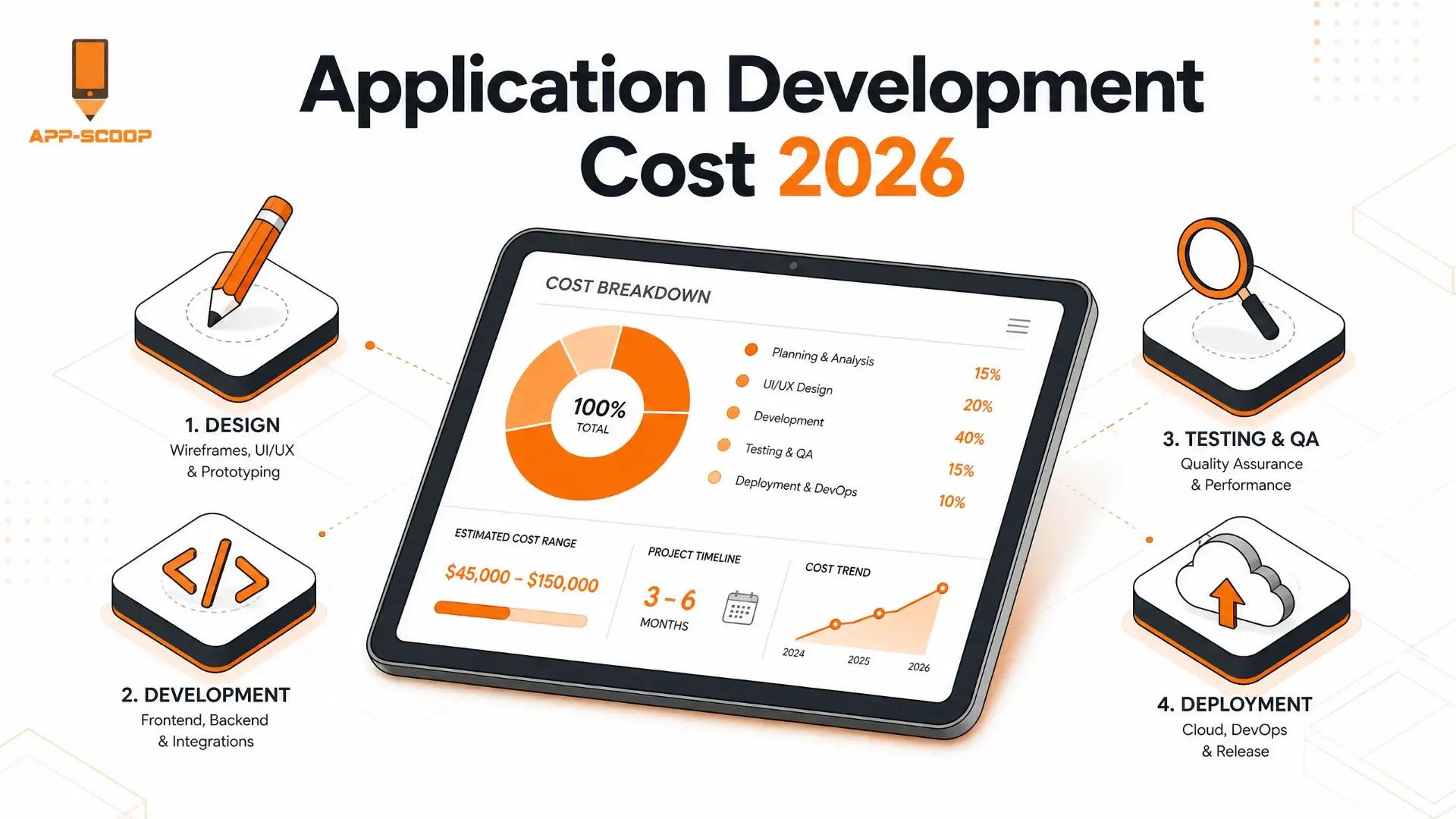
Application Development Cost in 2026: App Pricing Guide
If you’re considering developing a mobile app in Canada in 2026, understanding the costs involved is crucial for budgeting and planning. The cost to build an app can vary significantly based on factors such as complexity, platform choice, development team location, and additional features. This comprehensive guide will provide you with detailed insights into app development costs in Canada, helping you make informed decisions for your project.
Average App Development Charges in Canada (2026)
The cost of developing a mobile app in Canada ranges from approximately CAD 8,000 to CAD 200,000, depending on various factors. Here’s a breakdown based on complexity:
| App Complexity | Estimated Cost (CAD) | Development Time |
|---|---|---|
| Simple App | 8,000 – 16,000 | 2 – 4 months |
| Mid-Scale App | 18,000 – 32,000 | 4 – 8 months |
| Large-Scale App | 45,000 – 55,000 | 8 – 10 months |
| Complex App | 80,000 – 95,000 | 6 – 10 months |
| Enterprise-Level App | Starts from 95,000 | 8 – 12 months |
Source: TekRevol
Development Using AI for Faster, & Cost-Effective App Development
AI is transforming the app development landscape by making the process faster, smarter, and more cost-efficient. By integrating AI into development workflows, businesses can build high-quality applications while saving time and resources.
- Reduced cost and faster development: AI-powered development helps reduce project costs and delivery time by automating repetitive tasks, accelerating testing, and improving overall efficiency without compromising quality.
- Our team uses AI-driven development: Our experts actively leverage advanced AI technologies to streamline workflows, optimize performance, and build smarter, scalable applications tailored to your business needs.
- Powered by tools like Cloud.ai: We use modern AI tools to accelerate development and deliver cost-effective solutions.
If you believe AI can make your app development faster, smarter, and more affordable, talk to us to explore how we can help.
Factors Influencing App Development Costs
Several factors can impact the cost of developing a mobile app in Canada:
1. App Complexity
- Simple Apps: Basic functionalities like calculators or note-taking apps.
- Mid-Scale Apps: Include features like user accounts and basic backend integration.
- Large-Scale Apps: Advanced features, real-time data synchronization, and custom animations.
- Enterprise-Level Apps: Comprehensive solutions with extensive features and integrations.
2. Platform Choice
- iOS Development: Typically ranges from CAD 10,000 to CAD 70,000, depending on complexity.
- Android Development: Ranges from CAD 10,000 to CAD 70,000, with potential additional costs due to device fragmentation.
- Cross-Platform Development: Using frameworks like Flutter or React Native can be more cost-effective, with costs ranging from CAD 25,000 to CAD 60,000.
3. Developer Location and Expertise
Developer rates vary across Canadian cities:
- Toronto: CAD 120 – 150/hour
- Montreal: CAD 90 – 110/hour
- Calgary and Halifax: CAD 80 – 100/hour
Source: Ptolemay
These rates can significantly influence the overall development cost.
4. App Category
Different app categories have varying cost structures:
- On-Demand Apps: CAD 35,000 – 90,000+
- eCommerce Apps: CAD 40,000 – 100,000+
- Fintech Apps: CAD 60,000 – 150,000+
- Gaming Apps: CAD 70,000 – 250,000+
- Social Media Apps: CAD 45,000 – 120,000+
- Healthcare Apps: CAD 50,000 – 150,000+
Source: Apptunix
Cost Breakdown by App Complexity
| App Complexity | Estimated Cost (CAD) | Development Time |
|---|---|---|
| Basic App | 6,000 – 18,000 | 3 – 4 months |
| Medium Complexity App | 18,000 – 60,000 | 4 – 7 months |
| High-End App | 60,000 – 160,000 | 5 – 9 months |
Source: Digittrix
Additional Costs to Consider
- App Maintenance: Typically accounts for 15-20% of the initial development cost annually.
- Hosting and Backend Services: Costs vary based on usage and provider.
- Marketing and App Store Fees: App Store fees are approximately CAD 137.11/year for iOS, and Google Play charges a one-time fee of CAD 34.64.
Tips to Optimize Your App Development Budget
- Define Core Features: Focus on essential functionalities to reduce complexity.
- Consider Cross-Platform Development: Utilize frameworks like Flutter or React Native to save costs.
- Adopt an MVP Approach: Launch a Minimum Viable Product to test the market before full-scale development.
- Choose the Right Development Team: Select a team with the necessary expertise and experience to ensure quality and efficiency.
City-Specific Insights
- Toronto: High developer rates but access to a large talent pool and market opportunities.
- Montreal: Lower developer rates with potential for bilingual support and access to European markets.
- Calgary and Halifax: Competitive rates with growing tech ecosystems and less saturated markets.
How Cost Breaks Down by Development Phase
Beyond app complexity, it helps to see where the money actually goes across a build. Here’s a typical breakdown by phase:
| Development Phase | % of Total Budget | What It Covers |
|---|---|---|
| Discovery | 5–8% | Requirements gathering, scoping, target audience and business goal alignment |
| UI/UX Design | 15–20% | Wireframes, user flows, visual design, prototyping, usability testing |
| Development | 50–65% | Frontend, backend, database, and API integration work |
| Quality Assurance | 10–15% | Manual and automated testing across devices, OS versions, and edge cases |
| Deployment | 2–4% | App Store / Play Store submission, production cutover, release verification |
| Maintenance (annual, ongoing) | ~15–25% of build cost per year | Bug fixes, OS updates, security patches, hosting |
This is useful for sanity-checking a quote: if a vendor’s proposal puts 90% of the budget into “development” with little to no line item for QA or design, that’s usually a sign corners are being cut somewhere that will surface after launch.
Cost by App Type: Native vs. Cross-Platform vs. PWA
Platform choice affects cost as much as feature count does. Here’s how the main approaches compare:
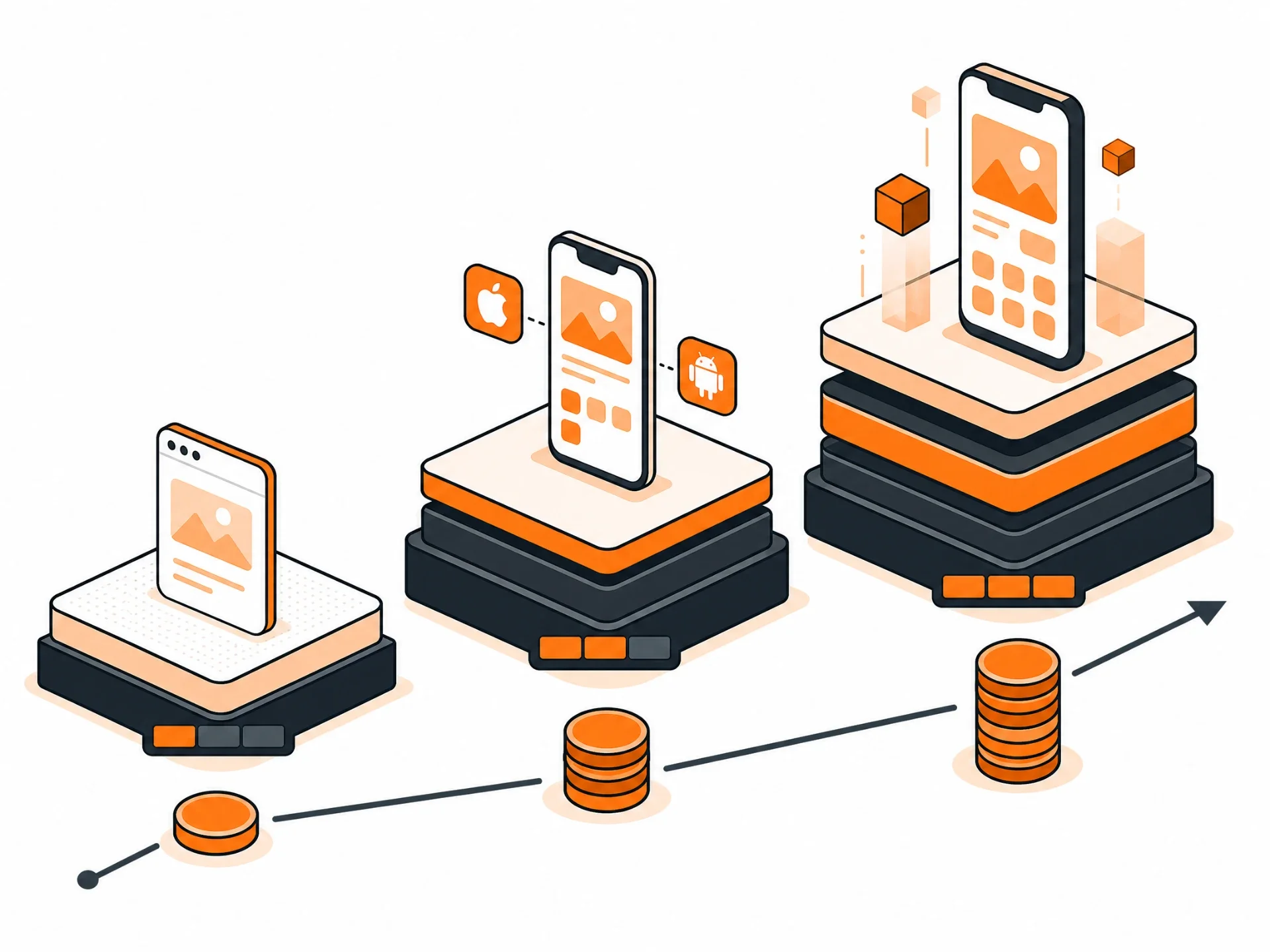
| App Type | Typical Cost (CAD) | Trade-off |
|---|---|---|
| Native (iOS + Android, separate builds) | 70,000 – 250,000+ | Best performance and full hardware access, but two codebases to build and maintain |
| Cross-platform (Flutter, React Native) | 40,000 – 120,000 | Single codebase for both platforms; 30–50% cheaper than native, with minor trade-offs on the heaviest animations |
| Progressive Web App (PWA) | 20,000 – 55,000 | Runs in the browser, installable to a home screen; budget-friendly but limited access to device hardware and push notifications on iOS |
| Web application only | 15,000 – 65,000 | No app store distribution needed; best for internal tools, dashboards, or when mobile isn’t the primary use case |
Feature-Level Cost Breakdown
Total app cost is really the sum of its features. Here’s roughly what individual features add to a build, which is useful for scoping an MVP against a fixed budget:
Basic features (most apps need these)
| Feature | Estimated Cost (CAD) |
|---|---|
| User login (email, social, or magic-link) | 1,500 – 5,500 |
| User profile & settings | 1,500 – 4,000 |
| Push notifications | 2,000 – 4,000 |
| Basic analytics integration | 1,500 – 3,000 |
| Static content pages (About, FAQ, Terms) | 700 – 2,000 |
Advanced features (add these only if the app needs them)
| Feature | Estimated Cost (CAD) |
|---|---|
| Per third-party API integration (payments, maps, messaging) | 5,500 – 8,500 |
| Machine learning / AI-powered personalization | 27,000 – 68,000+ |
| E-commerce module (cart, checkout, catalog) | 20,000 – 55,000 |
| Geolocation with routing/geofencing | 5,500 – 14,000 |
| Per phone sensor integration (gyroscope, NFC, etc.) | ~2,800 |
| IoT/Bluetooth device connectivity | from 12,000 |
| Accessibility compliance (WCAG/ADA) | 20,000 – 34,000 |
A practical way to use this: list only the features genuinely required for launch, add up the low end of each range, and compare that subtotal to the actual budget available. If the “must-have” list alone exceeds the budget, that’s the signal to trim scope before development starts, not after.
What It Costs to Add AI Features to Your App (Not Just Use AI to Build It)
It’s worth separating two different things this page already touches on: AI development speeding up the build process itself, and building AI-powered features into the app your users will interact with. The second one has its own, separate cost profile worth planning for.
- Basic AI feature (e.g., a simple recommendation engine or a chatbot on a third-party API): typically CAD 8,000 – 27,000.
- A production AI feature with custom logic (smart matching, personalized content, document processing): typically CAD 27,000 – 68,000+, depending on how much custom model work versus off-the-shelf API usage is involved.
- Ongoing AI running costs: if using a managed API (OpenAI, Anthropic, Google), costs are usage-based and often just a few cents per user interaction at moderate volume — self-hosting your own model only becomes cost-effective at very high, sustained usage, and carries real infrastructure overhead most apps don’t need at launch.
If your app idea leans on smarter matching, a support chatbot, or document/data processing, it’s worth scoping that piece separately — our AI Workflow Automation and ChatGPT & LLM Integration teams handle exactly this kind of build.
How Long Does It Actually Take?
| App Complexity | Typical Timeline | What Drives the Schedule |
|---|---|---|
| Simple app | 2 – 3 months | Basic screens, minimal backend, one or two core flows |
| Mid-size app | 3 – 6 months | User accounts, payments, basic third-party integrations |
| Large-scale app | 6 – 9 months | Multiple integrations, real-time features, deeper backend logic |
| Complex / enterprise app | 9 – 14+ months | AI/ML, compliance requirements, multi-role systems, heavy QA scope |
Scope discipline shortens a timeline more reliably than adding more developers to a project — past a certain team size, coordination overhead starts eating into the time gained.
A Few More Costs Worth Budgeting For
Beyond what’s already covered above, a handful of costs are easy to forget when budgeting a first app:
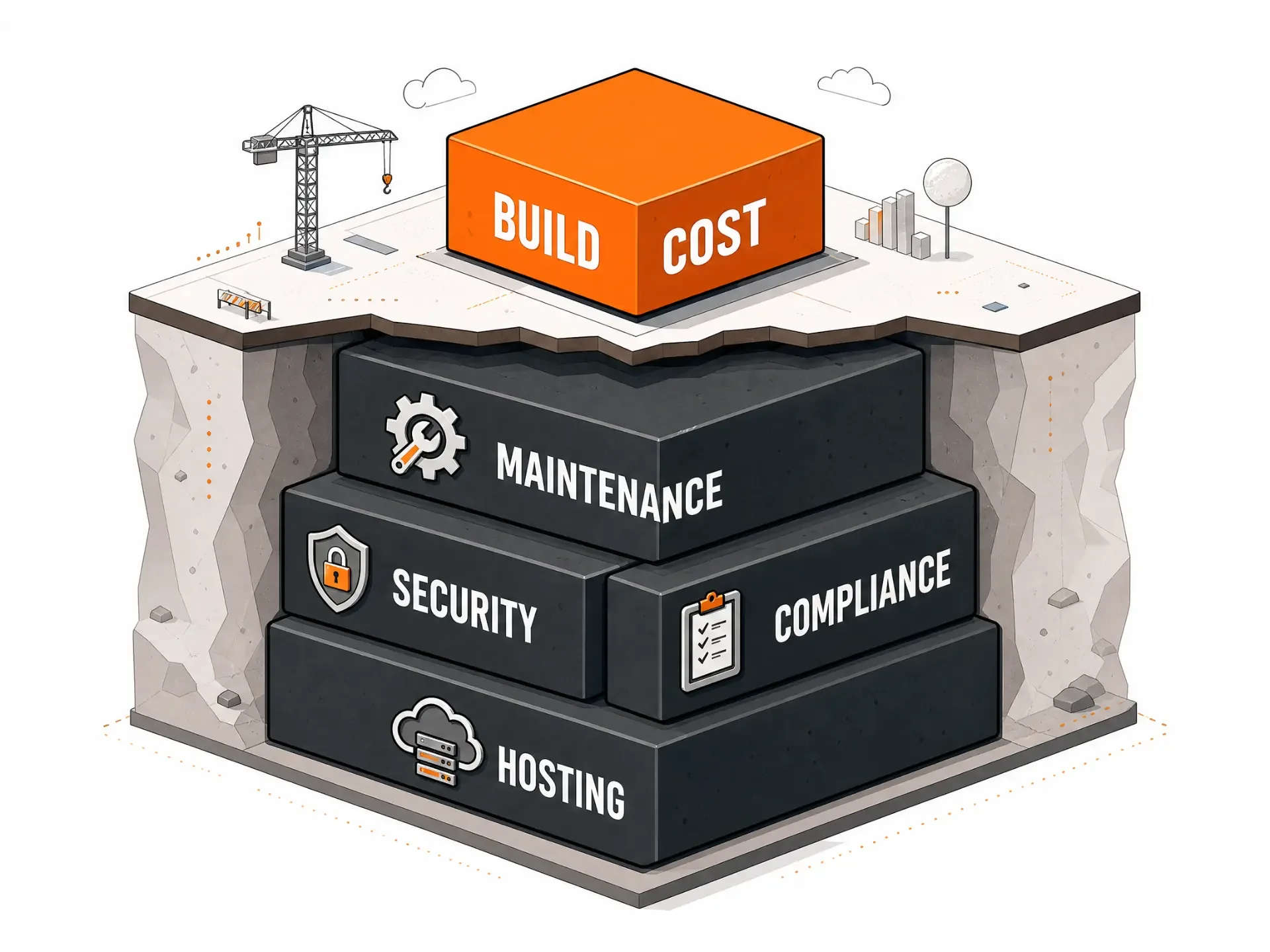
- Project management time — whether on the vendor’s side or yours, coordinating a build isn’t free even when it’s not a separate line item on a quote.
- Legal and compliance review — privacy policy drafting, terms of service, and (for regulated industries) compliance documentation.
- Go-to-market assets — App Store screenshots and copy, a marketing landing page, and basic analytics/attribution setup for tracking installs.
- A realistic first-year maintenance line — covered elsewhere on this page, but worth repeating: budgeting only for the initial build and not the year after launch is one of the most common planning mistakes we see.
Frequently Asked Questions
How much does it cost to build an app like Uber or Instagram?
Apps at that scale sit at the high end of the enterprise range, typically CAD 150,000 and up. Real-time matching, multi-sided logistics, media storage at scale, and content moderation each behave like their own mini-project rather than a simple feature.
Is it cheaper to build for one platform first?
Usually, yes. Launching on the platform where your target audience is more concentrated, then expanding to the second platform once the concept is validated, is generally more budget-efficient than a thinner simultaneous launch on both.
Does an MVP really need to include AI in 2026?
Not necessarily. AI features add real cost, and they’re worth including only when they solve a specific, validated user need. Many successful apps still launch AI-free and add intelligent features once real usage data shows where they’d genuinely help.
How much should I budget for maintenance after launch?
As a planning rule, roughly 15–25% of the original build cost per year covers bug fixes, OS updates, security patches, and routine hosting costs. Apps with heavier third-party integrations or compliance requirements tend to sit toward the higher end of that range.
What’s the fastest way to reduce app development costs without hurting quality?
Trim scope, not corners. Ship the smallest version of the core workflow first, using cross-platform frameworks where hardware access isn’t critical, and defer advanced features (AI, IoT, deep accessibility work) until real usage justifies the investment.
Do fixed-price or hourly (time & materials) contracts work out cheaper?
It depends on how settled the scope is. Fixed-price suits a tightly defined project where requirements won’t shift. Time & materials fits better when the product is still evolving, since it avoids renegotiating the contract every time scope changes.
Why do two apps with a similar-looking UI cost such different amounts?
The visible UI is rarely what drives cost. Backend complexity, the number of third-party integrations, compliance requirements, and how many user roles the system supports usually explain the gap far more than how the screens look.
Should I get quotes from multiple development companies before committing?
Yes, and it’s worth asking each one to break the quote down by phase (design, development, QA, deployment) rather than accepting a single lump sum — that makes it much easier to compare where the money is actually going between vendors.
Conclusion
Building a mobile app in Canada in 2026 requires careful planning and budgeting. Understanding the factors that influence development costs can help you make informed decisions and optimize your investment. Whether you’re developing a simple app or an enterprise-level solution, partnering with the right development team is crucial to the success of your project.
At App-Scoop, we specialize in providing transparent mobile app cost estimates and end-to-end app development solutions. Whether you’re looking for a simple app or a complex enterprise solution, we help you navigate app pricing in Canada efficiently while delivering high-quality results. Partnering with App-Scoop ensures your cost to build app stays within budget without compromising on performance or functionality.
If you’re ready to transform your app idea into reality, reach out to App-Scoop today for a personalized consultation and accurate cost estimate.
Have a project in mind?
Let's talk about how we can build it. Free consultation, no obligation.
Get a Free Consultation