
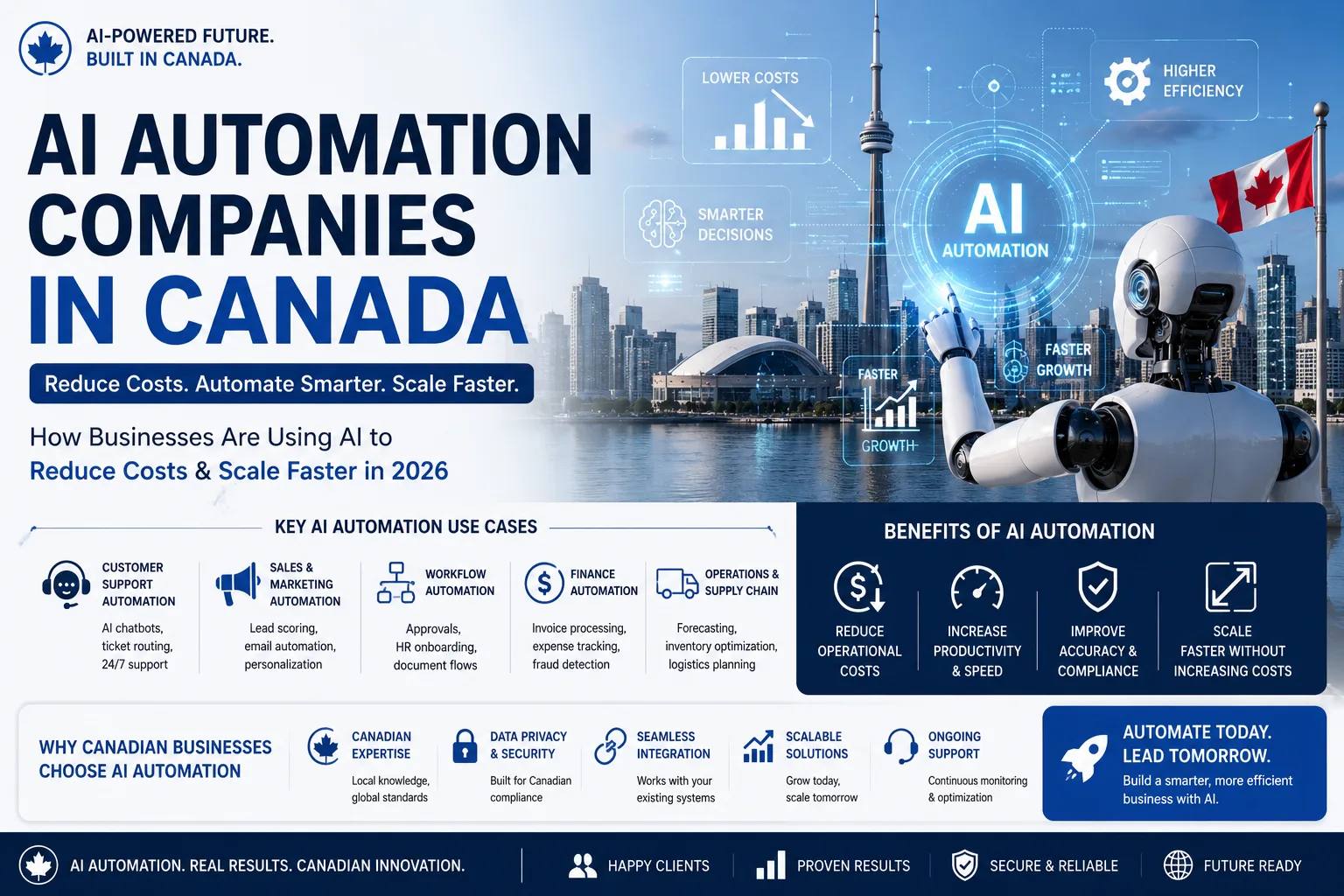
AI Document Automation in Canada
Canadian businesses are generating more documents than ever before—from invoices and contracts to purchase orders, employee records, insurance claims, compliance forms, and customer applications. Managing these documents manually is time-consuming, error-prone, and expensive.
This is where AI document automation is transforming operations. By combining artificial intelligence, optical character recognition (OCR), machine learning, and workflow automation, organizations can automatically extract, classify, validate, and process information from documents without human intervention.
Whether you’re a startup, healthcare provider, financial institution, logistics company, or enterprise organization, AI-powered document automation can dramatically reduce administrative workloads while improving speed and accuracy.
In this guide, we’ll explore how AI document automation works, its business benefits, real-world use cases, implementation best practices, and why Canadian companies are increasingly investing in intelligent document processing in 2026.
What Is AI Document Automation?
AI document automation is the process of using artificial intelligence technologies to read, understand, extract, organize, and process information from digital or scanned documents.
Unlike traditional automation that depends on fixed templates, AI systems can interpret different document layouts, handwritten text, scanned PDFs, emails, and even images.
The technology often combines:
- Optical Character Recognition (OCR)
- Natural Language Processing (NLP)
- Machine Learning
- Intelligent Data Extraction
- Workflow Automation
- Business Rules Engines
Together, these technologies eliminate repetitive manual data entry and accelerate business processes.
Why Manual Document Processing Is Holding Businesses Back
Many organizations still rely on employees to manually review documents and enter information into spreadsheets or business systems.
This creates several challenges:
- Slow turnaround times
- Human data-entry errors
- High operational costs
- Duplicate work across departments
- Compliance risks
- Poor customer experience
- Limited scalability
As document volumes grow, hiring additional staff becomes costly, while manual workflows struggle to keep pace.
AI document automation solves these problems by handling repetitive tasks automatically.
Key Benefits of AI Document Automation
1. Faster Processing Times
Documents that previously required hours can often be processed in seconds.
Examples include:
- Invoice approvals
- Insurance claims
- Purchase orders
- Loan applications
- Customer onboarding forms
2. Reduced Operational Costs
Automating repetitive administrative tasks reduces labor costs and allows employees to focus on higher-value work like customer service, analysis, and strategic decision-making.
3. Improved Accuracy
AI minimizes common mistakes caused by manual typing and copy-paste operations, improving data consistency across systems.
4. Better Compliance
Automated workflows maintain standardized processes, audit trails, document histories, and secure storage, helping organizations meet industry regulations.
5. Enhanced Customer Experience
Customers benefit from:
- Faster approvals
- Quicker responses
- Reduced paperwork
- Improved service quality
- Shorter waiting times
Common Use Cases Across Industries
Invoice Processing
AI automatically extracts:
- Vendor information
- Invoice numbers
- Payment amounts
- Due dates
- Tax details
The information can then flow directly into accounting systems.
Contract Management
Businesses can automate:
- Contract classification
- Key clause extraction
- Renewal reminders
- Risk identification
- Approval workflows
HR Document Processing
Recruitment teams can automate:
- Resume screening
- Employee onboarding
- Identity verification
- Payroll documentation
- Benefits administration
Healthcare Administration
Medical organizations process:
- Patient records
- Insurance forms
- Lab reports
- Referral documents
- Consent forms
Automation reduces paperwork while improving operational efficiency.
Banking and Financial Services
Financial institutions automate:
- Loan documentation
- KYC verification
- Mortgage applications
- Compliance reviews
- Customer onboarding
Logistics and Supply Chain
Shipping companies use AI to process:
- Bills of lading
- Customs paperwork
- Delivery confirmations
- Purchase orders
- Warehouse documentation
The Role of OCR in AI Document Automation
Optical Character Recognition (OCR) converts scanned documents and images into machine-readable text.
Modern AI-enhanced OCR goes beyond simple text recognition by understanding document context, identifying fields automatically, and handling varying layouts.
This enables businesses to digitize paper records without extensive manual intervention.
Intelligent Document Management
Beyond extracting information, AI systems can organize documents intelligently by:
- Categorizing files
- Detecting duplicates
- Applying metadata
- Routing documents automatically
- Triggering approval workflows
- Storing files securely
This creates a centralized, searchable document ecosystem that improves productivity across teams.
Integrating AI with Existing Business Systems
One of the biggest advantages of modern document automation is seamless integration with existing platforms.
AI solutions can connect with:
- CRM software
- ERP systems
- Accounting platforms
- Customer portals
- HR systems
- Business intelligence dashboards
- Cloud storage solutions
This eliminates manual transfers between disconnected systems.
Industries Seeing the Biggest ROI
AI document automation delivers measurable value across many sectors, including:
- Healthcare
- Finance
- Insurance
- Legal services
- Manufacturing
- Logistics
- Retail
- Government
- Education
- Professional services
Organizations processing thousands of documents each month often achieve significant productivity gains.
Best Practices for Successful Implementation
To maximize results:
Start with high-volume workflows
Target repetitive processes like invoice handling or onboarding documents.
Standardize document formats
Consistent templates improve extraction quality and downstream automation.
Integrate with existing systems
Ensure AI outputs flow directly into business applications without manual intervention.
Keep humans involved where needed
Complex or low-confidence cases can be reviewed by staff while routine work remains automated.
Monitor and improve continuously
Track accuracy, processing time, and business outcomes to refine models over time.
Why Canadian Businesses Are Investing in AI Document Automation
As organizations pursue digital transformation, reducing administrative overhead has become a strategic priority.
AI document automation helps companies:
- Increase operational efficiency
- Reduce costs
- Improve compliance
- Accelerate customer service
- Scale without proportional staffing increases
- Make better use of business data
For growing businesses competing in fast-moving markets, intelligent automation provides a practical path to higher productivity and stronger long-term performance.
Conclusion
Paper-heavy workflows no longer have to slow business growth. AI document automation enables organizations to extract information, process documents, and trigger workflows with speed and accuracy that manual methods cannot match.
By combining OCR, machine learning, and intelligent automation, Canadian businesses can eliminate repetitive administrative work, improve data quality, and empower employees to focus on strategic initiatives.
Whether you’re modernizing finance operations, streamlining HR, or building smarter customer experiences, AI-powered document automation is becoming an essential capability for organizations preparing for the future of work.
If your business is exploring AI-driven process improvement, investing in document automation today can create lasting gains in efficiency, scalability, and competitive advantage.
Categories: Uncategorized
Have a project in mind?
Let's talk about how we can build it. Free consultation, no obligation.
Get a Free Consultation