
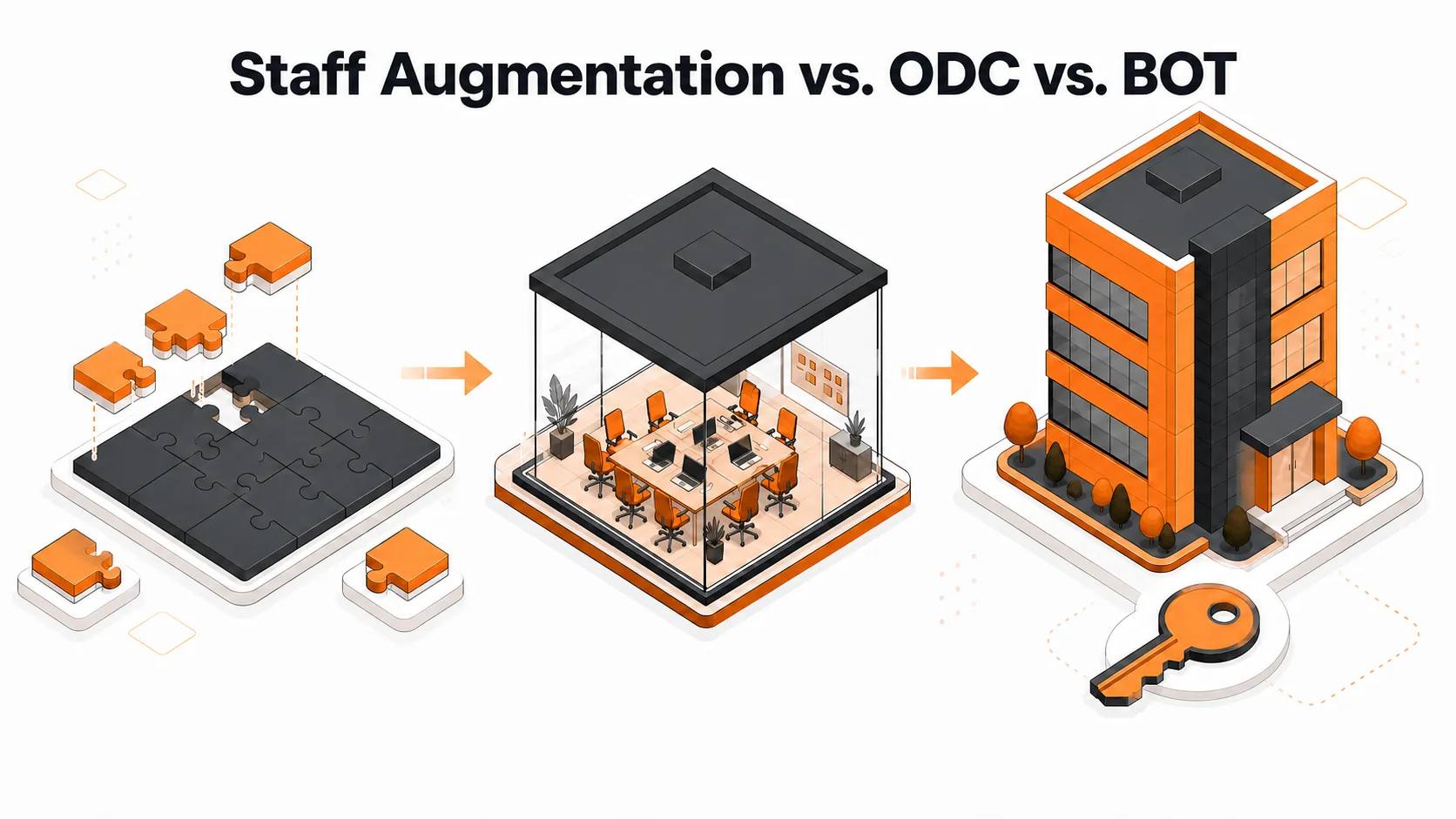
Staff Augmentation vs ODC vs BOT: Which Offshore Engagement Model Is Right for Your Business?
At some point, almost every growing company runs into the same wall: the roadmap is bigger than the team available to build it, and local hiring isn't fast enough to close the gap. That's usually the moment "offshore" enters the conversation — and almost immediately, three unfamiliar terms show up together: staff augmentation, ODC, and BOT.
They get talked about like they're variations on the same thing. They're not. Each one solves a different problem, fits a different timeline, and hands a different amount of control to you versus your development partner. Picking the wrong one doesn't just cost money — it costs the thing you were trying to fix in the first place: speed.
Here's what each model actually means, what it costs, and how to tell which one fits where your business is right now.
TL;DR
- Staff augmentation adds individual developers to your existing team, fast, with you managing the work — best for a defined skill gap or a project with a clear end date.
- An Offshore Development Center (ODC) is a dedicated team built exclusively for you, run under your processes — best once you're committing to 12+ months of ongoing work.
- Build-Operate-Transfer (BOT) has a partner build and run your offshore team, then hand over full ownership — best for companies that want a permanent offshore presence but don't want to start from zero.
- Most companies don't pick one forever. The common path is augmentation first, then ODC, then occasionally BOT, as the relationship and the roadmap both prove out.
What Is Staff Augmentation?
Staff augmentation means adding individual developers to your existing team without putting them on your payroll. The provider handles hiring, contracts, and admin; you manage the actual work — sprints, priorities, code review, all of it.
It's built for speed. A defined role, a vetted developer, and you're often working together within days rather than the months a traditional hire can take. It's also the most flexible of the three: scale up for a launch push, scale back down once it's over, without restructuring anything.
Where it works well
- You have a functioning team and process, and a specific skills or capacity gap — not a structural problem.
- The need is genuinely time-boxed: a migration, a launch crunch, a skill you need for one quarter, not permanently.
- You want to keep full control over architecture and day-to-day decisions.
- Budget needs to flex with headcount rather than commit to a fixed monthly cost.
Where it falls short
Augmented developers aren't your employees in any lasting sense, and the knowledge they build often leaves when the contract ends. If half your core product team is made up of rotating augmented hires, you're quietly carrying a continuity risk — and if your actual bottleneck is a broken process rather than missing hands, augmentation won't fix that either.
What Is an Offshore Development Center (ODC)?
An ODC is a dedicated team built exclusively for your company, hosted and operationally managed by a vendor, but run under your reporting lines, your priorities, and your definition of done. Unlike augmentation, this isn't a rotating cast — it's the same people, working only on your product, for as long as the engagement runs.
The distinction that matters: with staff augmentation you're renting hands. With an ODC, you're building a team that happens to sit somewhere else. That team accumulates real product knowledge sprint after sprint, the same way an in-house team would, which is exactly what a rotating contractor pool can't offer.
Where it works well
- Your roadmap runs 12 months or longer, not a single project with an end date.
- You want continuity and compounding product knowledge, not a revolving door of contractors.
- You're not ready to register a legal entity or run HR/compliance in another country yourself.
- Predictable monthly cost matters more than hourly flexibility.
Where it falls short
ODCs take longer to stand up (often six to ten weeks) and they can drift if left unmanaged — without clear reporting lines and regular leadership contact, an offshore team can quietly develop its own habits that diverge from how the rest of the company works. That's a governance problem, not an inherent flaw in the model, but it's a real one if nobody owns it.
What Is the Build-Operate-Transfer (BOT) Model?
BOT hands a partner the job of setting up and running your offshore team, then transfers full ownership to you once things are stable. It runs in three phases that are exactly what they sound like:
- Build — the partner sets up infrastructure, hires the team, and establishes compliance and governance.
- Operate — the partner runs the center for a defined period (commonly 12–24 months) while you stay engaged and gradually take over leadership.
- Transfer — full ownership moves to you: your entity, your team, your processes.
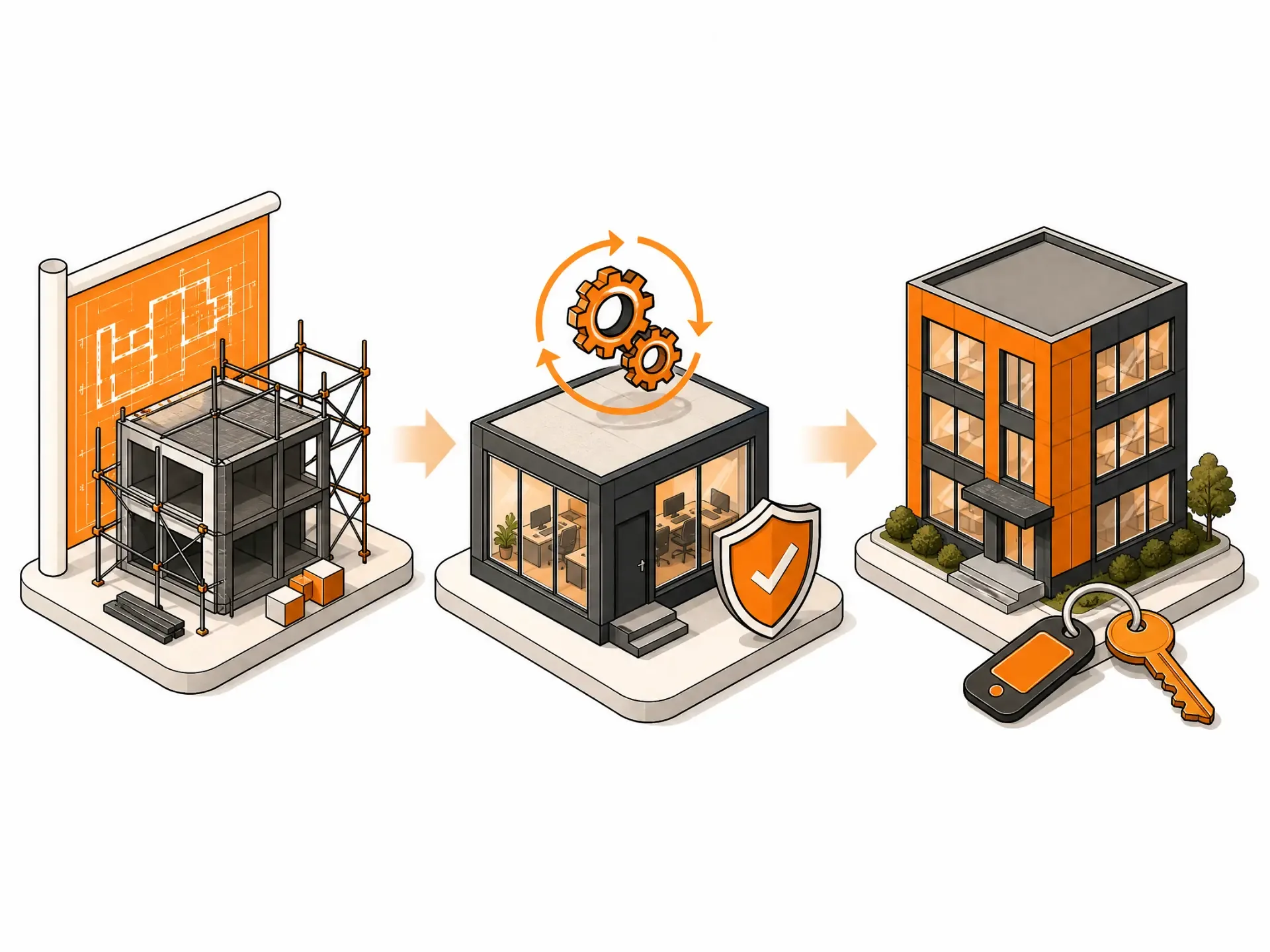
The appeal is straightforward: you end up with a fully operational offshore team under your own roof, without personally navigating a new country's entity registration, labor law, and hiring market from scratch.
Where it works well
- You want a permanent offshore presence, not just delivery support for a season.
- Your horizon is measured in years, not a single product cycle.
- You want the risk of the early setup phase absorbed by a partner who's done it before.
Where it falls short
BOT only works as well as the partner running the Build and Operate phases. If they cut corners on hiring quality or compliance early on, you inherit those problems at Transfer — which makes due diligence on the partner non-negotiable, not optional. The timeline is also the longest of the three, typically 18 to 36 months start to finish.
Staff Augmentation vs ODC vs BOT: Side by Side
| Factor | Staff Augmentation | ODC | BOT |
|---|---|---|---|
| Cost model | Hourly/monthly, variable | Fixed monthly team cost | High upfront, lower long-term |
| Control | Full client control | Shared with vendor | Vendor-led, then client-owned |
| Time to start | Days | 6–10 weeks | 18–36 months, full cycle |
| Team ownership | Vendor | Vendor | Client, after transfer |
| Best for | Filling a skill gap fast | Ongoing product development | Permanent offshore presence |
What Each Model Actually Costs
The sticker price rarely tells the whole story. Management overhead, ramp-up time, and how long a team actually stays intact all affect the real cost more than the invoice does.
| Cost Factor | Staff Augmentation | ODC | BOT |
|---|---|---|---|
| Setup cost | None | Low to moderate | Significant upfront investment |
| Ongoing cost | Per-developer, hourly/monthly | Fixed team retainer | Lower per-head once transferred |
| Management overhead | Falls on you | Mostly handled by vendor | Vendor-managed pre-transfer |
| Best financial fit | Short-term, variable budgets | 12–24 month horizon | 3+ year commitment |
A model that looks cheaper hourly can end up costing more overall once you factor in the time spent managing it, or the cost of losing accumulated product knowledge every time a contract ends. Total cost of ownership, not the rate card, is what should drive the decision once a team crosses the 12-month mark.
How to Choose: A Practical Decision Framework
Strip away the labels and the decision comes down to three honest questions.
How much day-to-day management do you actually want to own?
All of it points toward staff augmentation. Very little points toward an ODC or BOT. If you can't clearly name who on your side will manage the work week to week, that's a signal you want a managed model, not augmentation.
How long is this actually going to run?
Weeks or a single quarter favors augmentation. A multi-year roadmap favors an ODC. A permanent offshore presence, planned years out, is where BOT starts to make sense.
Are you filling a gap, or building lasting capacity?
A gap — a skill you need temporarily — is augmentation. Capacity — a team that's meant to exist indefinitely — is an ODC, or BOT if full ownership is the actual end goal.
One pattern worth watching for: companies that reach for staff augmentation because it's fastest to start, then quietly keep renewing the same contractors for years. If you've renewed the same people three times and you're managing them like employees in every way but title, you're paying augmentation rates for something that should already be an ODC.
Common Mistakes Companies Make
- Scaling augmentation without governance — adding offshore hands with no clear ownership or escalation path turns speed into chaos fast.
- Chasing the lowest hourly rate — a cheap rate looks good until management overhead quietly erases the savings.
- Skipping compliance checks — weak data-handling and IP protection is a real exposure once information starts crossing borders, especially in regulated industries.
- Picking a BOT partner on price alone — what you inherit at Transfer depends entirely on how well the Build and Operate phases were run. A partner who cuts corners early hands you their shortcuts later.
- Building for today's headcount only — a structure that works for five people rarely holds up at thirty without deliberate planning.
The Path Most Companies Actually Take
Very few businesses land on the right model on day one, and that's normal. The typical path looks something like this: start small with staff augmentation to test whether offshore collaboration actually works for your team. Once that holds up, formalize it — defined sprints, shared processes, a real team identity. From there, some companies graduate into a dedicated ODC as the roadmap stabilizes into something longer-term. A smaller number eventually move toward BOT, once full ownership of a permanent offshore presence becomes the actual goal rather than just a nice idea.
None of this has to be locked in upfront. A custom software development partner worth working with will tell you honestly which stage you're actually at, rather than selling you the model that's easiest for them to staff.
Frequently Asked Questions
What's the actual difference between staff augmentation, ODC, and BOT?
Staff augmentation adds individual developers to your team, and you manage the work. An ODC is a dedicated team built exclusively for you, run under your processes but hosted by a vendor. BOT has a vendor build and run the team first, then hand you full ownership once it's stable.
Which model is fastest to get started?
Staff augmentation, by a wide margin — often days rather than weeks. An ODC typically takes six to ten weeks to properly stand up, and a full BOT cycle runs 18 to 36 months from build through transfer.
Is staff augmentation cheaper than an ODC?
Often on paper, yes, especially short-term. But augmentation carries higher management overhead on your side and no continuity once a contract ends. Once a team's horizon crosses roughly 12 to 24 months, an ODC's fixed team cost usually works out more efficient overall.
Can we switch models later if our needs change?
Yes, and it's common. Many companies start with staff augmentation to test the waters, then move the same working relationship into an ODC once the roadmap justifies it. Switching doesn't have to mean starting over with a new team.
Which model offers the strongest IP and compliance protection?
Generally, protection strengthens as you move from staff augmentation toward ODC and then BOT — loose augmentation contracts typically offer the least built-in legal coverage, while ODC and BOT arrangements bake in more formal governance and data protection structure from the start.
Does BOT mean we lose control during the Build and Operate phases?
You have less day-to-day operational control during those early phases, yes — that's the tradeoff for not managing the setup yourself. What matters is staying engaged enough during Operate that Transfer is a handover, not a surprise.
How do we know if we've outgrown staff augmentation?
The clearest sign is renewing the same contractors repeatedly while managing them exactly like employees. If that's been happening for more than a couple of contract cycles, you're likely paying augmentation-level overhead for what should already be a dedicated team.
Is one model objectively better than the others?
No — they solve different problems. The mismatch, not the model itself, is what causes trouble: using augmentation for a multi-year platform build, or setting up a full ODC for a two-month project, both create more overhead than they solve.
Where App-Scoop Fits In
Whichever stage you're at, the underlying goal is the same: a team that actually ships, without you having to become an expert in offshore HR and compliance just to get there. At App-Scoop, we build custom software, web applications, and AI-powered systems for companies at every one of these stages — from a single specialist filling a short-term gap to a long-term dedicated team working as an extension of yours.
If you're trying to figure out which model actually fits your roadmap and budget, get in touch and we'll talk it through honestly, including if the answer is a model that isn't the easiest one for us to staff.
Have a project in mind?
Let's talk about how we can build it. Free consultation, no obligation.
Get a Free Consultation