

SaaS Product Design and Development in Canada: What Founders Should Know
Every few months a founder tells us they are thinking about building their SaaS product in Canada, and the reasons are nearly always the same three: the time zone works, the engineering talent is strong, and if they are funded in US dollars the exchange rate makes the budget stretch. All true. But “build it in Canada” is not a plan, and a handful of things that matter far more than the country on your invoice rarely come up until they are expensive to fix.
This guide covers what SaaS product design and development actually involves, what it realistically costs in Canada, how the SR&ED tax credit fits in—and where it gets oversold—what Canadian privacy rules mean for your architecture, and how to choose a partner without getting burned.
TL;DR
- Canada offers SaaS founders North American time zones, deep engineering talent, and a favourable exchange rate if they are funded in US dollars. It is not the cheapest option, though, and the country on the invoice matters less than who does the work and how.
- Budget directionally CAD $40,000–$85,000 for a focused MVP, $90,000–$200,000 for a scaling product, and $200,000+ for complex or regulated platforms. Scope, integrations, and compliance move the number far more than the hourly rate.
- The SR&ED tax credit can offset a real share of eligible R&D costs, and the enhanced refundable limit is now $6 million. Routine software development often does not qualify, and the paperwork has to start on day one.
- The expensive mistakes are early architecture choices: multi-tenancy, billing, roles and permissions, and your cloud region. Decide them deliberately before the build, not after.
Why Founders Build SaaS in Canada (and Where the Pitch Gets Oversold)
The genuine advantages are easy to list. Canadian time zones overlap with US business hours on both coasts, which matters more than people expect when a blocking question needs an answer before lunch. There is a deep engineering pool in Toronto, Waterloo, Vancouver, and Montréal. Contract and IP frameworks are familiar to North American investors. And if your funding is in US dollars, the exchange rate does some of the work for you.
Where it gets oversold: “Canada is cheaper” is only true relative to big US cities. Toronto and Vancouver agency rates are not low, and offshore teams will always win on hourly price. The savings that actually extend your runway come from building the right thing once, not from shaving a few dollars off an hourly rate and then paying to rebuild. Treat location as a tiebreaker, not a strategy.
What SaaS Product Design and Development Actually Includes
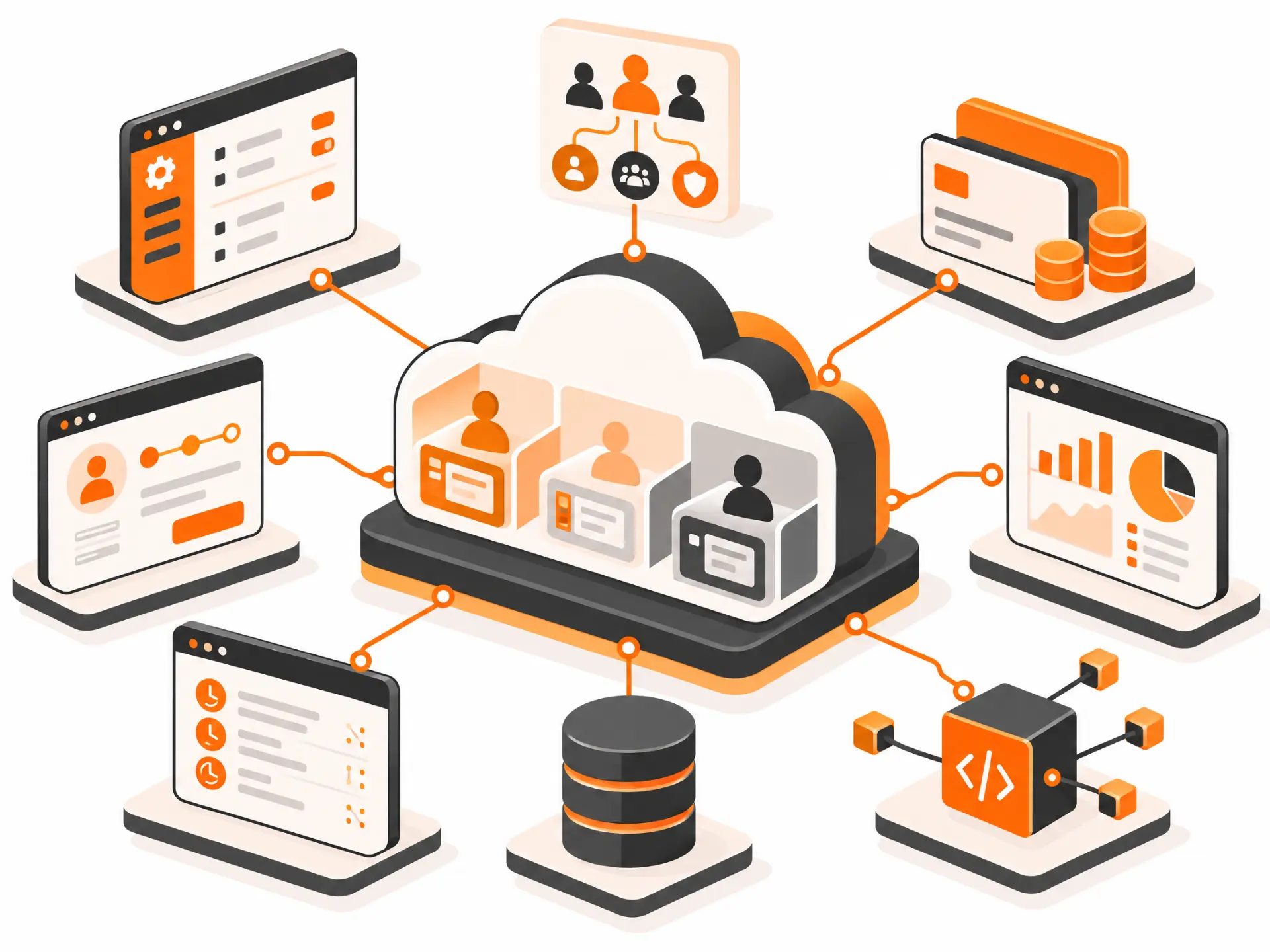
A SaaS product is not a website with a login. It is a multi-user system that has to keep working, keep billing, and keep customer data separated while people you have never met use it in ways you did not anticipate. A complete engagement usually covers product discovery and scoping, UX and interface design, architecture, frontend and backend development, APIs and integrations, QA and security testing, deployment with monitoring, and a plan for what happens after launch.
One thing worth saying plainly: design and engineering belong in the same conversation. When one agency hands finished screens to a separate development shop, the handoff is where scope leaks—a polished settings screen may assume a permissions model nobody built. Whether you use one partner or two, make sure the people designing the product and the people building it are talking weekly, not just at handoff.
Then there are the SaaS-specific pieces first-time founders tend to forget exist:
- An admin panel. In effect, a second application for managing users, subscriptions, and support issues.
- Roles and permissions. So a team administrator and a team member see different things.
- Subscription billing. Plans, trials, upgrades, failed payments, invoices, and taxes.
- Onboarding and transactional email. The things that decide whether a new user gets value in their first session.
- Audit logs and usage analytics. Which enterprise buyers ask about sooner than you might think.
The Decisions That Are Expensive to Change Later
Most SaaS regret is architectural. These choices are cheap to make on paper and costly to reverse once real customer data is in the system:
- Multi-tenancy. Do customers share one database with logical separation, or does each get isolated storage? Shared is cheaper to build and run. Isolation is a stronger security story and sometimes a contractual demand from larger customers. Retrofitting either direction is a project.
- The data model. Shape it around how customers actually work, not around the first screen you designed. Migrating a live schema is far more painful than getting it roughly right early.
- Billing logic. Per-seat, usage-based, and tiered pricing behave differently in the database. Changing your pricing model after launch means migrations and customer communication, not just a new price list.
- Roles and permissions. Bolted-on roles are a classic regret. Decide the model, even a simple one, before building features that depend on it.
- Integrations. Customers will expect your product to connect to their CRM, accounting software, or single sign-on. Designing a clean API surface early is far cheaper than patching one in, and it is exactly what our API & System Integration work covers.
None of this is exotic. It is just unglamorous, which is why it gets skipped when everyone is racing to a demo. It is also a big part of what separates a prototype from a production-ready product.
Design Choices That Quietly Decide Whether a SaaS Product Succeeds
Good SaaS design is not about polish. It is about removing the reasons people leave in their first week.
- Time to first value. How long is it between sign-up and the moment a user thinks, “This is useful”? Every extra step before that is churn.
- Empty states. A brand-new account has no data. What the product shows at that moment is the first real impression.
- Permission-aware screens. Do not show buttons a user cannot use. It reads as broken, and it generates support tickets.
- Billing and upgrade flows. A failed-payment screen is a customer-service moment. Design it deliberately.
- Accessibility. Many enterprise and public-sector buyers ask about accessibility conformance during procurement, and it is far cheaper to build in than to retrofit.
What a SaaS Build Costs in Canada
The honest answer first: it depends on scope far more than on geography. These directional ranges align with published Canadian agency benchmarks and the ranges used elsewhere on this site. They are estimates, not a quote.
| Scope | Typical Range (CAD) | Typical Timeline | What Is Usually Included |
|---|---|---|---|
| Focused MVP | $40,000–$85,000 | 3–5 months | Core value proposition, authentication, one billing model, basic admin panel, and one or two key integrations |
| Scaling product | $90,000–$200,000 | 6–9 months | Hardened multi-tenancy, several integrations, roles and permissions, analytics, and deeper QA |
| Complex or regulated platform | $200,000–$400,000+ | 9–12+ months | Compliance work, SSO, audit logging, AI features, and often a mobile companion app |
Published 2026 benchmarks from Canadian agencies put senior developer rates at roughly CAD $90–$140 an hour and blended agency rates around $100–$150, with Toronto and Vancouver at the high end. Treat that as context rather than a price list: who is doing the work, and how much of it is design versus engineering, matters as much as the headline rate.
What Pushes the Number Up
- Scope. “Users can sign up” can mean email and password, or Google, Apple, SSO, magic links, and two-factor authentication. The difference is real engineering time.
- Integrations. Stripe and email are well-trodden. Legacy banking, ERP, or healthcare systems are not.
- Compliance. Health and financial products commonly add 20–30% for security work, audit logging, and compliance testing, according to published Canadian agency benchmarks.
- AI features. The API call is the easy part. Token costs, prompt management, guardrails, and evaluation are where the effort goes, which is what our ChatGPT & LLM Integration team spends its time on.
Costs That Arrive After Launch
Budget roughly 15–20% of the build cost per year for maintenance—dependency updates, security patches, bug fixes, and small improvements—plus cloud hosting and usage-based third-party fees for payments, email, SMS, or AI. In year one, hosting is often modest; it is people-time that adds up. For the wider picture, see our Application Development Cost guide.
Canada, the US, or Offshore?
| Factor | Canada | United States | Offshore |
|---|---|---|---|
| Typical hourly cost | Mid to high, usually below big-city US rates | Highest | Lowest |
| Overlap with North American hours | Strong | Strong | Varies; often limited |
| Management overhead | Low | Low | Higher unless well structured |
| Contract and IP familiarity for North American investors | High | High | Varies |
| Government R&D incentives | SR&ED plus provincial credits | Varies by state | Not applicable |
The tidy comparison hides a reality: plenty of Canadian agencies, including us, work with distributed teams. App-Scoop is headquartered in Vancouver with a second office in Gurugram, India. What matters is not the map. It is whether the people doing the work are accountable to you, overlap with your day, and write things down. Ask any partner where the work actually happens and who you will be talking to.
The SR&ED Tax Credit: What Founders Should Know
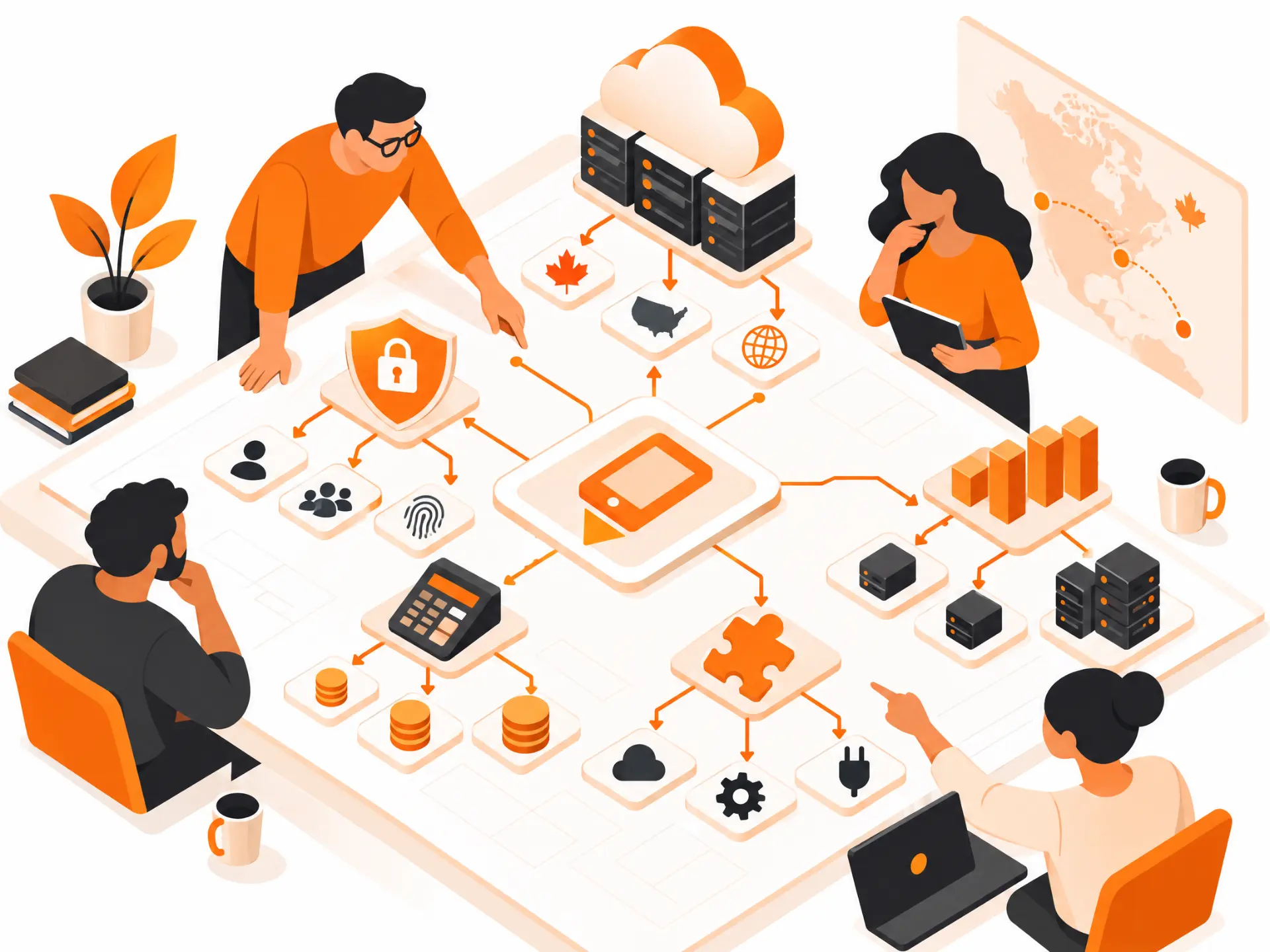
Canada's Scientific Research and Experimental Development program is a real advantage, and also one of the most frequently overstated ones. Canadian-controlled private corporations can earn an enhanced 35% refundable federal investment tax credit on qualifying SR&ED spending up to an annual limit. That limit was $3 million, rose to $4.5 million, and then to $6 million under Budget 2025 measures enacted in Bill C-15, which received Royal Assent on March 26, 2026. The change applies to tax years beginning on or after December 16, 2024, and the maximum refundable credit therefore doubled to $2.1 million. Older articles—and even some official pages—may still show the earlier figures, so check before relying on any one number.
Here is where it gets oversold:
- It is for genuine R&D. The work has to be aimed at resolving technological uncertainty. Building a standard SaaS app with well-known patterns usually does not qualify. Specific parts, such as a hard performance problem or an unproven integration approach, sometimes can.
- Documentation decides everything. You need records created as the work happens: the uncertainty, what you tried, and what you learned. Reconstructing it at tax time is how claims get weak.
- Eligibility depends on your situation. Corporate status, taxable capital or revenue thresholds, and how contractor work is structured all matter. Provinces add their own credits, and they vary.
This is general information, not tax advice. If SR&ED could matter to your funding plan, speak to an accountant who files these claims regularly, and do it before you sign the build contract rather than after.
Privacy, Data Residency, and Compliance
Privacy rules shape your architecture, so they belong in the design phase.
- Federal and provincial privacy law. PIPEDA covers much private-sector commercial activity, while Quebec's Law 25, Alberta's PIPA, and British Columbia's PIPA can apply depending on where your users are.
- Health data. Ontario's PHIPA has specific requirements for personal health information. We go deeper on that in our Healthcare App Development Toronto: PHIPA & Cost Guide.
- US customers. HIPAA, state privacy laws, and a SOC 2 report are common asks from B2B buyers, often before they will sign.
- Data residency. It is not usually a blanket legal rule for private-sector products, but health, finance, and public-sector customers frequently require Canadian hosting by contract. Choose your cloud region at design time; moving later is a project, not a setting.
In practice, treat privacy features as product features: encryption, access logging, and workflows for exporting and deleting a customer's data should exist from the first release. This is general information rather than legal advice; confirm requirements for your product with counsel.
How to Choose a SaaS Development Partner in Canada
- Do they design and build, or just one half? Integrated design and engineering avoids the handoff leaks described above.
- Who actually does the work, and where? Ask for names and time zones, not just an office address.
- What is fixed and what floats? A fixed scope backed by a written blueprint protects you from open-ended hourly drift. If a partner prefers hourly, ask how they cap it.
- Who owns the code, repositories, and cloud accounts from day one? The answer should be you, in writing, with accounts created in your name rather than transferred at the end.
- What happens after launch? Maintenance, monitoring, and support should be spelled out, not discovered later.
- Can they show products running with real users? Ask to speak to someone whose product is live, not just to see screenshots.
Our own approach starts with a fixed-scope Blueprint before any code is written, then a precision build and a stabilization phase backed by a Zero-Defect Guarantee. If you want to see the engineering behind that approach, explore our Full Stack Development and Web Application Development work.
Frequently Asked Questions
How much does it cost to build a SaaS product in Canada?
Directionally, CAD $40,000–$85,000 for a focused MVP, $90,000–$200,000 for a scaling product, and $200,000+ for complex or regulated platforms. Scope, integrations, and compliance move the number far more than hourly rates do. A fixed-scope blueprint is the fastest way to turn a range into a real quote.
How long does it take to build a SaaS MVP in Canada?
Typically three to five months for a focused MVP when scope is disciplined, six to nine months for a scaling product, and nine to twelve months or more for complex or regulated builds. “How long?” only gets a real answer once the scope is written down.
What is the cheapest way to build a SaaS product?
No-code and low-code tools are the cheapest way to test whether anyone wants the product, and for a prototype that is often the right call. They tend to hit limits around custom logic, scale, and data portability, so plan to rebuild if the idea works. A tightly scoped custom MVP is usually the cheapest route to something you can actually grow.
How much does it cost to maintain a SaaS app after launch?
A common rule of thumb is 15–20% of the original build cost per year, plus hosting and usage-based fees from third-party services. It runs higher with many external integrations or in regulated industries.
Can SR&ED tax credits reduce my SaaS development cost?
Possibly, for eligible work. Canadian-controlled private corporations can earn an enhanced 35% refundable federal credit on qualifying R&D up to a $6 million annual limit, but routine development often does not qualify and you need contemporaneous records. Talk to an SR&ED accountant before signing a build contract. This is general information, not tax advice.
Are Canadian developers better than US or offshore developers?
Skill is not the differentiator; strong engineers exist everywhere. What differs is cost structure, time-zone overlap, communication overhead, and legal familiarity. Canada tends to sit in the middle on price while offering strong overlap with North American business hours.
Do I need to host my SaaS data in Canada?
Not as a blanket legal rule for most private-sector products, but plenty of customers in health, finance, and the public sector require Canadian data residency by contract. Choose your cloud region deliberately at design time.
Can my SaaS product integrate with the systems my customers already use?
Yes, and that is often where a SaaS product earns its keep. Payments, CRM, accounting, email, and single sign-on are common. Standard integrations are straightforward; legacy or industry-specific systems take real design effort, so scope them early.
Who owns the code when an agency builds my SaaS product?
It should be you. Make sure the contract says so explicitly, and that repositories and cloud accounts are set up in your name from day one.
Where App-Scoop Fits In
If you are planning a SaaS product and want an honest read on scope, cost, and what to decide first, get in touch. We will help you turn the idea into a production-ready plan before expensive assumptions make their way into the build.
Have a project in mind?
Let's talk about how we can build it. Free consultation, no obligation.
Get a Free Consultation