
Mobile App Development Trends in 2026: What's Actually Worth Your Budget
Every year brings a fresh list of "top mobile app trends," and most of them read the same way: a dozen bullet points, each one framed like skipping it means your business is doomed. Most of those lists are written by people who don't actually build apps for a living.
We do. So instead of another 12-item checklist where everything sounds equally urgent, here's an honest breakdown: what's genuinely worth funding in 2026, what's worth a small pilot, and what's mostly noise for the average business. Not every trend fits every app — that's the actual point.
TL;DR
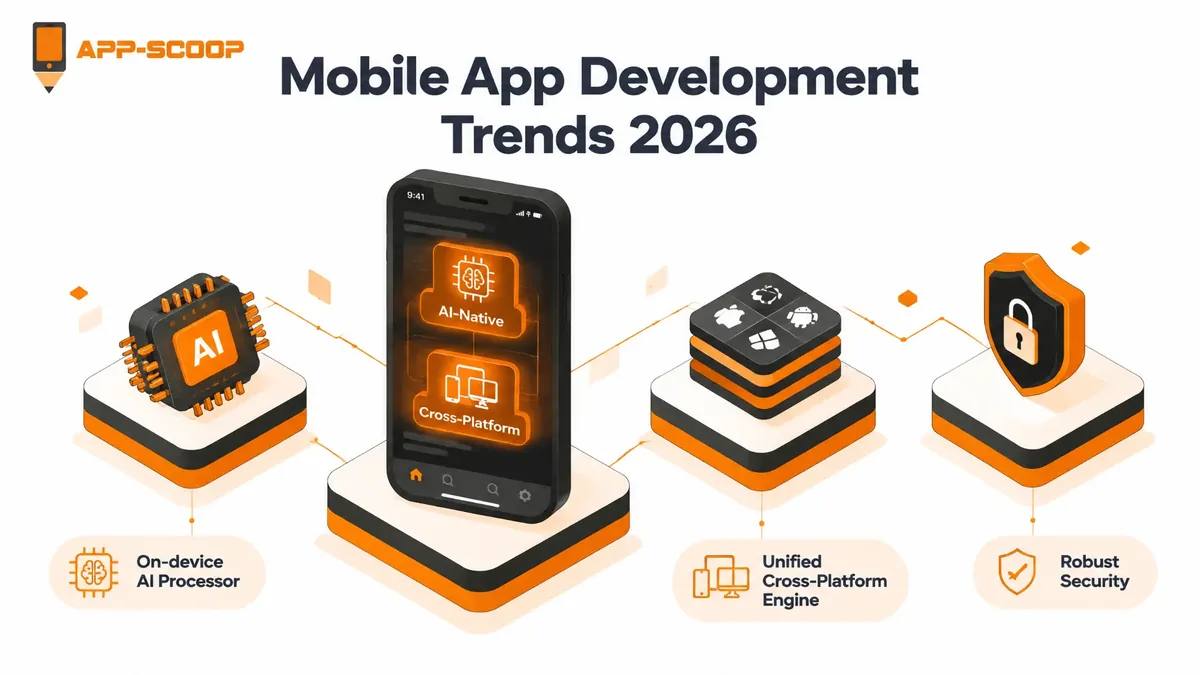
- Worth real budget for most teams: AI-native features (especially on-device), cross-platform development as the default, and privacy/security engineering. These aren't optional anymore.
- Worth a small pilot before committing real money: hyper-personalization, agentic AI in your own development pipeline, and super-app style feature bundling — useful in the right context, not universal.
- Mostly hype for the average business right now: extended reality, foldable-specific UI, and green/sustainable coding as a headline feature. Fine to have on the radar, not worth a 2026 roadmap slot for most apps.
- The global mobile app market is projected to pass $1 trillion within the next several years — growth isn't the question. The question is which specific trends actually move the needle for your specific app.
Fund These Now
These three aren't really "trends" anymore so much as table stakes — skipping them isn't a bold contrarian choice, it's just falling behind.
1. AI-Native Features, Especially On-Device Fund now
AI has moved from a backend nice-to-have to core app architecture, and the meaningful shift in 2026 is where that processing happens. On-device AI means features work faster, more privately, and without an internet connection — auto-suggestions, real-time photo processing, offline voice features, layouts that adapt to how someone actually uses the app.

The tradeoff is real engineering work: on-device models need to be small enough to run locally without draining battery, which is a genuinely different design problem than calling a cloud API. Where it fits, it's worth the investment. Our AI Workflow Automation and ChatGPT & LLM Integration teams build exactly this kind of feature.
2. Cross-Platform as the Default Fund now
Building separate native iOS and Android apps is increasingly the exception, not the rule. Flutter, React Native, and newer entrants like Kotlin Multiplatform let one shared codebase handle the business logic — API calls, data models, state management — while each platform gets a thin, native-feeling shell on top. That's a smart default for most consumer and business apps in 2026, not a compromise.
The exception is genuinely deep, platform-specific work — heavy AR, certain background processing, tight hardware integration — where fully native still wins. That's a real exception, not an excuse to default to native out of habit.
3. Privacy-First Security Engineering Fund now
This isn't optional anymore, and treating it as a checkbox at the end of a build is how apps end up in the news for the wrong reasons. Biometric authentication, end-to-end encryption, secure APIs, and zero-trust architecture need to be part of the plan from day one, not bolted on before launch. Users increasingly notice and care when an app is upfront about how it handles their data — and increasingly distrustful when it isn't.

Pilot These First
Genuinely useful in the right context. Worth testing before committing a full roadmap slot to them.
4. Hyper-Personalization via AI Analytics Pilot
Dynamic content feeds, behavior-based UI changes, predictive suggestions — done well, this measurably improves engagement. Done badly, it feels invasive rather than helpful, and the line between the two is thinner than most teams expect. Start with one clearly bounded use case (better notification timing, smarter default content) rather than trying to personalize everything at once.
5. Agentic AI in Your Own Development Pipeline Pilot
Separate from AI features inside your app: AI tools that help write, test, and review the code itself. This is genuinely accelerating how apps get built in 2026, not just marketing. It's also exactly the topic we wrote about in Vibe Coding vs. Professional App Development — the short version: useful as a productivity layer inside a reviewed, tested workflow; risky as a full replacement for one.
6. Super Apps & Mini-App Ecosystems Pilot
Bundling multiple services into one app (think: one app handling messaging, payments, and bookings) drives real engagement where it's worked. It also requires an existing user base large enough to support that bundling, plus product-management discipline most teams underestimate. Worth watching, worth piloting if you already have the audience; not a starting point for a first app.
Skip or Wait on These
Real technologies, genuinely interesting — just not where most businesses should be spending 2026 budget.
7. Extended Reality (AR/VR/Spatial Computing) Mostly skip
Virtual try-ons, AR navigation, and immersive product visualization are real and occasionally impressive. They're also expensive to build well and only pay off for specific use cases — retail try-before-you-buy, real estate tours, certain education and training scenarios. Outside those, it's an expensive feature most users won't notice is missing.
8. Foldable & Wearable-Specific UI Niche
Worth real investment only if your actual user base skews toward foldable phones or wearables in a meaningful way. For most consumer and business apps, standard responsive design covers this adequately without a dedicated foldable-specific redesign.
9. Green/Sustainable Coding as a Headline Feature Low priority
Efficient code, reduced server usage, and battery-friendly design are good engineering practice — they should happen regardless of whether "sustainability" is a marketing angle. Building an app specifically to market its "greenness" rather than because efficient code is just better engineering is usually solving the wrong problem.
The 2026 Verdict at a Glance
| Trend | Verdict | Why |
|---|---|---|
| AI-native features, especially on-device | Fund now | Table stakes; faster, more private, works offline |
| Cross-platform as the default | Fund now | One codebase, near-native performance, lower maintenance |
| Privacy-first security engineering | Fund now | Has to be designed in from day one, not bolted on |
| Hyper-personalization via AI analytics | Pilot | Real engagement lift, but easy to make it feel invasive |
| Agentic AI in your dev pipeline | Pilot | Strong productivity layer inside a reviewed workflow |
| Super apps & mini-app ecosystems | Pilot | Needs an existing audience and product discipline |
| Extended reality (AR/VR) | Mostly skip | Expensive; pays off only in specific use cases |
| Foldable & wearable-specific UI | Niche | Standard responsive design usually covers it |
| Green coding as a headline feature | Low priority | Good engineering anyway; weak as a marketing angle |
How to Decide Which Trends Are Actually Worth It for You
- Does it solve a problem your actual users have? Not a hypothetical future user — the ones you have or are specifically trying to reach.
- Can you measure whether it worked? If you can't define what success looks like before you build it, that's a sign you're chasing the trend itself rather than a business outcome.
- Does your existing architecture support it, or does adopting it mean a bigger rebuild than the trend itself is worth? Sometimes the honest answer is that the trend is fine, but your app isn't ready for it yet.
- What's the real cost — build, maintain, and the talent to support it long-term? A trend that requires a specialist you can't easily hire or retain is a liability a year from now, not just an upfront cost.
Frequently Asked Questions
What's the single most important mobile app trend in 2026?
AI-native features, particularly on-device processing. It's the trend most consistently named across current industry research, and unlike some others on this list, it's genuinely reached table-stakes status rather than staying optional.
Is cross-platform development actually as good as native now?
For the large majority of apps, yes — modern frameworks like Flutter compile to native code rather than running through a performance-costly bridge layer. The exception is apps needing deep, platform-specific functionality, where native still has a real edge.
Should every app have AI features in 2026?
No. AI features add real cost and are worth including only when they solve a specific, validated user need. Plenty of apps launch successfully without AI and add intelligent features later once real usage data shows where they'd genuinely help.
Is AR/VR worth building into a mobile app right now?
For most businesses, not yet. It's genuinely valuable for specific use cases — retail try-ons, real estate tours, certain training scenarios — but expensive to build well and easy to overinvest in for a use case that doesn't need it.
How do I know if a trend fits my specific app?
Ask whether it solves a problem your actual users have, whether you can measure if it worked, and whether your current architecture can support it without a disproportionate rebuild. If you can't answer those clearly, that's usually a sign to wait.
Are low-code and no-code tools a real threat to traditional app development?
They're a real and growing part of how early-stage ideas get validated and prototyped, not a wholesale replacement for professional development on anything that needs to scale, handle sensitive data, or last years. We wrote about this tradeoff in more depth in our vibe coding comparison.
What should I actually budget for in 2026 if I'm building a new app?
Prioritize AI-native features where they solve a real problem, a cross-platform framework as your default architecture, and security/privacy engineering from day one. Treat everything else on this list as a pilot-or-skip decision based on your specific audience and use case.
Where App-Scoop Fits In
We build mobile apps for iOS and Android, including cross-platform builds with Flutter, and we'd rather tell you honestly which of these trends is actually worth your budget than sell you on all of them. If you're planning a 2026 build and want a straight read on what fits your specific app, get in touch.
Have a project in mind?
Let's talk about how we can build it. Free consultation, no obligation.
Get a Free Consultation