
How to Hire SaaS Developers for Your Startup: In-House, Freelance, Agency or Dedicated Team?
"We need developers" is usually the first sentence of a much bigger decision. A pre-seed founder with a validated idea, a seed-stage company with paying customers and a Series A team scaling an existing platform all need SaaS developers, but they need very different setups. Hire the wrong way at the wrong stage and you either burn runway on a team you didn't need yet, or end up with a product that can't grow.
This guide compares the five main ways to hire SaaS developers, shows which fits each startup stage, explains the real cost of each in Canada, and lists the skills and interview questions that separate genuine SaaS developers from general web developers.
Key takeaways
- There are five main models: in-house hires, freelancers, a full-cycle agency, a dedicated team and staff augmentation. Each fits a different stage.
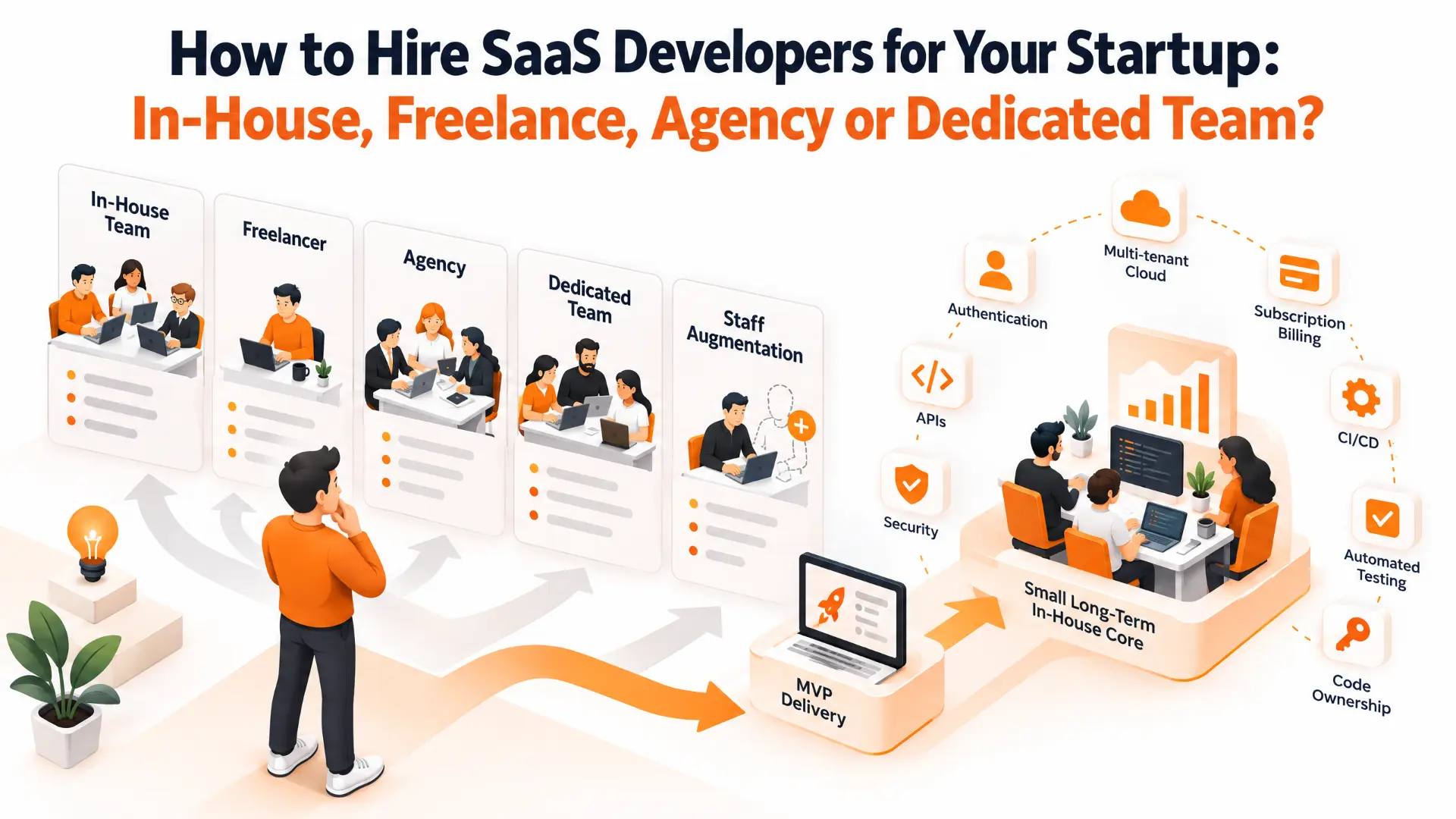
- Most startups do best with a hybrid: an agency or dedicated team for the MVP, then a small in-house core once there are paying customers and a long-term roadmap.
- Hiring in-house too early is one of the costliest startup mistakes: recruiting takes months, and salaries, benefits and ramp time add up before the product earns anything.
- SaaS developers need specific skills: multi-tenant data design, authentication and SSO, subscription billing, cloud infrastructure, security and automated testing.
- Whatever the model, own your code, repositories and cloud accounts from day one, and plan knowledge transfer before you need it.
What Makes a SaaS Developer Different
A developer who has built websites or one-off apps isn't automatically ready to build SaaS. Look for experience with:
- Multi-tenant data design: keeping many customers' data separate and secure on one platform.
- Authentication and authorization: secure login, roles and permissions, and SSO for enterprise customers.
- Subscription billing: plans, trials, upgrades, failed payments and usage metering with providers such as Stripe.
- APIs and integrations: designing APIs and connecting to CRMs, accounting tools and other systems.
- Cloud and DevOps: infrastructure, CI/CD pipelines, monitoring, backups and zero-downtime releases.
- Security and testing: secure coding practices, dependency management and automated tests on critical flows.
The 5 Ways to Hire SaaS Developers
| Model | Best for | Strengths | Watch out for |
|---|---|---|---|
| In-house team | Post-traction companies with a long-term roadmap | Deep product knowledge, full control, long-term continuity | Slow to hire, high fixed cost, you manage everything |
| Freelancers | Small, well-defined tasks; prototypes | Flexible, fast to start, lower cost for small scopes | Availability, quality varies, you coordinate and QA the work |
| Full-cycle agency | MVPs and major builds with a defined scope | Complete team (product, design, engineering, QA, DevOps), predictable delivery | Less day-to-day control; quality depends heavily on the partner |
| Dedicated team | Ongoing development after the MVP | A stable external team working only on your product | Needs clear priorities and product ownership on your side |
| Staff augmentation | Adding skills to an existing in-house team | Fills specific gaps quickly | Needs strong internal technical leadership to direct the work |

Which Model Fits Your Startup Stage?
| Stage | Recommended approach | Why |
|---|---|---|
| Idea and validation | No-code tools, a prototype or one freelancer | You're buying learning, not a product |
| MVP (pre-seed to seed) | Full-cycle agency, ideally with a fixed scope | A complete team ships faster and more predictably than hiring from scratch |
| Early traction | Agency or dedicated team, plus your first in-house hire (often a technical lead) | Keep momentum while building internal ownership |
| Scaling (post product-market fit) | In-house core team, with agency or augmentation for peaks and specialist work | The product now justifies permanent institutional knowledge |
If you're at the MVP stage, our guide to SaaS MVP development covers scoping and costs in detail, and how to choose a B2B SaaS development agency explains how to compare partners.
The Real Cost of Each Option in Canada
In-house developers
Salary is only the start. In Canada, employers also pay CPP and EI contributions, usually offer health and dental benefits, and often pay recruiting fees. Then there's equipment, software, management time and the months before a new hire is fully productive. Hiring an experienced SaaS developer can itself take several months. For a startup still searching for product-market fit, that's a large fixed cost committed before the product earns anything.
Freelancers
Freelance rates vary enormously by experience and location. The hidden cost is coordination: someone on your side has to define the work, manage several freelancers, review quality and handle testing and deployment.
Agency or dedicated team
Agencies and dedicated teams cost more per hour than individual freelancers, but the price usually includes project management, design, QA and DevOps. For an MVP, a fixed-scope project is often the most predictable option. As a guide, focused SaaS MVPs built by Canadian agencies commonly cost around CAD $40,000–$85,000.
For a fuller picture, see SaaS product design and development in Canada and fixed-scope vs. time and materials.
Where to Find SaaS Developers
- Referrals from founders, investors and accelerators: usually the highest-quality source.
- LinkedIn, using searches for SaaS-specific skills (multi-tenant, Stripe, SSO, AWS) rather than generic titles.
- Startup job boards and tech communities in Vancouver, Toronto, Waterloo, Montreal and Calgary.
- Freelance platforms, for well-defined pieces of work.
- Agencies and dedicated-team providers with live SaaS products in their portfolio.
10 Interview Questions for SaaS Developers
- How would you make sure one customer can never see another customer's data? Look for data-layer enforcement and tests, not just interface checks.
- How would you implement plan upgrades and downgrades mid-billing cycle? Look for an understanding of proration and billing-provider webhooks.
- How do you add single sign-on for an enterprise customer? Look for familiarity with standards such as SAML or OpenID Connect.
- How do you release changes without downtime? Look for CI/CD, staging environments and rollback plans.
- What do you test automatically, and why? Look for priorities: login, billing and core workflows first.
- How would you know if production broke at 2 a.m.? Look for monitoring, alerting and logging.
- How do you handle secrets and API keys? Look for a secrets manager and never committing keys to code.
- How do you design a database migration on a live product? Look for reversible migrations and backups.
- How do you use AI coding tools? Look for AI speeding up routine work, with human review of everything.
- Tell me about a SaaS product you worked on that's live today. Look for specifics: their role, the scale, what they'd do differently.
Red Flags When Hiring
- No experience with multi-tenant products, only websites or single-customer apps.
- No automated tests or code review in their past work.
- Reluctance to put code ownership and IP assignment in writing.
- Cloud accounts or repositories set up under the developer's own name.
- Estimates given before understanding the product.
The Hybrid Approach Most Startups Use
The pattern that works for many startups: an agency or dedicated team builds the MVP; your first in-house hire, often a technical lead, joins once there are paying customers; the external team then hands over gradually or continues alongside for peaks and specialist work. Plan the handover from the start: documentation, clean repositories, architecture notes and a few weeks of overlap.

Canadian Considerations
- Employee or contractor? The CRA looks at the actual working relationship, not just the contract, when deciding whether someone is an employee or self-employed. Get advice before treating a long-term, full-time developer as a contractor.
- IP assignment. Make sure every employee, freelancer and agency assigns the intellectual property they create to your company.
- Provincial employment rules. Hiring remotely across provinces means following each province's employment standards.
- SR&ED. Qualifying salaries and some contractor payments may count toward SR&ED tax credits, so keep records of technical work as it happens.
This is general information, not legal or tax advice.
How App-Scoop Can Help
We build SaaS products end to end, from a fixed-fee Blueprint through a fixed-scope build and launch, and we can work alongside your in-house developers as your team grows. You own the code and accounts from day one, and we document everything so a future internal team can take over smoothly. See our approach to production-ready SaaS development, or book a strategy call.
Year-End Offer: Start 2027 With Your Product Team in Place
Hiring takes months; a build partner can start in weeks. Through Cyber Monday, November 30, 2026, we're offering special year-end pricing on SaaS Blueprints and MVP builds booked this month, plus priority start dates in January.
Book a free 30-minute strategy call to see what applies to your project. Book a strategy call →
Frequently Asked Questions
How do I hire SaaS developers for a startup?
Decide on the model first (in-house, freelancers, agency, dedicated team or augmentation) based on your stage, then look for SaaS-specific skills: multi-tenant design, authentication, billing, cloud and testing. Check live work and references before hiring.
Should a startup hire in-house developers or outsource?
Before product-market fit, most startups outsource the MVP to an agency or dedicated team. Once there are paying customers and a long-term roadmap, building an in-house core makes sense.
How much does it cost to hire SaaS developers in Canada?
In-house developers cost a salary plus CPP, EI, benefits, recruiting and ramp time. Freelance rates vary widely. A focused SaaS MVP built by a Canadian agency commonly costs around CAD $40,000–$85,000.
What's the difference between a dedicated team and staff augmentation?
A dedicated team works on your product as a unit and usually brings its own process. Staff augmentation adds individual developers to your existing team, who work under your technical leadership.
Are freelancers a good choice for building a SaaS product?
For small, well-defined tasks or prototypes, yes. For a full SaaS product, coordinating several freelancers, testing and DevOps usually becomes the founder's job, which is hard to sustain.
What skills should a SaaS developer have?
Multi-tenant data design, authentication and SSO, subscription billing, API design, cloud infrastructure and CI/CD, security and automated testing.
How long does it take to hire a SaaS developer?
Hiring an experienced in-house developer often takes several months. An agency or dedicated team can usually start within a few weeks.
When should a startup hire its first in-house developer?
Usually once there are paying customers and a clear roadmap, often starting with a technical lead who can own the architecture and work with external partners.
How do I protect my IP when hiring developers?
Use written agreements that assign all IP to your company, keep repositories and cloud accounts in your name, and use NDAs before sharing sensitive details.
Can we switch from an agency to an in-house team later?
Yes. Plan for it from the start with documentation, clean code, architecture notes and an overlap period for knowledge transfer.
Have a project in mind?
Let's talk about how we can build it. Free consultation, no obligation.
Get a Free Consultation