
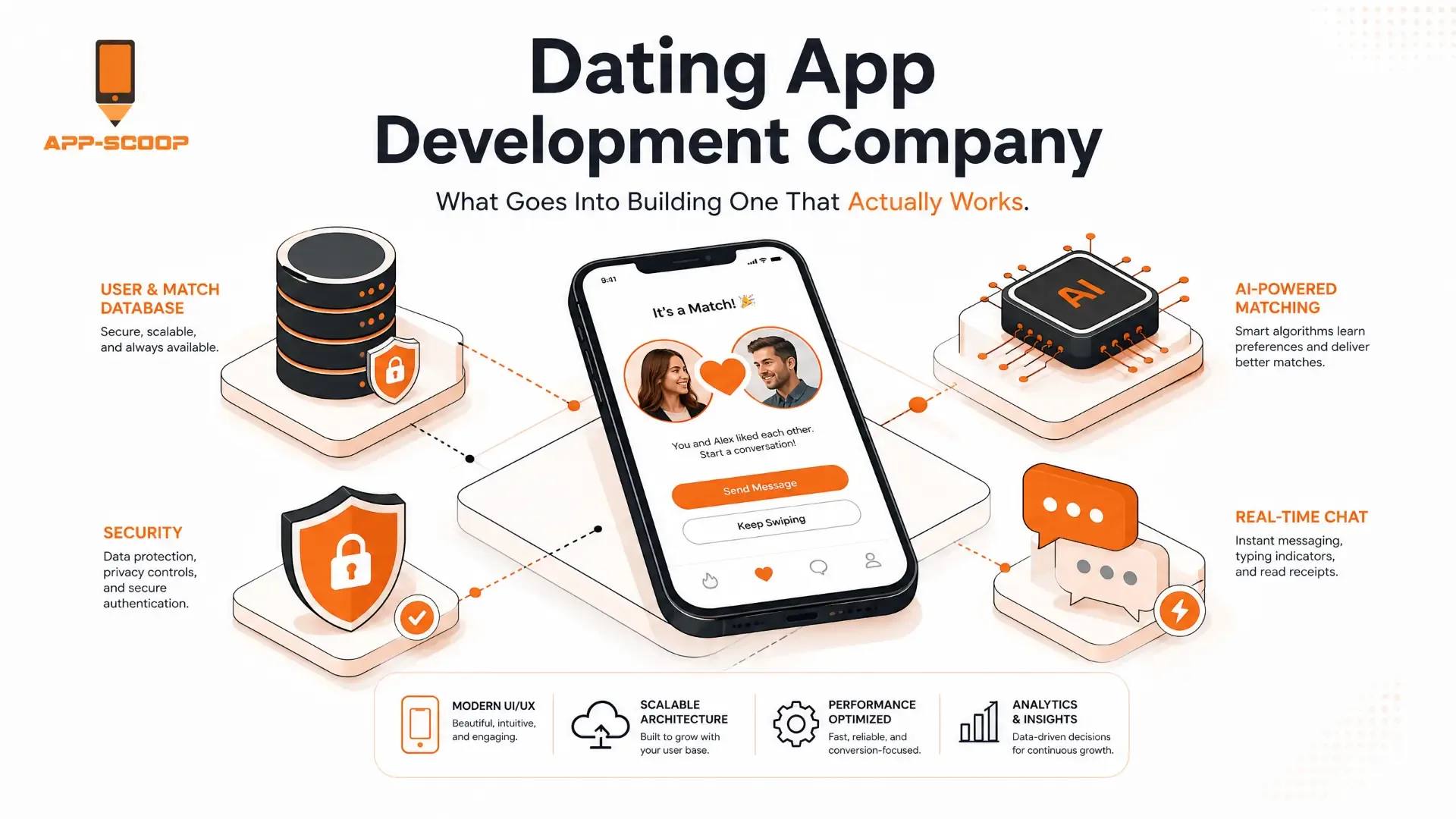
Dating App Development Company: What Goes Into Building One That Actually Works
Every major dating app on someone's phone started as the same basic pitch: help two people who'd never otherwise meet, actually meet. The apps that succeeded weren't the ones with the most features — they were the ones that got matching, safety, and that first conversation right, and built everything else around those three things.
If you're looking into building a dating app, the technical side is genuinely more involved than most app categories. Real-time messaging, location data, identity verification, and payment handling all show up in a dating app on day one, not as later additions. Here's what actually goes into building one, what it costs, and what tends to separate the apps that get real traction from the ones that quietly fade.
TL;DR
- Dating apps are one of the more technically demanding app categories — real-time chat, geolocation, identity verification, and payments are all core requirements, not optional extras.
- The apps that retain users get matching, safety, and the first-message experience right before chasing extra features.
- Niche and identity-specific dating apps (faith-based, LGBTQ+, 40+, hobby-specific) consistently outperform generic "swipe" clones on user retention.
- A realistic MVP build runs roughly 3–6 months and a mid five-figure to low six-figure budget, depending on platform scope and how much of the matching and safety logic is custom versus off-the-shelf.
The Different Kinds of Dating Apps Being Built Right Now
"Dating app" covers a much wider range of products than it did a decade ago. Where you land here shapes almost every decision that follows — features, moderation approach, even the tone of the UI.
Mainstream / swipe-based apps
The Tinder-style model: broad audience, swipe-based discovery, casual-to-serious intent left up to the user. Fastest to describe, but also the most saturated category — standing out here usually means a genuinely different matching mechanic, not just a different color scheme.
Niche and identity-specific platforms
Faith-based, LGBTQ+-focused, culturally specific, or built around a shared interest (hiking, gaming, sober dating). These consistently show stronger retention than generic apps because the audience has already self-selected — the app doesn't have to work as hard to create a sense of shared context.
Age-focused platforms
Apps built specifically for older adults tend to prioritize simplicity and larger UI elements over feature density — fewer gestures to learn, clearer text, less reliance on visual-first swiping.
Location-based and hyperlocal apps
Built around real-time proximity rather than broad geographic filtering — useful for event-based or travel-oriented dating, but this category leans harder on getting geolocation accuracy and battery efficiency right.
AI-enhanced and next-gen matching apps
A newer wave uses AI beyond basic preference filtering — conversation-style compatibility assessment, personality-based matching, even AI-assisted icebreakers. This is genuinely useful when it improves match quality, and genuinely gimmicky when it's just a chatbot bolted onto a standard swipe interface. The difference shows up fast in reviews.
Core Features: What a Dating App Actually Needs
Feature lists for dating apps tend to run long. These are the ones that determine whether the app works at all, organized by what they're actually solving.
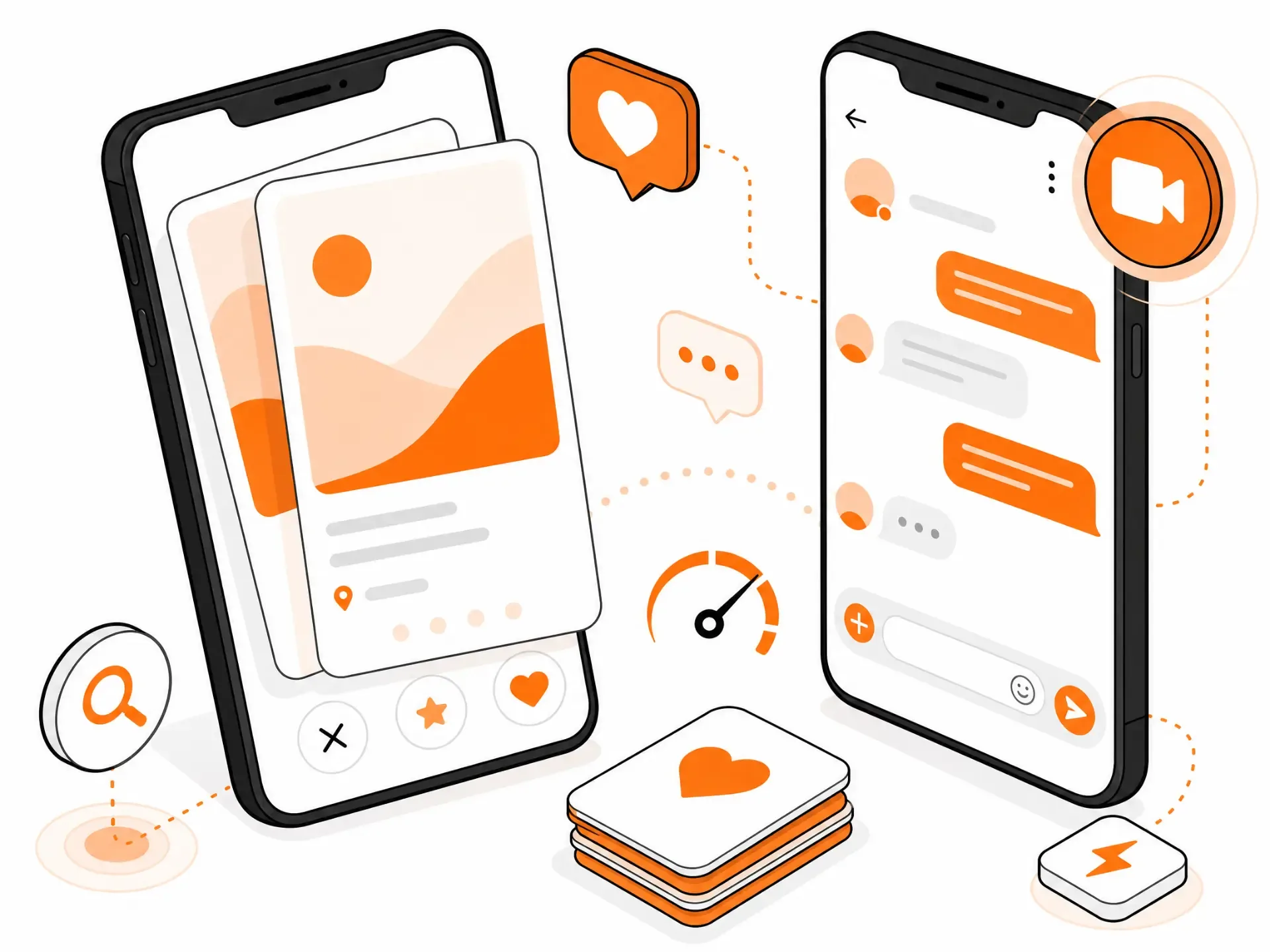
Matching and discovery
- Preference-based and AI-assisted matching algorithms
- Swipe, browse, or hybrid discovery modes
- Geolocation-based proximity search with adjustable radius
- Advanced filters (interests, lifestyle, relationship intent)
Communication
- Real-time text chat
- Voice and video calling (WebRTC-based, for low-latency in-app calls)
- Icebreaker prompts and shared-interest conversation starters
- Read receipts and typing indicators, with user controls to disable them
Trust and safety
- Photo and identity verification (selfie-match verification is now close to standard, not a premium add-on)
- Block and report tools with real moderation behind them, not just a button that does nothing
- AI-assisted content moderation for images and messages
- Panic and safety features for in-person meetups, where relevant to the audience
Monetization
- Freemium tiers with paid upgrades (extended filters, unlimited likes, profile boosts)
- Virtual gifts and in-app currency
- Subscription tiers rather than one-off purchases, for predictable recurring revenue
Profile and personalization
- Rich media profiles (photo and video galleries)
- Social login for faster onboarding
- Language auto-detection and translation for cross-region apps
- Granular privacy controls (visible to matches only, hidden mode, and similar)
The Technology Behind a Modern Dating App
None of the features above work well without the right infrastructure underneath. A few decisions matter more than the rest.
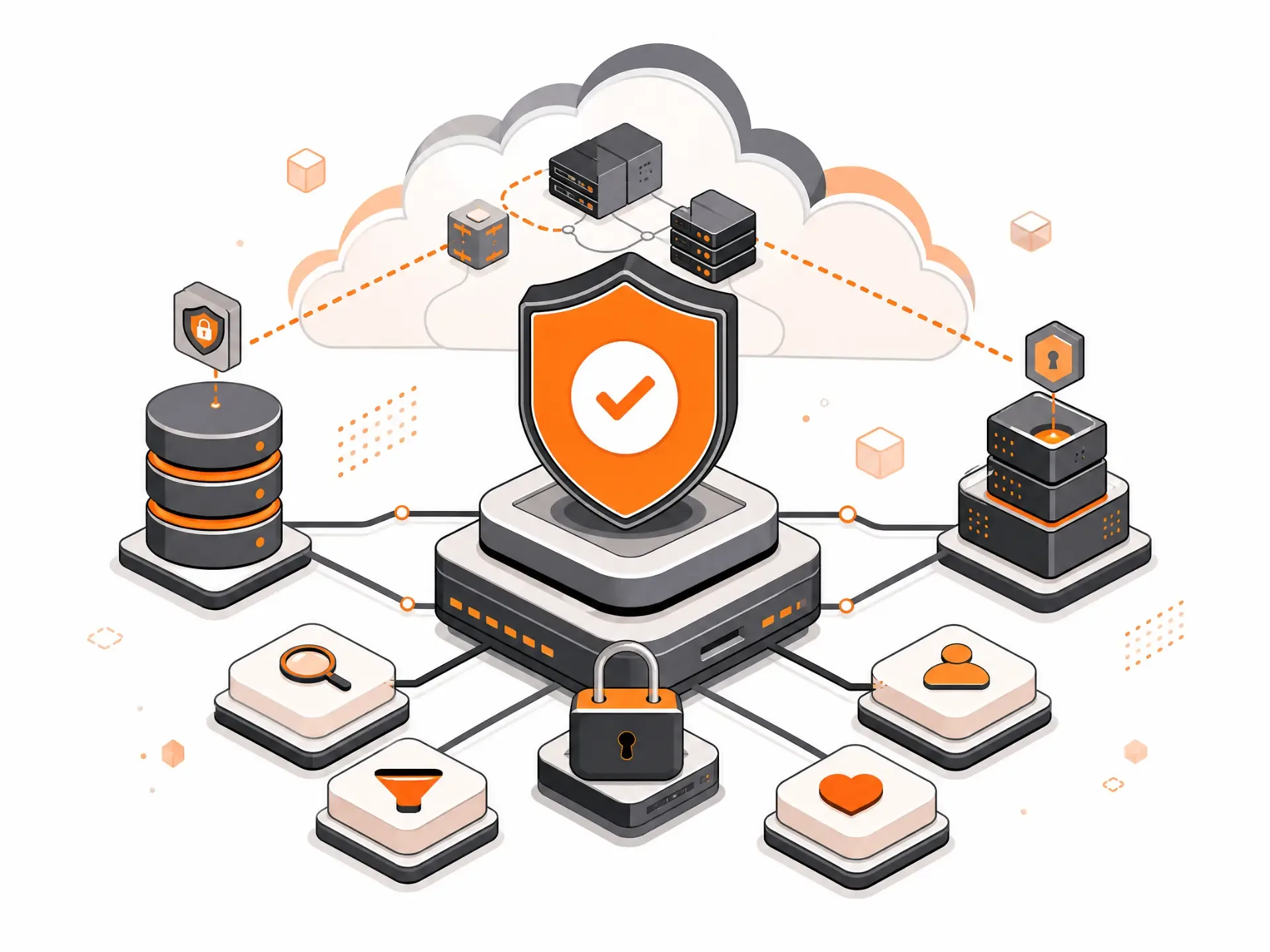
- Cloud architecture: Dating apps see unpredictable usage spikes (evenings, weekends, post-marketing-push), so cloud infrastructure built to autoscale — AWS, GCP, or Azure — matters more here than in a lot of app categories.
- Real-time infrastructure: Chat and calling need a real-time messaging layer (WebSockets or a managed service like Firebase or Pusher) and WebRTC for voice and video — bolting these on after launch is far more painful than building for them from day one.
- Matching algorithm design: Whether it's simple rule-based filtering or a genuine ML-driven compatibility model, this is usually worth building custom rather than relying entirely on a third-party matching SDK — it's the part of the app hardest for a competitor to copy.
- Data privacy and compliance: Dating apps handle some of the most sensitive personal data any app category touches — location history, sexual orientation, relationship status. GDPR (if serving EU users) and general data protection practices aren't optional extras here; they're close to table stakes for user trust.
How a Dating App Actually Gets Built
The process isn't fundamentally different from other app categories, but a few stages carry more weight given what's at stake with user trust and safety.
- Discovery and positioning: Defining exactly who the app is for and what makes it different from the fifteen other apps already doing something similar — this shapes every feature decision downstream.
- UX and safety-first design: Wireframing the core flows (matching, messaging, verification) with safety and moderation built into the design, not layered on afterward.
- Development: Building the mobile apps (iOS and Android, native or cross-platform depending on budget and timeline) alongside the backend, matching logic, and admin/moderation tools.
- QA and security testing: Beyond standard QA, this includes testing the verification flow, moderation triggers, and payment handling specifically — these are the areas where bugs cause the most damage to user trust.
- Launch and post-launch iteration: Dating apps live or die on early retention data — expect the first few months post-launch to involve real changes based on how people are actually using (and abandoning) the app.
What It Actually Costs to Build a Dating App
| Build Scope | Typical Range | What's Included |
|---|---|---|
| Basic MVP | $25,000 – $50,000 | Core swipe/match, chat, basic profiles, single platform |
| Full-featured app | $50,000 – $120,000 | Both platforms, video/voice calling, AI-assisted matching, monetization |
| Enterprise-scale platform | $120,000+ | Custom matching algorithms, advanced moderation, multi-region compliance, high-concurrency architecture |
These are directional, not a quote — actual cost depends heavily on how much of the matching and moderation logic is custom-built versus using existing services, and whether you're launching on one platform or two from day one. The honest advice: resist the urge to build every feature in the list above before launch. Most successful dating apps launched with a genuinely narrow feature set and earned the right to add more once real users proved the core concept worked.
Where App-Scoop Fits In
We build custom mobile apps for iOS and Android, and dating apps sit squarely in the kind of product we're built for: real-time features, careful UX, and the kind of trust-and-safety thinking that a consumer app handling sensitive personal data actually needs. If part of your dating app concept leans on smarter matching or AI-assisted conversation starters, our AI Workflow Automation and ChatGPT & LLM Integration teams build that properly rather than bolting on a generic chatbot.
You can see examples of the kind of product work we do in our portfolio. If you've got a dating app concept you're trying to scope, get in touch and we'll give you an honest read on what it would actually take to build.
Frequently Asked Questions
How long does it take to build a dating app?
A focused MVP typically takes 3 to 5 months. A full-featured app with video calling, AI-assisted matching, and both iOS and Android from launch usually runs 6 to 9 months. Timeline depends more on how much custom logic (matching, moderation) is involved than on the app's visual complexity.
Should I build for iOS, Android, or both at launch?
It depends on your target audience and budget. If budget is tight, launching on the platform where your target demographic is more concentrated and expanding afterward is often smarter than a thinner launch on both. Cross-platform frameworks can also let you cover both from day one at lower cost, with some trade-offs on performance for the most demanding features like video calling.
Is it better to build a niche dating app or compete in the general market?
Niche and identity-specific apps consistently show stronger user retention than general-market apps, mainly because the audience arrives with more shared context already. Competing head-on with established general-market apps is a much harder growth problem than most founders initially expect.
What's the biggest technical challenge in building a dating app?
Usually it's the real-time infrastructure — chat and video calling need to feel instant, which means getting the messaging architecture right from the start rather than retrofitting it. A close second is building moderation and safety tooling that actually works at scale, not just a report button that goes nowhere.
Do I need AI-based matching to compete?
Not necessarily, but basic preference-based filtering alone is now the baseline, not a differentiator. Some layer of smarter matching, even a fairly simple compatibility score, tends to meaningfully outperform pure swipe mechanics on user satisfaction.
How important is identity verification?
Very. Photo and selfie verification has moved from a premium feature to something users increasingly expect by default, partly driven by high-profile safety incidents across the industry. Apps that treat verification as optional are increasingly at a trust disadvantage against ones that don't.
What monetization model works best for a new dating app?
Freemium with a subscription tier for extended features tends to outperform one-off purchases for recurring revenue predictability. Virtual gifts and profile boosts work well as secondary revenue once the core subscription base is established, but rarely work as the primary model on their own.
Can an existing dating app be modernized instead of rebuilt from scratch?
Often, yes. If the core matching and user base are working but the technology underneath has aged (slow performance, outdated chat infrastructure, no video calling), a modernization project is usually faster and cheaper than a full rebuild — worth scoping specifically before assuming a from-scratch build is necessary.
Have a project in mind?
Let's talk about how we can build it. Free consultation, no obligation.
Get a Free Consultation