
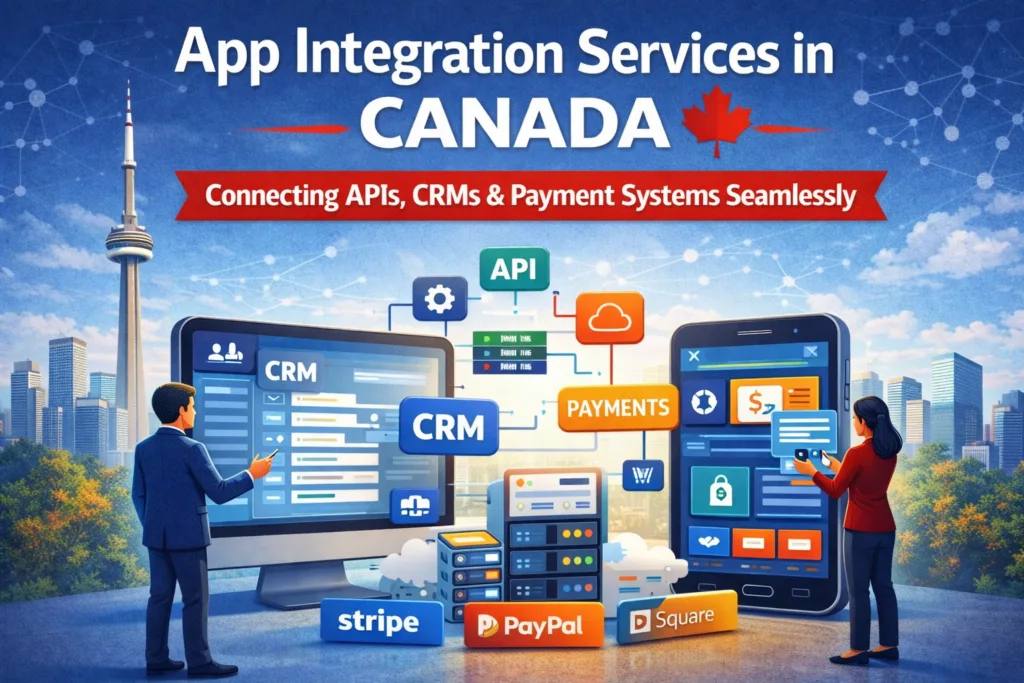
App Integration Services in Canada: Connecting APIs, CRMs & Payment Systems Seamlessly (2026 Guide)
Modern applications don’t work in isolation. Whether you run a startup, SME, or enterprise, your mobile or web app likely needs to connect with CRMs, payment gateways, cloud platforms, analytics tools, and third-party services.
That’s where app integration services in Canada play a critical role.
In this guide, we’ll explore integration types, costs, technologies, compliance considerations, and why seamless API connectivity is essential for scalable business growth in 2025.
What Are App Integration Services?
App integration services connect different software systems so they can share data and function as a unified ecosystem.
For example:
- Your e-commerce app connects to a payment gateway
- Your mobile app syncs with a CRM
- Your SaaS platform integrates with accounting software
- Your marketplace app connects to shipping APIs
Instead of manual data entry, everything communicates automatically through APIs (Application Programming Interfaces).
Why App Integration Is Critical for Canadian Businesses
1️⃣ Real-Time Data Synchronization
Customer orders, payment confirmations, CRM updates — all synced instantly.
2️⃣ Improved Operational Efficiency
Automation reduces manual work and human errors.
3️⃣ Better Customer Experience
Seamless payments, faster service delivery, personalized interactions.
4️⃣ Scalable Growth
Integrated systems make it easier to expand features and services.
Types of App Integration Services in Canada
🔹 API Integration
Connecting your app with external APIs for payments, logistics, analytics, or communication.
🔹 CRM Integration
Syncing customer data between apps and CRM platforms like:
- Salesforce
- HubSpot
- Zoho
This enables better lead tracking, marketing automation, and customer management.
🔹 Payment Gateway Integration
Secure payment processing via:
- Stripe
- PayPal
- Square
Essential for e-commerce, fintech, and subscription apps.
🔹 ERP & Accounting Integration
Connect business operations with platforms like:
- SAP
- QuickBooks
🔹 Cloud & Database Integration
Seamless connection with:
- Amazon Web Services
- Microsoft Azure
Cost of App Integration Services in Canada (2025)
Integration costs vary based on complexity and number of systems involved.
| Integration Type | Estimated Cost (CAD) |
|---|---|
| Basic API Integration | $5,000 – $15,000 |
| CRM or Payment Integration | $10,000 – $25,000 |
| Multi-System Enterprise Integration | $25,000 – $80,000+ |
Factors Affecting Cost:
- Number of APIs involved
- Data security requirements
- Custom vs pre-built connectors
- Real-time vs batch processing
- Compliance requirements
Key Technologies Used in App Integration
Backend Technologies
- Node.js
- Python (Django, FastAPI)
- Java (Spring Boot)
Integration Tools & Protocols
- REST APIs
- GraphQL
- Webhooks
- OAuth 2.0 Authentication
- JSON / XML Data Formats
Architecture Approach
- Microservices architecture
- Middleware integration layers
- Enterprise Service Bus (ESB)
Security & Compliance in Canada
When integrating applications, businesses must ensure compliance with Canadian data privacy regulations, especially when handling personal or financial data.
Key considerations:
- End-to-end encryption
- Secure token authentication
- Role-based access control
- Compliance with PIPEDA
- PCI-DSS compliance for payment integrations
Security-first integration design is critical for fintech, healthcare, and enterprise applications.
Benefits of Professional App Integration Services
✅ Automated Workflows
Reduces manual processes and increases productivity.
✅ Data Accuracy
Prevents duplication and inconsistencies.
✅ Improved Customer Insights
Integrated analytics provide deeper business intelligence.
✅ Faster Scaling
New services can be added without rebuilding core systems.
Challenges in App Integration
While powerful, integration can present challenges:
- API version changes
- Third-party dependency risks
- Data mapping complexities
- Legacy system compatibility
- Security vulnerabilities
Working with experienced integration specialists reduces these risks significantly.
Industries That Rely on App Integration in Canada
- E-commerce & Retail
- FinTech & Digital Banking
- Healthcare & Telemedicine
- Logistics & Transportation
- SaaS & Enterprise Platforms
Nearly every modern industry now depends on seamless third-party app integration.
App Integration vs Custom Development
| Factor | App Integration | Full Custom Build |
|---|---|---|
| Speed | Faster | Slower |
| Cost | Lower | Higher |
| Flexibility | Moderate | Full Control |
| Ideal For | System Connectivity | New Platform Creation |
Often, integration complements custom development rather than replacing it.
Future of App Integration in Canada (2025 & Beyond)
With increasing API-driven ecosystems and cloud-native infrastructure, integration services will continue to grow. Businesses are shifting toward modular architectures where multiple tools connect seamlessly instead of relying on monolithic systems.
AI-powered automation and API marketplaces will further simplify integrations in the coming years.
Final Thoughts
App integration services in Canada are essential for businesses that want to scale efficiently, automate operations, and deliver seamless customer experiences.
Whether you’re integrating CRMs, payment gateways, cloud systems, or enterprise platforms, a well-structured integration strategy ensures long-term scalability, security, and operational efficiency.
In 2025, connectivity is no longer optional — it’s the backbone of digital growth.
Categories: Uncategorized
Have a project in mind?
Let's talk about how we can build it. Free consultation, no obligation.
Get a Free Consultation